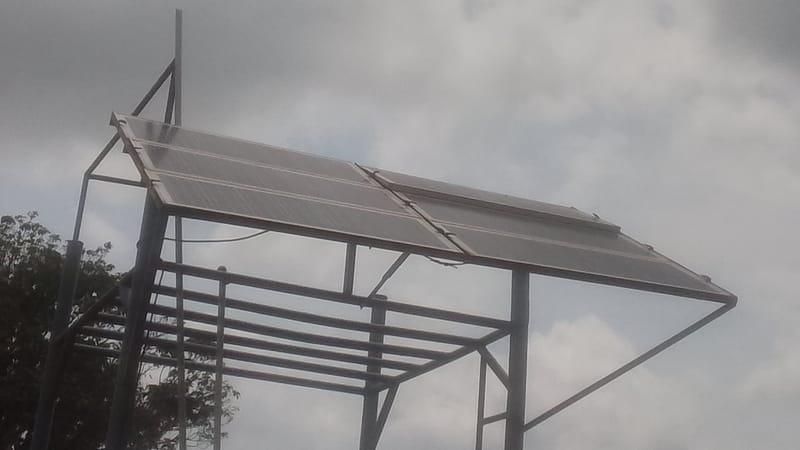
• The Rural Electrification Agency (REA) and Okra Solar signed a memorandum of understanding in Lagos on 26 November 2026 for a planned facility of up to $20 million, the Mesh-Grid Accelerator (MEGA), that would lend local developers the money to build solar mesh-grids before their government grants arrive.
• Developers using mesh-grids hold signed REA grant agreements for 13,438 connections and have another 98,252 awaiting approval, and the agency pays a flat $300 per connection only after each one is live and verified.
• The $20 million has not been reported as raised yet, Okra is targeting a first financing close by the end of March 2027, and no report TheRadar opened says which communities come first or what households will pay for the power.
Picture a small solar company that has won a grant to wire up a village that has never been on the grid. The grant is real, but it is paid only after the homes are connected, so the panels, batteries, cables and labour have to be paid for first. For many local builders, that gap is where projects stall.
That gap is what a new deal announced this week is meant to close. According to BusinessDay's report on the $20 million facility, published on 28 November 2026, REA and Okra Solar launched MEGA to lend to developers who already hold grant agreements under DARES, REA's results-based energy access programme. The paper put the problem plainly: the facility targets a bottleneck "that has little to do with customer interest."
Why "solar power" is in the news this week
Solar has been all over the energy pages since the Renewable Energy Forum Africa met in Lagos, where the MEGA memorandum was signed on 26 November. The same day, BusinessDay reported that Power Minister Joseph Tegbe commissioned a 3MW solar hybrid plant with 2.2MWh of battery storage at Michael Okpara University in Umudike, Abia State, under the World Bank-funded Energising Education Programme run by REA.
The MEGA story matters for a different group of people. It is not about city homes buying inverters. It is about the roughly 90 million Nigerians BusinessDay says still live without electricity, and about the small Nigerian companies that are paid to connect them.
How the money is meant to move
According to OkayNews' report on the signing, REA managing director Abba Abubakar Aliyu signed for the agency and Ajibola Abiodun signed for Okra Solar. Okra plans to raise up to $20 million and lend it to developers, and Aliyu said the company is targeting a first financing close by the end of March 2027. The facility's stated aim is more than 240,000 connections, which is a target, not homes already lit.
The loan would cover equipment and installation. Once a connection is built and verified, REA would pay its $300 grant directly to MEGA rather than to the developer, so the lender is repaid from the grant. "A developer cannot wait until a community has been connected to find the money needed to build its electricity system," Aliyu said, as quoted by OkayNews. Okra chief executive Afnan Hannan told BusinessDay that MEGA "means developers with grant agreements can get the finance to build, removing the biggest barrier to deployment."
One naming detail: Daily Times, in its 27 November report, called the scheme REA's "Market Driven Energy Access (MEGA) initiative", while BusinessDay and OkayNews use Mesh-Grid Accelerator. Both describe the same $20 million facility.
What a mesh-grid is, and why REA backs it
A mesh-grid links solar panels and batteries across neighbouring homes and shops into one shared network, so power can move from one system to another. In a May 2025 explainer, Okra Solar's own blog on DARES grants describes it as solar home systems strung together with small low-voltage DC cables and a power-sharing device, and says mesh-grids get a flat $300 per connection while mini-grids get between $350 and $600.
BusinessDay reports that such systems can run lights, phone charging, welding machines, mills and freezers, which is where the hustle angle sits for small rural businesses. Aliyu told the paper that REA's analysis shows mesh-grids are "the lowest cost way to energise more than 12 million households in Nigeria." In an earlier example published by Nairametrics on 10 November, a phone-charging business in Nasarawa State reportedly cut its weekly energy spend from ₦60,000 on a petrol generator to about ₦6,000; that figure came from a statement by investor British International Investment citing the business owner, and TheRadar could not check it independently.
What is still unclear for households and builders
The numbers in this deal are about developers, not bills. None of the reports TheRadar opened gives a tariff, a connection fee or a payment plan for households on these mesh-grids, and none names the communities or states that will be connected first. BusinessDay also notes that the March 2025 agreement this builds on involved five Nigerian developers, but it does not name them.
For local solar companies, the path still runs through REA. The agency's DARES application page lists six windows, including performance-based grants for interconnected and isolated mini-grids and for stand-alone solar, but TheRadar could not find a separate, dedicated mesh-grid application page on it. BusinessDay's own sum, not an official estimate, puts the current pipeline of 111,690 connections at about $33.5 million in grants at $300 each.
The plain reading is this: a lender is being lined up so that builders who already have REA grant agreements can start work sooner. If the money is raised and the first close happens by March 2027, more villages could get shared solar power faster. Until then, it is a signed plan with a target, not a switch that has been flipped.
Also read: Home solar in Nigeria is listed from ₦70,000 to ₦4.7m for 5kW. What a small generator burns instead
Also read: Tubular or lithium inverter battery: the cheaper one to buy is not always cheaper to run
Would a shared solar grid work in your town or village, and what would you be willing to pay for it each month? Tell us in the comments.