
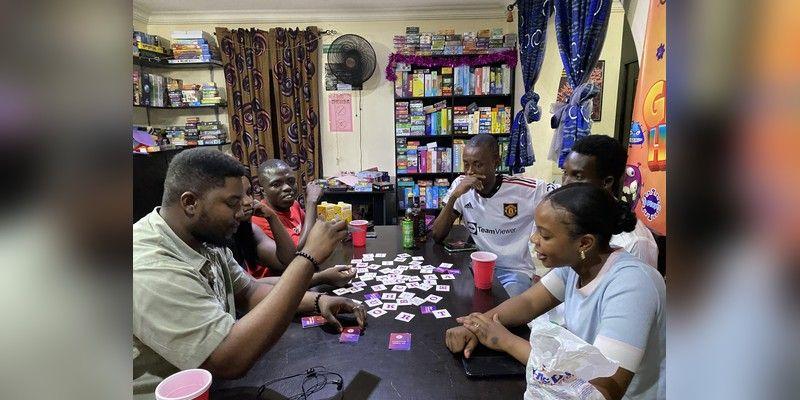
• African Boardgames Convention says its 10th anniversary edition is scheduled for Abuja on 27 and 28 November 2026.
• The organisers launched a Kickstarter on 11 August with a US$14,000 goal, saying the money is intended for venue and production costs, logistics, accessibility and expanded programming.
• That goal is an organiser’s plan, not proof of a mature market. But it shows that tabletop games in Nigeria are being treated as products, events and creative work—not only something to bring out after dinner.
Before phone screens took over every waiting room, a lot of Nigerians learned the shape of competition on a table. Somebody shuffled the cards. Somebody argued about a rule. Somebody was accused of changing the rules because they were losing. And everybody knew the game could bring people together even when it caused small fights.
Ludo, Whot and draughts taught many people that play can live in the room, not only in an app. The harder question now is whether a physical-game scene can turn that shared instinct into something that supports designers, printers, retailers, game cafés and the people willing to teach strangers how a new game works.
A convention is not the same as a market
The African Boardgames Convention, known as AB Con, says its 10th anniversary edition will take place in Abuja on 27 and 28 November. In its official announcement, the organisers describe a space for designers, publishers, educators, manufacturers, retailers, creators, students, families and players.
That kind of gathering matters because board games have a problem music and film do not always have: people usually need to see the object, understand the rules and play it with someone before they know whether it is worth buying. A good game can be sitting in a box for months if nobody has been given a reason to open it.
A convention can create that first reason. It can put a prototype in front of a curious player, let a designer hear where the rules are confusing and help a retailer see which game makes people stop at a table. But it is still a temporary room. The real business test begins after the tables are packed away.
From a good idea to a physical product
Tabletop games are unusually unforgiving to vague ambition. A designer needs a game that works. Then they need art, cards or boards, usable instructions, samples, production decisions, packaging, storage and a way to reach players who are not already their friends.
That does not mean every African board game has to look expensive from day one. It means the route from “we played this at a game night” to “people can buy this and teach it to their friends” has real costs. Print quality, missing pieces, how many copies to make and whether a shop will give the game shelf space all change the calculation.
The useful thing about a tabletop community is that playtesting can happen in the open. A player who has never met the designer can expose the rule nobody understood or the moment that makes the game memorable. That feedback is part of the product, not a distraction from it.
The Kickstarter is an invitation, not a verdict
AB Con says it launched a Kickstarter campaign on 11 August with a US$14,000 funding goal for the 2026 edition. According to the organisers, the funds are meant to support venue and production costs, volunteer support, logistics, marketing, accessibility improvements and wider programming.
The announcement also lists possible stretch ideas: a kids’ gaming competition, a designers’ grant, an impact award and the prospect of a third convention day. Those are aspirations attached to the campaign, not outcomes anybody should count as delivered yet.
Still, the campaign makes a useful point. A board-game culture cannot grow only on enthusiasm. Someone has to pay for the boring infrastructure that lets a room of players become a repeat event: tables, signs, venues, transport, reliable volunteers and a way for first-timers to feel welcome.
Games can carry local stories without becoming homework
There is a temptation to make every African game “educational” in a stiff way. But a game can carry history, humour, language or a familiar social situation simply by being fun enough to be played twice. That is where local storytelling can have commercial value: not as decoration, but as a reason a player remembers the experience and invites another person into it.
The opportunity is not limited to designers. A game café can host a new-game night. A shop can stock a small set of games it can actually explain. A content creator can film a playthrough that makes the rules feel less intimidating. A school club can discover that strategy and storytelling do not always need a screen.
The table is the distribution channel
The first sale of a tabletop game is often less important than the second group who plays it. If people learn it easily, argue about it happily and want to bring it to another table, the game has started doing its own marketing.
AB Con’s tenth edition will not, by itself, prove that Nigeria’s tabletop scene has found a business model. But it is evidence of the patient work required to find one: give people a table, let them play, help creators improve, and see which games leave the room with a life of their own.
Also read: Naija Ludo and Whot are still on the charts. Can local games turn everyday culture into business?
Also read: Anime, cosplay and gaming are no longer side hobbies. Nigeria’s fandom economy is growing
Which Nigerian game would you take to a new group of players—and what would make you buy a locally made board game? Tell us in the comments.
