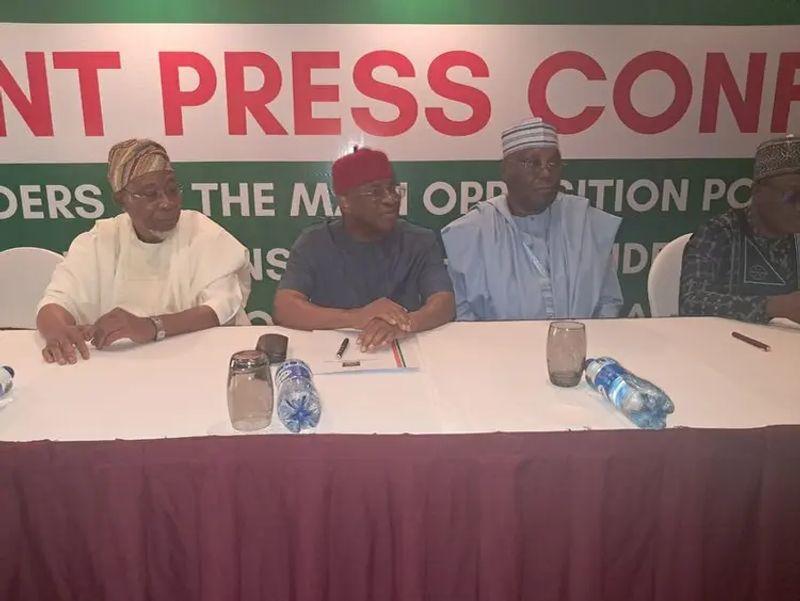
- Leaders of the opposition parties have called on the National Assembly to urgently reopen and amend the Electoral Act 2026
- NNPP National Chairman, Ajuji Ahmed, described the new law as “anti-democratic,” warning that its implementation could undermine electoral transparency ahead of the 2027 general elections
- Former Vice-President Atiku Abubakar, Labour Party’s 2023 presidential candidate Peter Obi, ADC Chairman David Mark, and other political stakeholders were present at the Abuja press conference
Leaders of opposition political parties, the African Democratic Congress and the New Nigeria Peoples Party, have urged the National Assembly to immediately begin a fresh amendment process of the Electoral Act 2026, describing several of its provisions as anti-democratic and potentially harmful to the credibility of future elections.
The call was made on Thursday, February 26, at a press conference in Abuja, where the National Chairman of the New Nigeria Peoples Party (NNPP), Ajuji Ahmed, spoke on behalf of opposition leaders. He asked lawmakers to expunge what they termed “objectionable provisions” from the newly enacted law.
The Electoral Act 2026, recently passed by the National Assembly and assented to by President Bola Tinubu on February 18, introduced significant changes to Nigeria’s electoral framework.
Unlike the Electoral Act 2022, which allowed political parties to adopt direct primaries, indirect primaries, or consensus arrangements for candidate selection, the new law restricts parties to only direct primaries and consensus options.
The Act also shortens campaign periods and timelines for party primaries. Additionally, funding for the Independent National Electoral Commission (INEC) will now be released six months before an election, instead of the previous 12 months.
Ahmed said opposition leaders view parts of the new law, signed with what they described as undue haste, as a calculated attempt by the ruling All Progressives Congress (APC)-led administration to weaken the electoral process ahead of the 2027 general elections.
He said, “We therefore state unequivocally that the new Electoral Act is anti-democratic, and its implementation will undermine electoral transparency and the sanctity of the ballot, which are fundamental to free, fair and credible elections and the bedrock of participatory democracy.
“The introduction of the proviso in Section 60(3), which allows wide and undefined discretionary powers to the presiding officer, overrides and negates the purpose of introducing electronic transmission of election results from polling units. This negation is unambiguously intended to provide a blank cheque to those who seek to manipulate election results by delaying the electronic transmission of results from the polling units to the IReV on the pretext of network failure.
“The premise of the proviso in Section 60(3) is the unavailability or possibility of network failure. We find this premise dubious and inconsistent with reality. The immediate past INEC Chairman, Prof. Mahmud Yakubu, stated on record that the BVAS equipment, which operates offline, had worked with over a 90 per cent success rate across the nation, and in the event of network failure at the point of transmission, the transmitted results would be delivered successfully whenever the network becomes available.
“This position has been further confirmed most recently by a former INEC Commissioner, Festus Okoye, as widely reported, that every polling unit in Nigeria has internet access. Indeed, these statements by those who have been in a position to know provide a counterfactual to the lies that are being fed to the Nigerian people by a government that has lost respect for reason and reality.”
Ahmed added that data in the public domain further supports the opposition’s position.
He said, “According to the Nigerian Communications Commission, as of 2023, Nigeria had achieved more than 95 per cent 2G coverage, which is more than sufficient for the transmission of election results from polling units.
“By that same period, Nigeria already had more than 159 million internet subscribers and more than 220 million telephone subscribers using the 2G network. It is also noteworthy that this capacity provides 24-hour coverage of the entire country. This goes to show that denying mandatory real-time transmission of election results from polling units on the basis of a lack of a communication network is not supported by evidence.
“Fortunately, millions of our people who transact business daily with various financial platforms, even from the remotest parts of the country, know that the no-network argument is fraudulent and is merely part of the APC game plan to rig the election in 2027.
“Indeed, we find it quite ironic that the same APC that strongly agitated for electronic voting only a few years ago is now opposed to the use of technology for the mere transmission of results. The game at hand is very clear.”
On the issue of party primaries, the opposition criticised the amendment to Section 84 of the Act, which limits political parties to direct primaries and consensus arrangements.
They argued that this constitutes an encroachment on the constitutionally guaranteed autonomy of political parties to manage their internal affairs.
Ahmed said, “There is nothing undemocratic about indirect primaries, which create an electoral college for the selection of candidates in an objective, transparent and orderly manner.
“Our position, therefore, is that as political parties, we do not need legislation that prescribes which mode of party primaries political parties must adopt. In other words, the mode of nominating candidates should be strictly the internal affair of political parties.
“It is obvious that the objective of the APC government and its accomplices in the legislature is to provide the legal pretext for the corruption of the electoral system.
“They harbour neither plans nor intentions to conduct free and fair elections in 2027 because, even in their arrogance and self-delusion, they are acutely aware of their growing unpopularity across the length and breadth of Nigeria, despite the recent gale of coerced and procured defections to their party.
“We demand that the National Assembly immediately commence a fresh amendment to the Electoral Act 2026 to remove all obnoxious provisions and ensure that the Act reflects only the will and aspirations of Nigerians for a free, fair, transparent and credible electoral process in our country. Nothing short of this will be acceptable to Nigerians.”
Among opposition figures present at the Lagos/Osun Hall of Transcorp in Abuja were the National Chairman of the African Democratic Congress, David Mark; NNPP chieftain Buba Galadima; former Vice-President Atiku Abubakar; and the 2023 presidential candidate of the Labour Party, Peter Obi.
Also in attendance were the ADC National Secretary, Rauf Aregbesola; former Rivers State Governor, Rotimi Amaechi; the party’s National Publicity Secretary, Bolaji Abdullahi; Senator Dino Melaye; former ADC National Chairman Ralph Nwosu; and former Cross River State Governor Liyel Imoke, among other stakeholders.