
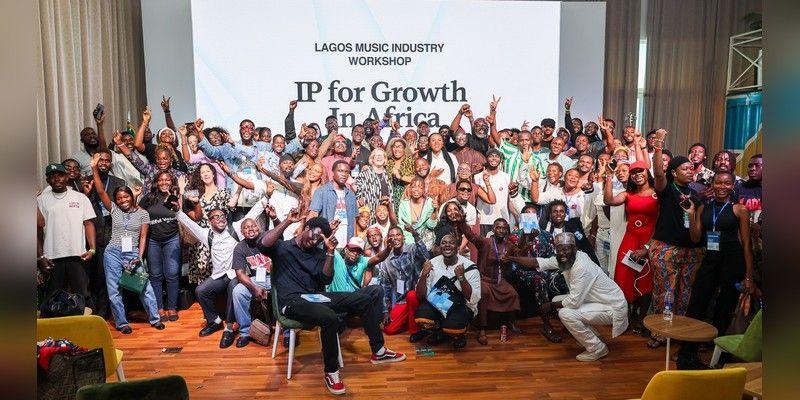
• U.S. Consulate General Lagos says its August music-industry workshop brought together more than 120 policymakers, lawyers, executives, artists, producers and distributors to discuss the business foundations around Nigerian music.
• The workshop cited partnerships such as Universal Music Group–Mavin and EMPIRE–YBNL as examples of U.S.–Nigeria commercial collaboration, while its sessions covered licensing, contracts, publishing and international market access.
• More outside interest can create options for Afrobeats businesses, but a deal still depends on its ownership, recoupment, term and exit clauses—not only its headline figure.
When the money conversation comes, it rarely arrives as a neat spreadsheet. It comes as a call after a song starts moving, a message from a distributor, an introduction to a label executive or a proposed partnership that feels like the next level.
For Nigerian music, that moment is becoming more familiar. The U.S. Consulate General in Lagos recently described the industry as a significant trade and investment opportunity, while pointing to the global audience, revenue and market access that international platforms and companies can help build. But the interest around Afrobeats is not a verdict on every offer. It is the start of a more important conversation: what exactly is being bought, funded, licensed or shared?
Outside money can mean different things
“Investment” is a tempting word because it sounds like support without a cost. In music, it can describe very different arrangements. A company might finance a project, take a distribution role, license recordings for a period, buy rights in a catalogue, invest in a label business or advance money that will later be recouped from income.
Those are not interchangeable. A deal that helps an artist release internationally can be useful without being an ownership deal. A catalogue transaction can give a company long-term rights that make sense for one creator and not another. A distribution agreement can open services and reach while leaving a different kind of control with the artist or label.
That distinction matters because the exciting part of a deal is often the number attached to it. The lasting part is the paperwork that says where the money is recovered from, who approves uses of the music, what happens to the masters, how long the arrangement lasts and what either side can do when the relationship ends.
The conversations are getting more serious
At its August workshop, the U.S. Consulate said more than 120 people from across the music ecosystem gathered to examine the commercial and legal foundations of the industry. Its release named Universal Music Group–Mavin and EMPIRE–YBNL as examples of collaboration that have helped Nigerian music reach wider audiences and create new revenue opportunities.
The Consulate’s account of the workshop is useful because it does not treat the business side as an afterthought. Panellists discussed copyright ownership, royalty systems, IP enforcement, licensing, contracts, monetisation, publishing and international market access. Those are the ordinary words behind an extraordinary song career.
Music Ally’s report on the same moment also points to the growing attention from American music companies and the importance of stronger IP protection for investor confidence. The lesson for creators is not that a foreign company automatically knows the value of a Nigerian catalogue better. It is that the deal table is becoming more complex.
The first question is not “how much?”
Money matters. For a young artist or independent label trying to pay for recording, marketing, video production, staff and touring, an advance can change what is possible next month. But the number should be read beside the terms.
Is the advance recoverable from future income? Which income? Is it for one project, one territory or a whole catalogue? Are masters being licensed or assigned? Does the deal cover publishing too? Who can approve a brand use, a film placement or a remix? When does the term end, and what happens after it does?
These are not questions that kill ambition. They stop a headline from doing more work than it should. A deal can be a real opportunity and still require an experienced lawyer, manager or business adviser who is working for the creator’s side of the table.
Leverage is more than streams
Afrobeats is drawing attention because the music travels. But leverage is not only a viral clip or a large listener count. It can also be clean ownership records, a clear split sheet, a functioning team, a proven live audience, a catalogue that has been properly tracked and a business that knows what it wants from a partner.
That is particularly important for the people building behind the artist: producers, writers, label staff, publishers, studios and small management companies. If more capital is looking towards Nigerian music, more people need to be able to explain what they own, what they control and what they are prepared to share.
Interest is not the finish line
The best thing about more outside money is not the noise around it. It is the possibility of better options: more routes to market, more capacity to fund work and more competition for a sound that Nigerians have spent years building.
But a good deal is not proved by where the money comes from. It is proved later, when the artist, label or creator can still understand the rights, the obligations and the value left on their side of the agreement.
Also read: A hit song is not one person’s work. Who gets paid when Nigerian music makes money?
Also read: Before your skit blows up, keep this proof against reposts
What part of a music deal do you think artists and creators should understand before the celebration starts? Tell us in the comments.
