
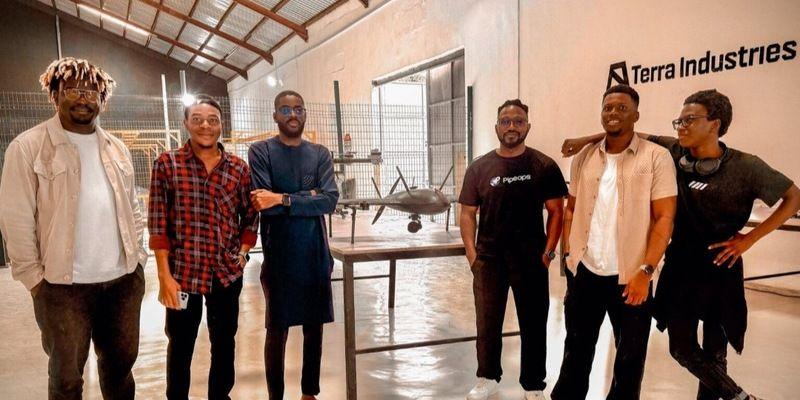
• Terra has added $18 million, taking its seed round to $52 million. The company says the money will support manufacturing, hiring and wider operations.
• Its planned Ghana facility matters because hardware is different. A factory must be built, staffed, supplied and kept running long after a headline fades.
• The real result will not be the round itself. It will be whether local production, engineering jobs and accountable infrastructure security actually follow.
A Nigerian company has just raised $52 million to build security technology in Africa.
That headline can easily become another tech-celebration post: a big dollar figure, a drone photo and a promise that Nigeria has arrived.
But Terra Industries' new funding is more interesting than the money.
The company said on 17 August that it had added $18 million to close a $52 million seed round. It is opening a London office, expanding its team and preparing a second manufacturing facility in Ghana while keeping production rooted in Africa.
That makes Terra a test case for a harder question: can a Nigerian company turn capital, engineers and a factory floor into a durable industrial business rather than a good funding announcement?
The money is real. The work starts after the announcement
Terra Industries is not selling a digital subscription or promising to ship an app update next week. It builds autonomous systems for governments and operators of critical infrastructure, including tools it says can support monitoring, first response and site security.
That is a difficult business to build from Nigeria because hardware carries costs that software companies can postpone. There are parts to source, skilled teams to retain, facilities to run, systems to test and customers who expect reliability long after the pitch deck has closed.
The additional $18 million matters because it gives Terra more room to do that work. TechCrunch reported that the new funding brings the company’s seed financing to $52 million, while investors cited in current coverage include 8VC, Silent Ventures and Nova Global.
But a raise is a starting gun, not a finish line.
The company has said it will use the money to increase manufacturing capacity, grow engineering and operations teams, and open its first international office in London. That is ambitious. It is also the part of the story to watch most carefully over the next year.
Abuja is the point of the story
Terra already operates a 15,000-square-foot facility in Abuja. It says its next factory, Pax-2 in Ghana, is planned for the fourth quarter of 2026 and will cover 34,000 square feet.
Those numbers are not just a brag about a bigger building.
They raise a question that comes up whenever African startups announce foreign offices and international investors: where will the difficult work happen? Where will the teams learn? Where will the supply chain deepen? Where will the value remain once the company starts selling outside the continent?
Terra says manufacturing will stay in Africa even as it opens a London office. If that happens, it is meaningful. It would mean more than a Nigerian founder using foreign capital to sell a foreign-made product. It would mean a company trying to build design, production and maintenance capability closer to the places where it expects its systems to be used.
That kind of capacity is harder to measure than a funding total. It shows up in technicians who can solve problems without flying in a specialist, suppliers who can meet a standard, graduates who get serious engineering work and factories that still have orders after the investor announcement disappears from the timeline.
The engineering jobs matter more than the announcement photo
Nigeria’s tech conversation often moves quickly from funding news to valuation talk. Hardware forces a more useful conversation.
A company making physical systems needs engineers, quality-control teams, production staff, software specialists, operations people and people who understand the realities of infrastructure sites. The jobs are not all glamorous. That is partly why they matter.
The country already has a large pool of people training for digital work. TheRadar has written about why completing a programme is not the same as finding a job in tech. Terra’s expansion does not solve that gap by itself, and it should not be presented as a shortcut for every graduate.
But it does point to a different kind of opportunity: technology work that is not only about writing code for a screen. A stronger industrial base gives more people a reason to build skills in electronics, manufacturing operations, product testing and infrastructure software too.
That is the long-term promise. The proof will be in the roles the company actually creates, the teams it builds locally and the work it keeps on the continent.
Local does not mean unquestioned
There is another reason this story deserves more than applause.
Technology built close to the people and infrastructure it affects can be easier to maintain and better adapted to local realities. It can also raise difficult questions about oversight, data, procurement and accountability—especially when it is used around critical infrastructure or public security.
Those questions do not make local manufacturing a bad idea. They make transparent rules more important.
The public should be able to ask what a system is meant to do, who is responsible when it fails, how contracts are awarded and what safeguards protect ordinary people. A serious local technology industry should be able to handle those questions without treating them as hostility.
That is the standard Terra will be measured against as it grows: not only whether it can build, but whether it can build trust.
London can help. Africa has to stay central
The planned London office is easy to misunderstand as a sign that the company is leaving.
It is more accurate to see it as a test of balance. International offices can make it easier to hire specialised talent, speak to investors and reach institutions that make large infrastructure decisions. African manufacturing can keep the production base, local knowledge and industrial learning closer to home.
Both can be true at once. The concern begins only if the high-value work quietly migrates while Africa is left with the assembly line and the press release.
Terra has said manufacturing will remain in Africa. That is a commitment worth following, not a line to repeat without checking back.
What success should look like next
By the end of 2026, the clearest signs of progress will be simple.
Has the Ghana facility actually opened on the timeline the company announced? Has the Abuja base grown? Are more technical and operations roles being filled locally? Can the company show that its systems are supporting critical infrastructure without making vague claims that cannot be independently understood? Are there clear governance and accountability standards around the technology?
If the answer to those questions becomes clearer, the $52 million round will look like more than a big seed cheque.
It will look like evidence that Nigeria can build difficult technology at home, keep serious manufacturing knowledge nearby and take a bigger place in the industries that shape its own infrastructure.
Also read: Nigeria's Startup Act is supposed to help founders. Why are they still waiting?
Also read: Nigeria is going to Gamescom. What should success in Cologne look like?
Would you rather see Nigerian companies build difficult technology at home, or focus first on services and software? Tell us why in the comments.
