- The U.S. President, Donald Trump, has openly stated that taking control of Iran’s oil resources remains “an option”
- He suggested that such a move could deliver significant economic benefits to the United States
- Trump referenced U.S. involvement in Venezuela’s oil sector, claiming the arrangement has generated billions of dollars for the US
The United States President, Donald Trump, has said that taking control of Iran’s oil resources remains “an option,” as tensions in the Middle East continue to intensify amid ongoing hostilities involving the United States, Israel, and Iran.
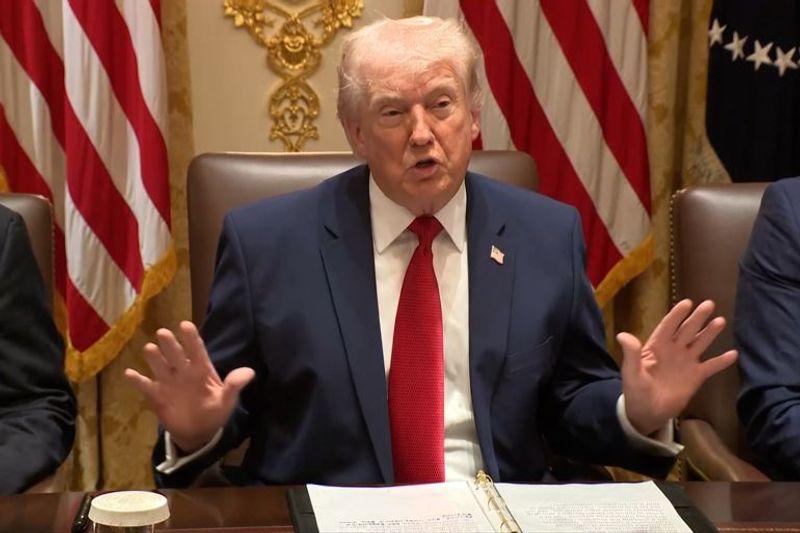
Speaking during a Cabinet meeting at the White House on Thursday, March 26, Trump suggested that Washington could consider asserting control over Iran’s vast oil reserves, pointing to what he described as a profitable U.S. arrangement in Venezuela.
“It’s an option,” Trump said when asked whether such a move was under consideration. “I mean, I wouldn’t talk about it, but it’s an option.”
He further highlighted U.S. involvement in Venezuela’s oil sector following efforts to unseat President Nicolás Maduro, claiming it had generated substantial revenue for the United States.
“Well, in Venezuela, we’ve done very well working with Venezuela. Certainly, we’ve taken in billions and billions of dollars,” he said.
“By the way, Venezuela is doing better right now than they’ve ever done in the history of their country, and a sort of joint venture, but the U.S. has made a lot of money.”
Rising tensions and strategic pressure
Trump’s remarks come at a critical moment in the escalating conflict in the Middle East, where tensions have disrupted global energy flows and heightened fears over regional stability.
At the center of the crisis is the Strait of Hormuz, a vital global oil transit route responsible for roughly one-fifth of the world’s oil supply. The waterway has been significantly impacted by the ongoing conflict.
The U.S. president had issued a deadline earlier in the week for Iran to reopen the strait, warning of severe consequences if it failed to comply.
“They should have done that four weeks ago. They should have done it two years ago, or they should have done it when we first came into office,” Trump said, expressing frustration over stalled negotiations.
He also issued a stark warning in recent days, threatening to “obliterate” Iran’s power plants and energy infrastructure if Tehran did not fully restore access to the strategic route.
Diplomatic signals amid hostility
Despite the hardline rhetoric, there are indications of ongoing indirect communication between Washington and Tehran. Trump claimed that Iran is eager to negotiate an end to the conflict.
“They’re great negotiators. I say they’re lousy fighters, but they’re great negotiators, and they are begging to work out a deal,” he said.
Iran’s Foreign Minister, Abbas Araghchi, has acknowledged that messages have been exchanged through intermediaries, though he emphasized that these do not constitute formal negotiations.
U.S. Middle East envoy Steve Witkoff confirmed that Washington has presented a 15-point “action list” outlining terms for a potential peace agreement.
The proposal, reportedly transmitted via Pakistan, includes demands related to Iran’s nuclear and missile programs, as well as its uranium stockpiles.
“This has been circulated through the Pakistani government acting as the mediator,” Witkoff said.
Trump also revealed that Iran recently allowed 10 oil tankers to pass through the Strait of Hormuz, describing it as a goodwill gesture.
“They gave us a present,” he said, adding that it demonstrated “the fact that we’re real and solid and we’re there.”
Iran, a key member of the Organization of the Petroleum Exporting Countries, holds some of the world’s largest proven oil reserves.
Any attempt to control or disrupt its oil sector could have far-reaching implications for global markets and geopolitical stability.
While Trump’s comments have fueled speculation about a more aggressive U.S. energy strategy, the White House has yet to outline any formal plan regarding Iran’s oil infrastructure.
The president also expressed disappointment with allies in the North Atlantic Treaty Organisation for failing to provide naval support to secure the Strait of Hormuz, warning that their response would not be forgotten.
“If you don’t do that, we’re going to remember, just remember,” he said. “They have a great expression: Never forget. Never forget.”
For now, it remains unclear whether Trump’s remarks signal a concrete policy direction or are part of broader strategic messaging aimed at increasing pressure on Tehran amid one of the most volatile geopolitical crises in recent years.