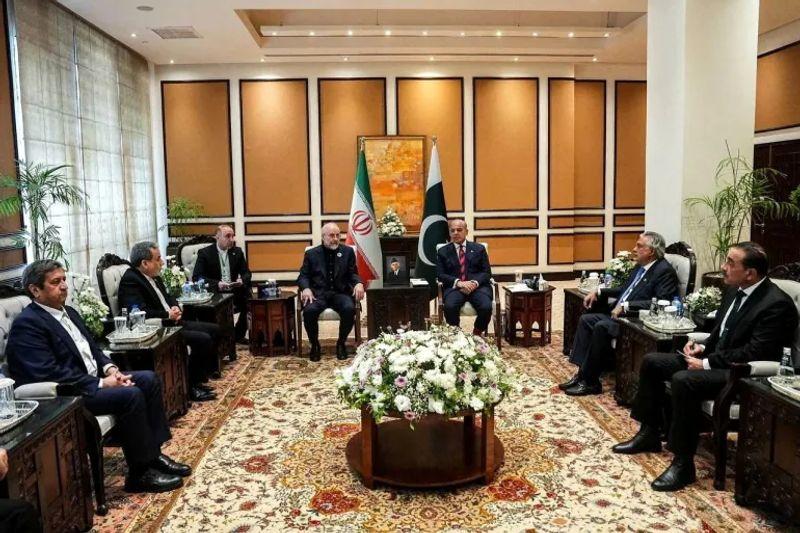
- Pakistan Prime Minister Shehbaz Sharif is set to visit Saudi Arabia, Qatar and Turkiye from April 15 to 18 ahead of a possible second round of US-Iran talks in Islamabad
- Sharif is expected to discuss regional security, the Strait of Hormuz and ceasefire efforts at the meeting in Antalya on April 17
- Saudi Arabia has pledged $3 billion to support Pakistan’s foreign reserves
Pakistan’s Prime Minister Shehbaz Sharif is set to begin a four-day diplomatic tour of Saudi Arabia, Qatar and Turkiye as Islamabad deepens efforts to mediate between the United States and Iran and prevent further escalation in the Middle East.
“Prime Minister Muhammad Shehbaz Sharif will undertake official visits to the Kingdom of Saudi Arabia, the State of Qatar and the Republic of Turkiye from 15–18 April 2026,” Pakistan’s foreign ministry said in a statement.
According to the ministry, Sharif’s visits to Saudi Arabia and Qatar will focus on bilateral relations, while his stop in Turkiye will include participation in the Antalya Diplomacy Forum, where he is expected to meet Turkish President Recep Tayyip Erdogan and other world leaders.
The diplomatic tour comes days after Islamabad hosted the first face-to-face talks between the United States and Iran in decades.
The talks, held over the weekend, were aimed at ending the more than six-week conflict that erupted after the United States and Israel launched attacks on Iran.
Although the discussions ended without a formal agreement, US President Donald Trump said negotiations could resume in Islamabad this week.
A fragile ceasefire remains in place, but tensions remain high following Iran’s retaliation against US allies in the Gulf, including Saudi Arabia and Qatar, as well as disruptions to regional energy exports.
Sharif is expected to be accompanied by Deputy Prime Minister and Foreign Minister Ishaq Dar, who played a central role in mediating the recent US-Iran dialogue.
The prime minister’s regional meetings are expected to focus heavily on the next phase of the Islamabad talks, the future of the ceasefire and the situation around the Strait of Hormuz.
Sources said Sharif will meet Saudi Crown Prince Mohammed bin Salman during the visit, with both sides expected to discuss regional developments, bilateral cooperation and ways to strengthen Pakistan-Saudi Arabia ties.
The visit also comes as Pakistan receives renewed financial backing from Riyadh.
Pakistan’s finance ministry announced that Saudi Arabia would provide the country with $3 billion to strengthen its foreign reserves.
The ministry also said an existing $5 billion Saudi deposit would be extended for an unspecified period.
The announcement came shortly after Pakistan disclosed that it had returned billions of dollars in loans to the UAE.
Meanwhile, President Asif Ali Zardari on Tuesday, April 14, praised Pakistan’s role in facilitating the US-Iran dialogue during a meeting with Sharif at Aiwan-e-Sadr.
The president described the regional crisis as one with far-reaching consequences for global security, the economy and politics.
Zardari commended the prime minister, Ishaq Dar, defence officials and state institutions for what he described as their “untiring efforts” in making the diplomatic initiative successful.
He said Pakistan had once again demonstrated its value as a responsible and influential state by creating a platform for dialogue between two longtime rivals.
Zardari also urged the government to remain engaged with Washington, Tehran and other major powers to ensure that peace efforts continue.
As part of those broader diplomatic efforts, foreign ministers from Pakistan, Saudi Arabia, Turkiye and Egypt are expected to meet again in Antalya on April 17 on the sidelines of the Antalya Diplomacy Forum.
The meeting will mark the third gathering of the four-country bloc, sometimes referred to as the “Muslim Quad”, following earlier meetings in Riyadh and Islamabad.
Pakistan is expected to use the Antalya meeting to push for a cooperative framework focused on peace, prosperity, economic development and de-escalation in the Middle East.
The Antalya Diplomacy Forum, themed “Mapping Tomorrow, Managing Uncertainties”, is expected to attract more than 20 heads of state, 15 deputy leaders and over 50 foreign ministers.
Among those expected to attend are Pakistan’s Ishaq Dar, Saudi Foreign Minister Prince Faisal bin Farhan Al Saud, Turkish Foreign Minister Hakan Fidan and Egyptian Foreign Minister Badr Abdelatty.
Pakistan’s foreign office said senior officials from the four countries had already met in Islamabad this week to prepare for the Antalya talks.
“Deliberations at the SOM will be submitted for consideration at the forthcoming foreign ministers meeting of the four brotherly countries, scheduled to be held in Antalya, Türkiye on April 17 on the sidelines of Antalya Diplomacy Forum (ADF),” the Foreign Office said.
Foreign Minister Dar also held talks with Turkish Foreign Minister Hakan Fidan ahead of the forum.
“Both leaders exchanged views on the regional situation, including the latest developments, and reaffirmed the importance of close coordination on issues of mutual interest. Both leaders also discussed important engagements at the upcoming Antalya Diplomacy Forum,” a statement said.
Pakistan’s recent mediation role has attracted international attention, with the foreign office claiming that Dar’s efforts have been recognised by officials and diplomatic voices from countries including the United States, Iran, China, Saudi Arabia, Turkiye, Egypt and South Africa.
The foreign office further claimed that Dar had emerged as the “#1 Most Positively Viewed World Leader globally” between April 5 and 11, citing international sentiment data.
With another possible round of US-Iran talks expected in Islamabad, Pakistan is increasingly positioning itself as a key diplomatic bridge in one of the world’s most volatile regions.
Pakistan hosts crucial US-Iran talks as Israel-Lebanon conflict threatens ceasefire
Meanwhile, TheRadar earlier reported that Pakistan planned to host high-stakes talks between the United States and Iran in Islamabad, but uncertainty looms over Tehran’s participation following deadly Israeli strikes on Lebanon that threaten the fragile ceasefire.
The negotiations, expected to address critical issues such as Iran’s nuclear enrichment programme and the free flow of oil through the Strait of Hormuz, come at a time of rising regional tension.