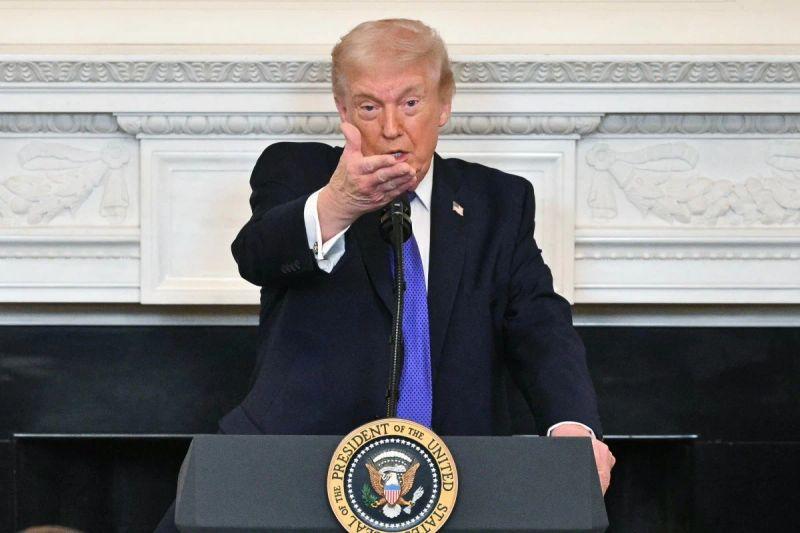
- President Donald Trump has warned that countries attempting to withdraw from recently negotiated U.S. trade agreements will face significantly higher tariffs
- The Supreme Court of the United States rules 6–3 that Trump exceeded his authority under the International Emergency Economic Powers Act (IEEPA), striking down a broad range of his emergency tariffs
- Trump administration activates Section 122 of the Trade Act of 1974, imposing new temporary tariffs of up to 15% on a wide range of imports
The United States President, Donald Trump, has warned countries against reconsidering recently negotiated trade agreements with Washington, threatening significantly higher tariffs and possible new license fees following a landmark Supreme Court ruling that struck down many of his earlier global duties.
In a series of posts on Truth Social on Monday, February 23, Trump cautioned that any country attempting to “play games” after the court’s decision would face harsher economic consequences.
“Any Country that wants to ‘play games’ with the ridiculous Supreme Court decision… will be met with a much higher Tariff, and worse, than that which they just recently agreed to,” Trump wrote.
On Friday, February 20, the Supreme Court of the United States ruled 6–3 that Trump had exceeded his authority under the International Emergency Economic Powers Act (IEEPA), a 1977 law he used to impose sweeping tariffs on multiple countries.
The decision, authored by Chief Justice John Roberts, reaffirmed the judiciary’s role in checking presidential powers.
While the ruling invalidated tariffs imposed under IEEPA, it left intact Trump’s sector-specific duties on goods such as steel and automobiles. The court’s decision also opens the door for potential refund battles over the now-illegal duties.
Despite the setback, Trump insisted the ruling actually strengthened his hand, saying it affirmed his ability to use other trade laws “in a much more powerful and obnoxious way, with legal certainty.”
New temporary tariffs take effect
In response, Trump moved quickly to revive his trade agenda by invoking Section 122 of the Trade Act of 1974. Fresh U.S. tariffs on imported goods took effect at 12:01 a.m. EST on Tuesday, February 24 (today).
Initially announced at 10 percent, Trump raised the rate to 15 percent, the maximum allowed under the statute. The temporary duty will apply to roughly $1.2 trillion worth of imports annually, about one-third of total U.S. goods imports.
According to White House officials, the new tariffs are intended to address “large and serious United States balance-of-payments deficits.” The measure will remain in place for 150 days unless extended by Congress.
U.S. Customs and Border Protection confirmed it would stop collecting the invalidated IEEPA-based duties while beginning collection of the new temporary tariffs.
Goods covered by sector-specific investigations, as well as items under the U.S.-Mexico-Canada trade agreement, are expected to retain certain exemptions.
EU delays vote, global talks uncertain
The move has already created ripples abroad. In Brussels, the European Parliament postponed a planned vote on the European Union’s trade deal with the U.S. following Trump’s announcement of the 15 percent duty.
Under the proposed deal, EU goods would face a 15 percent U.S. tariff with exemptions for hundreds of items, including food products, aircraft parts, pharmaceutical ingredients, and critical minerals. In exchange, the EU would remove duties on numerous American imports.
Meanwhile, China has urged Washington to scrap its tariff measures, and India has delayed planned trade talks with the United States.
U.S. Trade Representative Jamieson Greer said existing tariff agreements remain valid despite the court ruling and added that the administration expects partners to honor them.
He also indicated the administration plans to launch new Section 301 investigations into unfair trade practices, a legal pathway that could enable additional tariffs.
Trump also criticised the justices who ruled against him, including two he appointed during his presidency, and voiced concern that the court could rule against his administration in an upcoming case related to birthright citizenship.
As the new tariffs take effect, uncertainty continues to cloud the future of U.S. trade policy.
While some countries may avoid retaliation, analysts say prolonged instability could accelerate efforts by key partners to diversify trade relationships away from the United States.
For now, Trump has made one thing clear: any country reconsidering its trade commitments with Washington risks facing even steeper economic consequences.