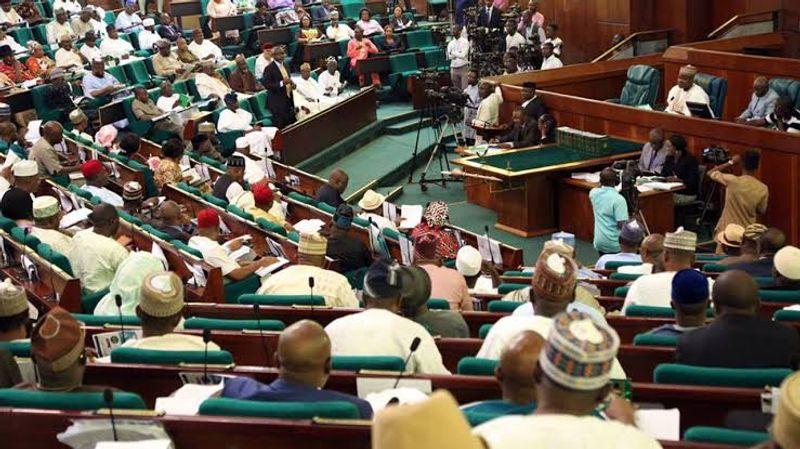
- The National Commission for Technology Transfer, Acquisition, and Promotion bill passed its second reading in the House of Representatives
- The bill introduced by Clement Jimbo, aimed to regulate foreign technology imports into the country
- Also aimed to promote the local processing of Nigeria’s raw materials into finished products
The National Commission for Technology Transfer, Acquisition, and Promotion bill has successfully passed its second reading in the House of Representatives.
The bill, which was introduced by Clement Jimbo, an All Progressives Congress (APC) representative for the Abak/Etim Ekpo/Ika federal constituency of Akwa Ibom state, cleared the second reading on Wednesday, November 27.
House passes Bill to promote production, employment, technology transfer
This bill is focused on monitoring the entry of foreign products and technology into Nigeria. While presenting the bill, the lawmaker outlined that the commission, once established, will, “leverage on our huge and active population to create jobs for youths, process our raw materials into finished goods/products, increase our gross domestic product (GDP), and transfer technology to Nigeria”.
“National Bureau of Statistics (NBB) says over 200 million cell phones, 500,000 solar systems, 12 million cars, cameras, microphones, laptops, and remote controls are currently in use in Nigeria,” he stated.
Speaking further, the lawmaker said, “Mr. Speaker, honourable colleagues, the above-listed products have one thing in common: batteries.
“Mr. Speaker, honourable colleagues, the major ingredient in the production of batteries is a solid mineral called lithium.
“A German foreign broadcasting company, Deutsche Welle DW says lithium has been discovered in large quantities in Nigeria and these states: Abuja, Nasarawa, Kogi, Ekiti, Kwara, and Cross River.”
The lawmaker explained that the bill aimed to foster regular value addition to Nigeria’s solid mineral exploration. He emphasised that the proposed legislation will, “jack up our gross domestic products and increase our revenue base through foreign exchange”.
The lawmaker further said the commission will, “leverage on Nigeria’s population to negotiate with other countries intending to make Nigeria their country of export of goods/products to mandatorily transfer technology for the production/manufacture of components of such production/goods to be exported to Nigeria, provided there is proof of availability of raw materials in Nigeria”.
In a voice vote led by Speaker Tajudeen Abbas, the bill was passed with unanimous approval from the lawmakers.
Diaspora voting bill passes second reading in the House of Reps
Meanwhile, TheRadar earlier reported that the Bill for diaspora voting passed a second reading in the Nigerian House of Representatives.
Lawmakers debated the importance of extending voting rights to Nigerians outside the country.