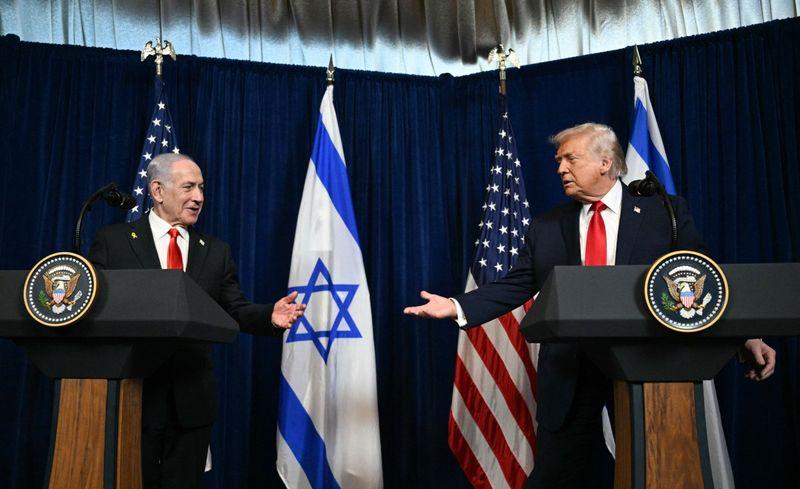
- Israel is considering gradually ending its dependence on the United States military aid
- The US currently provides Israel with $3.8 billion annually in military assistance
- However, Israeli officials are concerned about vulnerabilities tied to foreign military suppliers
Israeli Prime Minister Benjamin Netanyahu has renewed discussions about Israel’s long-term military independence after suggesting the country should gradually phase out its reliance on American military assistance.
The United States currently provides Israel with $3.8 billion in annual military aid under a 10-year agreement signed in 2016 during the administration of former United States President Barack Obama.
Most of the funding is tied to the purchase of American-made military equipment.
As negotiations for a new agreement expected to begin before 2028 draw closer, Netanyahu revealed that he had encouraged US President Donald Trump to consider gradually reducing the aid package until it eventually reaches zero.
Speaking during an interview on CBS’s 60 Minutes, Netanyahu said Israel should begin “weaning” itself off foreign military assistance, signaling a possible shift in the country’s defence strategy.
Since Israel’s establishment in 1948, the country has received more than $300 billion in American economic and military support when adjusted for inflation, according to the Council on Foreign Relations.
The organisation noted that US military assistance to Israel surged significantly in 2024 amid the ongoing war between Israel and Hamas in Gaza.
Netanyahu’s comments also come as support for Israel continues to decline among sections of the American public.
A recent survey by the Pew Research Center found that nearly 60 percent of US adults now hold an unfavourable opinion of Israel.
Israeli military historian Danny Orbach said the Prime Minister likely recognises changing political attitudes in the United States.
According to Orbach, reducing reliance on aid before political pressure forces the issue could be a strategic move by Israel.
The debate has also been fuelled by concerns over Israel’s dependence on foreign military suppliers.
Earlier this week, Israel’s state comptroller criticised successive governments for failing to strengthen local weapons production and for neglecting strategic reserves of essential military materials.
The report highlighted how wartime demand exposed weaknesses in Israel’s defence supply chain.
Recent military challenges have added to those worries.
In March, a malfunction involving the David’s Sling missile defence system reportedly allowed two Iranian ballistic missiles to strike southern Israel, leaving dozens injured.
Reports also suggested that supplies of the advanced Arrow interceptor system had become critically low.
Despite these concerns, US military assistance currently makes up less than eight percent of Israel’s proposed 2026 defence budget, which has grown to around 143 billion shekels, equivalent to approximately $49 billion, due to wartime spending.
Experts say an immediate break from American military support would be unrealistic because Israel still relies heavily on the United States for advanced fighter jets, submarines, weapons systems and spare parts.
However, Israel’s rapidly expanding economy has strengthened arguments for greater independence.
Former Israeli consul general in Los Angeles, Yaki Dayan, noted that Israel’s GDP has more than doubled since the current aid agreement was signed in 2016.
According to International Monetary Fund projections, Israel’s economy is expected to grow from roughly $320 billion in 2016 to about $720 billion by 2026, significantly reducing its financial dependence on Washington.
Dayan also argued that the US benefits considerably from the partnership because Israel serves as a testing ground for American military technology, helping US defence companies improve their systems through real battlefield experience.
Analysts believe reducing dependence on US aid could also allow Israel to diversify its defence partnerships with countries such as India, Serbia and Greece while maintaining its close alliance with Washington.
At the same time, strengthening domestic weapons production could further boost Israel’s growing arms export market.
Germany has already agreed to purchase Israel’s Arrow missile defence system in a multi-billion-dollar deal, while talks with other countries are reportedly ongoing.
Still, many defence experts insist that completely severing military ties with the United States remains unlikely in the near future.
Retired Israeli Colonel and defence analyst Adi Bershadsky warned that Israel’s security environment makes continued cooperation with Washington essential.
He noted that Israel remains a small country facing multiple regional threats without the protection of a collective defence alliance like NATO.
According to Bershadsky, the current geopolitical realities mean peace in the region remains uncertain, making the US-Israel military alliance too important to abandon completely.
US-Israel strikes five oil depots across Iranian capital
Meanwhile, TheRadar earlier reported that the United States and Israel carried out overnight air strikes on five oil facilities in Iran, including sites in Tehran and Alborz Province.
Iran’s National Iranian Oil Products Distribution Company confirmed that four oil depots and a petroleum products transport centre were targeted. Iranian officials insist fuel distribution remains stable, saying the country still had “sufficient gasoline reserves.”