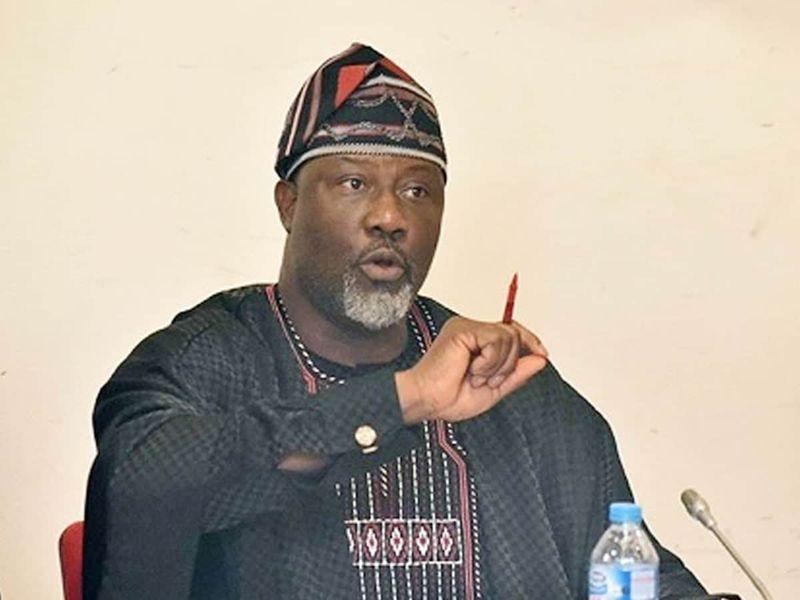
- Dino Melaye revealed that his absence from Shiloh 2024 was due to his disagreement over the forced retirement of Bishop Abioye from Living Faith Church
- Dino Melaye criticised the church's forced retirement of Bishop Abioye, questioning why a younger leader is retired while the older Bishop Oyedepo remains active
- The retirement of Bishop Abioye, a key figure in Living Faith Church has continued to cause an uproar with people disagreeing with the decision of the Living Faith Church
Dino Melaye, a former senator representing Kogi West, has explained that his absence from the 2024 Shiloh event hosted by the Living Faith Church in Ota, Ogun State, was due to the controversial retirement of Bishop David Abioye.
Shiloh, which took place between December 10 and 15, 2024, is one of the largest Christian gatherings in Nigeria, drawing attendees from across the globe.
However, Melaye took to social media on Sunday, December 15, to voice his displeasure over the church’s decision to “forcefully” retire Bishop Abioye, who had served as vice president of the church for over three decades.
In his post, Melaye questioned the fairness of the decision, pointing out that while Bishop Abioye, 63, was retired under the church’s operational guidelines, Bishop David Oyedepo, the General Overseer of Living Faith Church, who is older than Abioye, remains active in his role.
Melaye expressed disbelief over why a younger leader like Abioye would be forced into retirement while his senior, Bishop Oyedepo, continues to serve.
"I did not attend Shiloh 2024 because Shiloh without Bishop Abioye is somehow," Melaye wrote.
"I can’t understand why Bishop Oyedepo, who is older, is not retired, and it is Bishop Abioye who is younger that should be forcefully retired. God did not retire Abioye, only Oyedepo did."
The former Senator’s comments have reignited public debate over the church’s decision, which some view as controversial, particularly in light of the long service of both bishops.
Bishop Oyedepo, in response to criticism, had earlier advised detractors to refrain from questioning the church’s internal decisions.
According to reports, Bishop Abioye's retirement was in line with Living Faith Church’s operational guidelines, which stipulate a retirement age of 58 for pastors, revised from the previous age of 60. This policy is reportedly part of the church’s "Liberation Mandate," which serves as its guiding constitution.
In his valedictory speech on October 18, 2024, Bishop Abioye expressed deep gratitude to Bishop Oyedepo for his mentorship over the years. Abioye, who retired at the age of 63, described his time in the church as a transformative journey that had provided him with "security of destiny."
He spoke fondly of Bishop Oyedepo, acknowledging the significant impact of his guidance and mentorship, which he said had shaped his ministry.
"My adventure in ministry is not about being desirous or having ambition but simply fulfilling purpose," Abioye said, reflecting on the lessons learned under Bishop Oyedepo’s leadership.
"Meeting with God’s servant became like entering into a school, and life-transforming lessons have been learnt."
Abioye, who joined the church in 1980 at the age of 19, expressed admiration for Bishop Oyedepo, describing him as a “trailblazer” whose influence had guided his spiritual and ministerial path.
The retirement of Abioye and other senior leaders, such as Bishop Thomas Aremu continues to generate varying opinions among people on social media and off it.
“Time for him to retire”: Nigerians criticise Pastor Adeboye for “spiritual solution” comment
Meanwhile, TheRadar earlier reported that the General Overseer of the Redeemed Christian Church of God (RCCG), Pastor Enoch Adeboye, came under fire on social media for saying Nigeria needed a spiritual solution to its problems.
In a video circulating on social media, Adeboye said Nigerian leaders are doing everything in their power to solve the problems of the country but according to him, Nigeria’s problems require divine intervention as the problems are more spiritual than political.