• A study in the journal Science Advances, led by Virginia Tech researcher Oluwaseyi Dasho and reported on 27 November 2026, used European satellite radar to measure land movement in 20 African coastal cities and put Lagos's average sinking rate at about 5.2 millimetres a year.
• The researchers estimate that more than seven million people across the cities studied could be exposed to flooding by about 2050, with Lagos and Alexandria in Egypt together accounting for about five million of them.
• The figures are city-wide averages and a self-described worst case that assumes no sea walls or other defences, and the published coverage does not say which Lagos neighbourhoods are sinking fastest or tell any household to move.
Picture a family in a low-lying part of Lagos that has learned to raise its doorstep every few years and to keep valuables off the floor in the rainy season. Most people put that down to rain, blocked drains and new building next door. A new piece of research says something slower is also at work: the ground itself is going down.
The finding comes from a study of 20 African coastal cities published in Science Advances and reported by the BBC and Carbon Brief on 27 November 2026. "Sinking cities" was among the searches rising in Nigeria on Google Trends on Friday evening, as the BBC story led with Lagos and Alexandria.
What the satellites measured
The Virginia Tech team used radar images from the European Space Agency's Sentinel-1 satellites, which pass over the same patch of ground every six to 12 days. According to the BBC's report on the study, the satellite sends a radar signal to the ground and times its return; small changes in that timing across many passes show how far the land has moved, down to about 1mm a year.
Carbon Brief's summary of the paper puts Lagos at 5.2mm a year and Alexandria at 6.3mm a year, and quotes the study calling both "subsidence hotspots" with rates comparable to Jakarta, Manila and Ho Chi Minh City. The BBC reports that both cities are sinking faster than the UN climate panel, the IPCC, estimated in 2021, while Durban in South Africa has stayed stable or risen slightly.
Why a few millimetres matters
Five millimetres a year is less than the thickness of a phone, and nobody will feel it underfoot. Lead author Oluwaseyi Dasho told the BBC that the effects of subsidence "are often invisible in everyday life, but over decades they can substantially increase flood exposure". When the land drops, the sea is effectively higher against it, on top of the rise that climate change is already driving.
The study combines the land measurements with the IPCC's sea-level projections. Carbon Brief reports that, under a moderate warming scenario, an extreme sea-level event could expose about $180bn in assets across the cities studied, with Lagos and Alexandria accounting for about five million people and $150bn of that. A BBC picture caption adds that four million people in Lagos may be exposed to extreme sea levels by the end of the century.
What is pushing the ground down
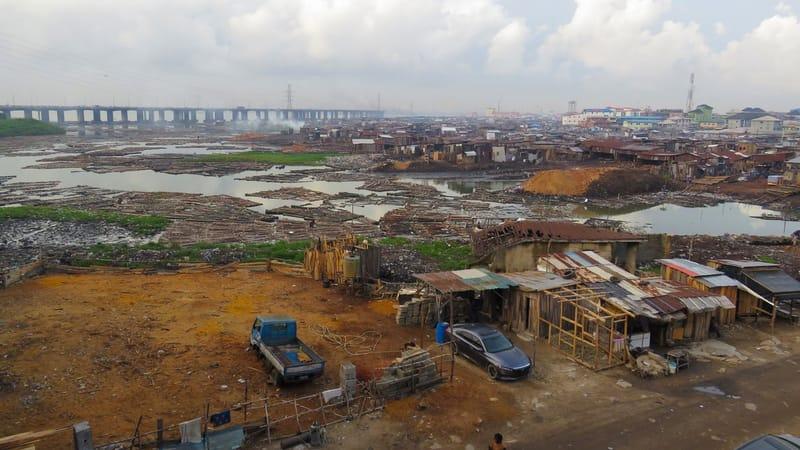
Some sinking is natural, but the researchers say much of it comes from human activity. One major cause they name is pumping too much water out of the ground, which lets the soil compact. For Lagos, the BBC reports the study also points to land reclaimed from the sea for artificial islands and buildings put up on loose ground.
That links the research to an argument Lagos is already having. In a statement reported by Nairametrics on 7 November 2026, Environment and Water Resources Commissioner Tokunbo Wahab denied that the state had introduced a new borehole tax and said it was enforcing existing permit rules for borehole drilling and groundwater abstraction. The state lists mitigating land subsidence among the reasons, alongside preventing contamination. The state says the rules are backed by Section 312 of the Lagos State Environmental Management and Protection Law 2017, and the Lagos State Water Regulatory Commission (LASWARCO) has warned it will seal facilities operating without permits and prosecute offenders. The coverage TheRadar opened gives no fee and does not spell out how the rules apply to an ordinary household borehole as opposed to a commercial driller.
What the study does not tell you
The numbers are averages for each city. The coverage TheRadar opened does not name which Lagos districts are sinking fastest, and TheRadar could not open the full paper to check. Dasho told Carbon Brief the flood model "assumes no coastal defenses, so the estimates are a worst-case physical picture". The population and building data are fixed at 2020 levels, so the exposure figures could be too high if people leave risky areas, or too low if the city keeps growing into them.
Senior author Manoochehr Shirzaei told the BBC the human causes are usually "extremely local", which he said means they can be tackled with local policies, from other sources of water to flood defences and moving key infrastructure to higher ground. TheRadar did not find a response to the study from the Lagos State Government by the time of publishing.
The short version: Lagos is not about to disappear, but a careful satellite measurement says the ground under it is dropping by millimetres every year, and that adds up over the life of a house or a mortgage. How the state handles groundwater, sand-filling and drainage will shape how much of that risk turns into water in people's homes.
Also read: El Niño is near record strength. What NiMet has said about Nigeria's dry season
Also read: What a self-contain or mini flat costs to rent in Lagos now, and what the law says about fees
Has your street in Lagos started flooding more than it did five years ago? Tell us where in the comments.