
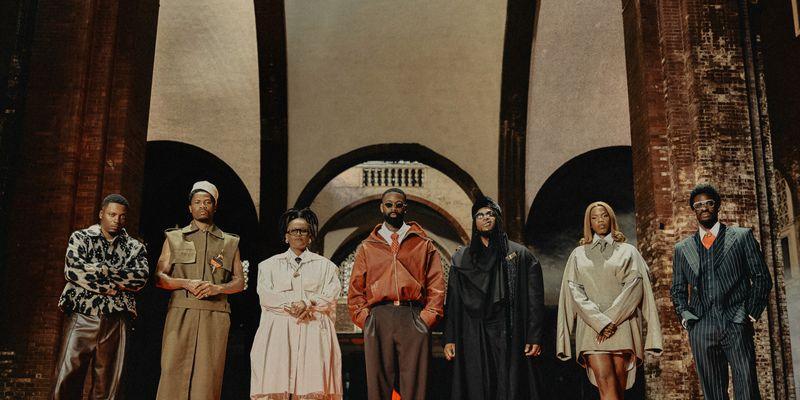
• Sarz produced the shared beat for Hennessy Cypher 2026, released on August 7. Six artists from across Africa and the diaspora used it to deliver their own verses.
• The line-up reaches from Nigeria and the UK to Kenya, Ghana, Côte d’Ivoire, Cameroon and South Africa. It is the first Cypher edition to place two Francophone African artists together.
• The video was made in Johannesburg, but the story is bigger than its set. A Nigerian producer is holding together different accents, rap traditions and ideas of what African hip-hop can be.
Hennessy Cypher 2026 gives Sarz a different kind of spotlight: not as the loudest voice in the room, but as the Nigerian producer who built the room’s common language.
Seven figures stand inside a grand Johannesburg set, dressed like they have come from different music worlds because they have. There are six artists—Yanga Chief from South Africa, Kwesi Arthur from Ghana, Fena Gitu from Kenya, Suspect 95 from Côte d’Ivoire, Tenor from Cameroon and British-Nigerian rapper ENNY—alongside Sarz, the Nigerian producer who made the beat under all of them.
The video arrived on August 7, marking 15 years of Hennessy Cypher, the rap showcase that began in Nigeria in 2011. Its obvious story is that an international line-up has gathered in one place. Its more interesting story is the person tasked with making that gathering sound like a record rather than a group project.
Sarz had to make room, not take it
A cypher is supposed to make difference audible. Every rapper comes to the same beat with their own accent, reference points, tempo and relationship to a bar. The producer’s job is not to flatten that into one generic “African sound.” It is to make enough room for everybody to land.
That is what Sarz’s production does here. Billboard Africa confirms that he helmed the 2026 edition, while OkayAfrica reports that the beat draws from Michael Jackson’s “Liberian Girl” and folds in amapiano-leaning log drums. The result has groove, but it never asks the MCs to abandon rap’s rough edges.
Sarz told OkayAfrica he was looking for the middle ground: something rooted in hip-hop but still alive to the rhythms African listeners move to. It is a useful description of the Cypher itself. Nobody sounds like a visitor on someone else’s record.
That is a different kind of Nigerian pop-cultural power. Sarz is not there to make the project Nigerian. He is there to give it a centre that can hold everyone else.
The line-up makes its own map
The 2026 cast does not read like a feature list built around the biggest streaming names. It reads like a map of different rap traditions.
ENNY brings a British-Nigerian spoken-word sharpness. Kwesi Arthur carries Ghanaian rap’s ease with big references and direct social feeling. Fena Gitu moves between singer-songwriter poise and hard-edged lines; Yanga Chief supplies a South African rapper’s veteran calm; Suspect 95 and Tenor bring Côte d’Ivoire and Cameroon into the same frame.
For the first time in the Cypher’s history, two Francophone African artists appear in the same edition. That detail matters because pan-African music projects often say “Africa” while still treating English-speaking markets as the default setting. This one makes the language difference part of the music, not an obstacle to be edited out.
The project was filmed in Johannesburg, another reminder that African rap does not need one capital city to prove it has a centre. The centre can move with the collaboration.
Hennessy has changed the room, but not the argument
It would be easy to describe the Cypher as just another polished brand collaboration. Hennessy is the organiser, and some coverage of the project is partnered or sponsored. That is worth saying plainly.
But the 15-year history gives the format a deeper record than a campaign launch. The Cypher began in Nigeria in 2011, and past editions have pulled together artists including M.anifest, Sarkodie, Ladipoe, Zlatan and Blaqbonez. This year’s version keeps the old discipline: original verses, one beat and a chance to see what happens when artists cannot hide behind a long playlist rollout.
That format is especially useful now, when much of African music conversation is about whether Afrobeats can travel, whether amapiano has gone global or which market has the next big star. Rap asks a less tidy question: what happens when several markets arrive with their own histories and none has to be the host?
The producer is part of the story
Nigerian music has spent years exporting singers, hooks and dance records. The Cypher is a reminder that production can travel differently. A beat can become a meeting point, a testing ground and a little piece of cultural infrastructure.
That is why the Sarz story matters beyond one video. His job was to make a shared stage without making the people on it sound the same. The closer African rap gets to doing that well, the less it needs permission from any one country to call itself continental.
Also read: Ayra Starr made Starrgirl for the world. She did not leave Nigeria behind
Also read: AniWeCon brought Nigerian anime fans to Yaba. The next question is how the community grows
Which Nigerian producer would you trust with the next pan-African rap cypher? Tell us in the comments.
