
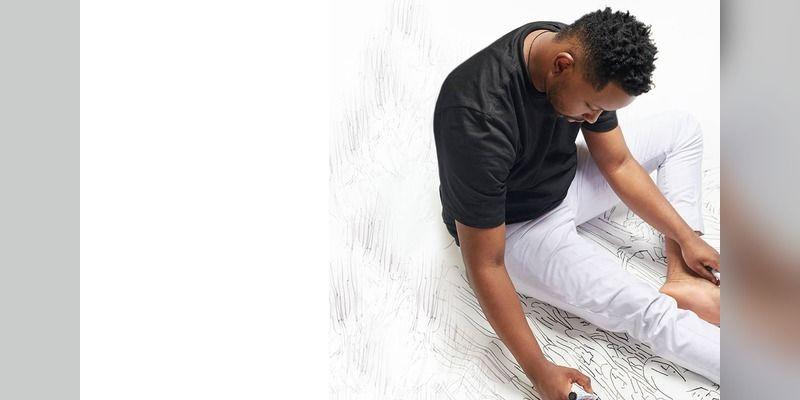
• Fola David has been named Festival Director for Lagos Arts & Health Festival 2026.
• The formal festival runs from August 27 to 30 under the theme Lagos as a Body – Creative Care in Action.
• Its reported activities include workshops, murals, performances, group-therapy sessions and community outreach.
Fola David has built a public identity between the clinic and the canvas. Lagos Arts & Health Festival is asking whether that space can do more than make a beautiful argument.
A city can carry stress in public. You hear it in traffic, see it in a long queue outside a clinic and feel it in the way people make jokes about exhaustion because saying they are exhausted feels too serious. Lagos Arts & Health Festival wants to place art inside that reality, not outside it as a poster on a wall.
Its choice of Festival Director makes the idea easy to understand. Dr Adefemi Gbadamosi, better known as Fola David, is a medical doctor and multidisciplinary visual artist whose record-breaking drawing made his work visible far beyond the usual art-world room. He is now being asked to direct an event built on a harder proposition: creativity can be part of how a city talks about care, wellbeing and public life.
The festival’s formal 2026 programme runs from August 27 to 30 under the theme Lagos as a Body – Creative Care in Action. That phrase could have stayed safely abstract. The reported activity list suggests the organisers are trying to make it practical.
What the festival says it will actually do
The Nation reports that the Lagos State Ministry of Tourism, Arts and Culture has endorsed the festival and that the four-day programme will combine exhibitions, workshops, performances, community activations, health programmes and interactive discussions. The event is intended to bring artists, healthcare professionals, researchers, educators, creatives and community stakeholders into the same conversation.
That is a wide room, which is both the opportunity and the risk. Festivals are good at gathering people who do not usually meet. They are less automatically good at producing something that lasts after the panels are packed away. The useful question is not whether art and health belong together. Lagos already shows they do. The useful question is whether the festival can connect that fact to real community work.
Reporting by Leadership points to the kinds of activity that could make the idea tangible: youth zine-making and poetry workshops, collaborative murals, group therapy, open-space sing-along and dance activations, and outreach to barracks, nursing homes and correctional facilities. The report describes a broader 24–30 August activation window, while the formal festival dates reported by The Nation are August 27–30. Anyone planning to attend should check the organiser’s current schedule as individual sessions are confirmed.
Why Fola David makes sense here
Fola David’s appointment is not just a celebrity booking. His public profile sits directly in the overlap the festival wants to explore. He has medical training, a visual-art practice and a record of taking a large art project into public conversation. That makes him a plausible guide for an event trying to prevent “creative health” from becoming a fashionable phrase with no local texture.
The festival’s own argument is that a city is a living body: it needs care, connection and room for people to process what happens to them. Art cannot replace hospitals, mental-health professionals, clean water or responsive public institutions. But it can make difficult conversations more accessible, make people feel seen, and create communal spaces that policy documents rarely manage to produce.
In Lagos, that does not have to be a borrowed idea. Music already carries grief, ambition and protest. Fashion creates public language around identity. Murals turn neglected walls into statements. Film helps people rehearse arguments about family, class and power. Street performance can make a neighbourhood pause. The festival is not inventing a link between creativity and wellbeing. It is trying to organise a link that already exists.
The partners matter as much as the poster
The Nation lists the Global Arts in Medicine Fellowship, The Foladavid Care Foundation, Studio Yadi, Ayo Ekunz Visuals Production and Uwana Energy as co-producers. Those names matter because a creative-health festival cannot be sustained by one charismatic director alone. It needs people who understand community practice, visual production, medical language, logistics and the unglamorous work of getting programmes beyond a central venue.
The Lagos State Ministry’s endorsement also gives the event a more public footing. Endorsement is not the same as funding, delivery or impact. But it signals that the arts-and-health conversation has moved close enough to official culture policy to be taken seriously. The test is whether that proximity produces more than a good opening ceremony.
For artists, there is another question beneath the health language. Creative work is often asked to prove social value for free. A mural, workshop or performance can be praised as community service while the artist is expected to accept exposure instead of fair pay. Leadership says the programme is intended in part to economically empower creative practitioners. That is a promise worth watching. Care for a city should include care for the people asked to make its creative life visible.
What a useful legacy would look like
Four days is enough time for a powerful performance, a moving conversation and a good photograph. It is not enough, on its own, to change a public-health system. A meaningful legacy would look more concrete: a community workshop that continues after the festival, a healthcare partner that keeps working with artists, a paid commission that reaches a neglected neighbourhood, or a programme that gives young people a language for stress before it becomes silence.
That is the standard the festival should invite people to hold it to. Not whether it can make Lagos look creative for a weekend, but whether it can make creative care feel useful after the lights go down.
Fola David gives LAHF a recognisable face. The programme will show whether it can build a recognisable practice too.
Also read: Can Men’s Fashion Week Nigeria turn Lagos style into a business for local designers?
Also read: Adidas put sneakers with Àṣọ Ẹbí. Now Nigerian wedding style is the campaign
Can art change how a city cares for itself, or does it need stronger institutions behind it? Join the conversation.
