
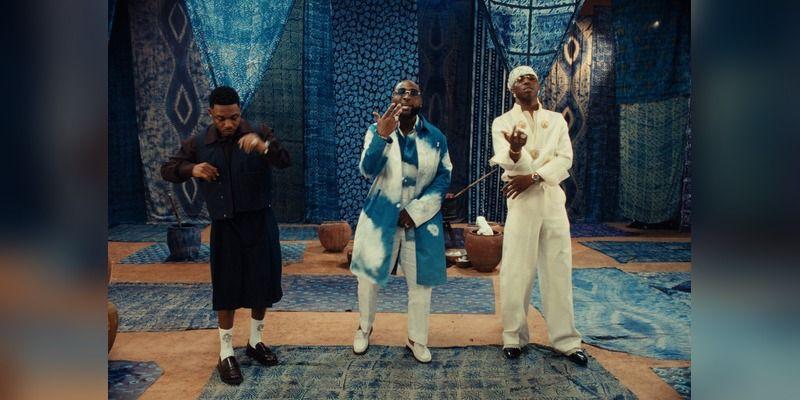
A big music video can borrow from a culture without letting that culture speak. Davido’s “B4 B4” does something more deliberate. It puts blue, indigo-dyed Àdìrẹ cloth in the middle of the frame and lets the fabric do part of the talking.
The new video brings Davido, Mayorkun and FOLA into a Lagos-built visual world of layered textiles, traditional accessories and styling that does not apologise for being local. It is a polished Afrobeats release, but it is also an argument about what Nigerian style can look like when it is not treated as a costume.
- “B4 B4” uses Àdìrẹ textiles, traditional styling and a Lagos setting as visual language, not just background decoration.
- Àdìrẹ—often written as Adire—is a Yoruba indigo-dye and resist-dye textile tradition. A global video can give people a closer look, but it does not automatically deliver money or credit to every maker behind the craft.
- The video arrives while the song is already travelling: Billboard recorded “B4 B4” at No. 6 on the U.S. Afrobeats Songs chart dated 15 August.
The important part is not that a famous artist wore blue. It is that a video with a large audience made room for an old visual language without trying to make it look foreign before it could look expensive.
Àdìrẹ is doing more than filling the background
Àdìrẹ is not one pattern and it is not simply “blue fabric.” Its name describes a Yoruba tradition of resist-dyeing cloth, with variations in motif, making and technique. In the “B4 B4” video, the textile appears in hanging panels, rugs and the colour world around the three artists.
That matters because the camera gives the cloth scale. Davido’s blue-and-white look sits against the textile setting rather than floating above it. Mayorkun, FOLA and Davido are placed inside a room that feels designed around fabric, texture and craft.
The visual choice is specific enough to notice without turning the song into a museum display. It is still a music video. The artists are still the focus. But Àdìrẹ is not left in the corner as a quick signal that the story is African.
The setting gives the song a home
The video was shot in Lagos by Nouvelle Films, according to current reporting on the release. That local setting helps explain why the imagery feels more grounded than a styling mood board pulled from the internet.
There are fila and kofi caps, clay vessels, indigo panels and a room where the colours feel lived in. The point is not to prove that every object comes from one place or one tradition. The point is that the video builds a recognisable Nigerian visual world around a song designed to travel far beyond Nigeria.
That kind of cultural movement is already part of a larger conversation. When EbonyLife Place London opened its doors to African stories, the bigger question was how Nigerian culture keeps its voice as it finds new rooms abroad. “B4 B4” asks a smaller version of the same question in three minutes: can a global-facing Afrobeats visual still feel like it knows where it came from?
The song gives the picture somewhere to go
The styling would have attracted attention on its own. The music gives it more distance.
Billboard reported that “B4 B4” entered at No. 6 on the U.S. Afrobeats Songs chart for the 15 August chart week, after 626,000 chart-eligible official streams in the United States during its opening tracking period. That does not mean a chart entry turns a fabric tradition into a fashion industry. It means the visual now has a larger audience than a local campaign would usually reach on day one.
That is the useful potential of a video like this. Someone can come for Davido, Mayorkun or FOLA and leave asking what the cloth is called. Another viewer can see the same blue-and-white styling and recognise something they grew up around. Both responses are more useful than treating Nigerian culture as a generic backdrop for export.
FOLA gets more than a guest verse
“B4 B4” also brings three artists at different points in their careers into the same frame. Davido has the scale and catalogue of a major Afrobeats star. Mayorkun has his own established pop lane. FOLA is still building the kind of recognition that changes a rising artist’s next move.
A feature on a song is one thing. A full visual treatment is another.
FOLA gets to appear inside the same high-production cultural world, not only as the newest face standing beside two bigger names. The video does not guarantee what happens next for him. It does give him a visual association with a song that is already finding an audience.
That is part of why music videos still matter. They can introduce an artist, a designer, a fabric or a city without needing a long explanation first.
Credit has to travel with the cloth
There is one limit worth keeping in view. Àdìrẹ does not need an Afrobeats video to become meaningful. Makers, traders, designers and wearers have kept the tradition alive long before this release.
A popular video can create curiosity. It cannot replace proper credit, fair sourcing or support for the people who make the work it borrows from. If more fashion houses, artists and stylists use Àdìrẹ because this video put it in front of them, the better question will be who gets named, paid and included in the next step.
For now, “B4 B4” has done something simple but useful: it has shown that Nigerian style does not need to be stripped of its history to look contemporary.
Also read: EbonyLife Place London opens in October as Mo Abudu bets on a permanent home for African stories
Also read: Wizkid will open Detty December Fest 2026 as organisers bet on emerging acts
Did “B4 B4” make you look at Àdìrẹ differently, or should Nigerian music videos go even further in crediting the people behind their visual culture? Tell us in the comments.
