
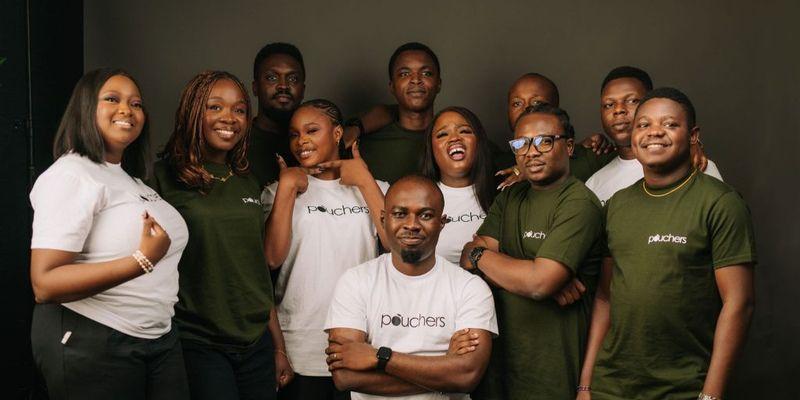
• Pouchers has raised US$500,000 in pre-seed funding. The round was led by Stack Directory LLC, with strategic angel participation.
• The startup has also left beta. Pouchers says the funding will help it expand the payments infrastructure behind its next stage.
• Its current pitch is simple. It offers stablecoin-powered payments and virtual dollar cards; foreign-currency accounts are planned, not yet a live feature.
Pouchers has raised fresh money for a problem many Nigerians who work online already know: being paid is often only the first step in getting paid properly.
The familiar sequence starts with a message from an overseas client: the transfer has been sent. Then comes the waiting, the exchange-rate maths, the search for a working card, and sometimes the uncomfortable call to somebody with a foreign account. For freelancers, remote workers, creators and small businesses whose money crosses borders before it becomes usable at home, the payment is rarely just a payment.
Pouchers has just placed a US$500,000 bet on that frustration. The stablecoin-powered payments startup announced a pre-seed round led by Stack Directory LLC, a Dubai-based internet investment company, and said it was leaving beta. Its announcement frames the moment as a chance to build faster for people whose work and money do not fit inside one currency or one country.
The raise is also an exit from beta
The funding is not merely a line on a startup deck. It marks the moment Pouchers says it is moving beyond the testing period that helped it learn how users receive, hold and spend money across borders.
Chief executive Ayo Adewuyi put the company’s case plainly in the announcement: Nigerians are already earning and doing business globally, and the financial infrastructure should make that easier rather than harder. The company says the US$500,000 will help it move into its next phase with more capacity to build and scale.
That is a useful distinction. The news is not that Nigerians suddenly need cross-border payment tools. They already do. The real question is whether a young product can make the existing patchwork of wallets, cards, bank accounts and informal favours feel less like a workaround.
The problem is bigger than receiving a transfer
A remote worker in Lagos can be paid by a company in London, buy an online tool priced in dollars and still need naira for the rest of the week. A creator can earn from an audience outside Nigeria while trying to pay for software, ads or subscriptions that do not recognise a local card. An importer may be solving a different version of the same headache when a supplier expects money to arrive across a border.
TheRadar recently examined that business-side pressure in its report on Clea’s effort to make foreign-supplier payments easier for Nigerian importers. Pouchers is chasing the smaller, more personal end of the same problem: people who live one payment, one card or one invoice at a time.
TechCabal’s report on the round says Pouchers currently gives users a digital-dollar wallet for USDT and USDC, alongside virtual dollar cards for global spending. The company’s own description is broader: it wants to make it easier to earn globally, keep money in a chosen currency and use it when needed.
That pitch lands because the audience is not abstract. It is the person who has stopped asking whether an international payment can arrive and started asking how many steps it will take before they can actually use it.
One product, several moving parts
Pouchers is trying to become one place for a cross-border money journey that many Nigerians now split between several services. The current offer combines stablecoin-powered payments with virtual dollar cards. The company says it is building for freelancers, remote workers, business owners and creators.
There is a temptation, whenever a startup bundles those tools together, to describe the solution as seamless before it has earned the word. Pouchers is still early. The funding itself is pre-seed, and the company has only just left beta.
But the direction is clear. Instead of presenting a card as the whole answer, Pouchers is pitching a connected route: receive, hold and spend. That is a more ambitious proposition than another virtual card app, because it puts the awkward middle of the payment journey at the centre of the product.
What is live and what is still coming
The details matter in a space where product language can race ahead of product availability. According to TechCabal, Pouchers’ existing wallet supports USDT and USDC, while its virtual dollar cards can be used for global spending. The same report says foreign-currency accounts are coming to the platform.
“Coming” is the important word. The accounts should be treated as an announced plan, not a feature users can already assume is available. It is a small point, but it is the difference between reporting what a company has built and repeating what it hopes to build next.
That caution does not weaken the story. It makes the US$500,000 more interesting. The money gives Pouchers room to expand its product and payments infrastructure; it does not make every cross-border friction disappear overnight.
The real competition is the workaround
Pouchers is entering a crowded financial-technology conversation, but it is not only competing with other apps. It is competing with the ways people have learned to improvise: several accounts, several cards, a trusted person abroad, a delayed transfer, a payment that arrives but cannot be spent where it needs to be spent.
That is why this raise matters beyond its size. Half a million dollars is modest beside the continent’s headline-grabbing funding rounds. For the remote worker waiting on a client payment, though, the important test is much closer to home: can one less workaround make global work feel a little more normal?
Pouchers has raised the money. Now it has to prove that the workaround can finally lose.
Also read: Clea wants to make it easier for Nigerian importers to pay foreign suppliers
Also read: Crypto tax is getting closer. What Nigerian traders must stop doing with their profit screenshots
Have you had to piece together different services to receive or spend money from abroad? Tell us what the real bottleneck is in the comments.
