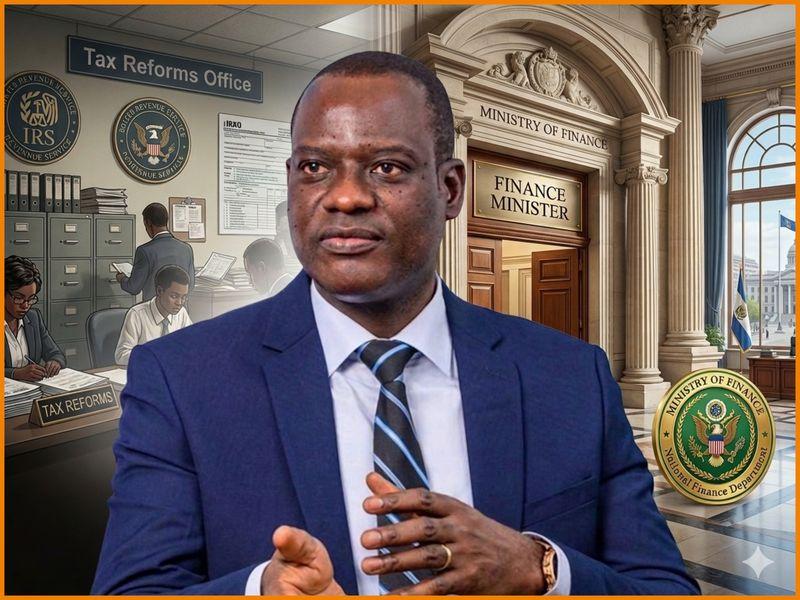
- Taiwo Oyedele rose quickly from tax reform leader to Nigeria’s Finance Minister within five weeks.
- His appointment reflects Bola Tinubu’s push for stronger fiscal reforms during economic uncertainty.
- He now faces the challenge of turning policy reforms into real improvements for Nigerians.
Depending on how you view life, the rapid ascent of Taiwo Oyedele from tax reform czar to Nigeria’s chief fiscal driver is either a story of mind-bending grace or a culmination of years of technical competence, policy influence, and strategic positioning.
In a space of barely five weeks, Oyedele moved from being a tax reform enforcer to being sworn in as a Minister of State for Finance on March 16, 2026, then to assuming office as a substantive Minister of Finance and Coordinating Minister of the Economy on April 21, 2026, following a cabinet reshuffle by President Bola Tinubu that replaced his predecessor, Wale Edun.
For many with eyes and ears in the corridors of Tinubu’s administration, this was not a surprise but for the average Nigerian who relies on ITK tweets and newspaper exclusives, this was not foreseen few months ago.
The swift elevation did not occur in a vacuum. Some have said that it reflects both the administration’s recalibration of its economic team and the growing weight of fiscal reform within Nigeria’s policy agenda. Analysts have further noted that the reshuffle came at a time of persistent macroeconomic strain, marked by inflationary pressure, currency instability, and the social consequences of subsidy and exchange rate reforms, requiring a more technocratic grip on fiscal management.
A section of Nigerians will argue that Nigeria has always been in perpetual macroeconomic strain, inflationary pressure and currency instability, therefore, Oyedele’s appointment should not be perceived as messianic. Particularly, how did he move from a committee man to the country’s finance man in a few months?
From tax reform architect to fiscal helmsman
Before entering government, Oyedele had already carved out a reputation as one of Nigeria’s leading tax policy experts. A former Fiscal Policy Partner and Africa Tax Leader at PwC, he spent over two decades advising governments and corporations on taxation, economic strategy, and public finance. His transition into public office began with his appointment as chairman of the Presidential Committee on Fiscal Policy and Tax Reforms in 2023, where he led efforts to simplify Nigeria’s notoriously complex tax system—cutting layers of overlapping taxes and pushing for a more coherent, business-friendly framework.
This reformist profile made him a natural fit for a government seeking to expand revenue without overburdening citizens. Nigeria’s tax-to-GDP ratio, which is one of the lowest globally, has long constrained fiscal space and driven reliance on borrowing. Oyedele’s work aimed to reverse that trend by broadening the tax base, improving compliance, and introducing transparency into revenue administration.
Taiwo Oyedele: The making of a technocrat
Born on June 18, 1975, in Ikare-Akoko, Ondo State, Oyedele’s trajectory reflects a blend of academic discipline and professional depth. He holds a Higher National Diploma from Yaba College of Technology and a degree in Applied Accounting from Oxford Brookes University, complemented by executive training at institutions such as the London School of Economics and Harvard Kennedy School.
Beyond credentials, his influence has extended across policy and institutional platforms, ranging from the Nigerian Economic Summit Group to professional bodies like ICAN and CITN. This places him at the intersection of academia, private sector expertise, and public policy. This hybrid experience has shaped his reputation as a “policy translator,” someone capable of turning complex fiscal ideas into actionable governance frameworks.
Why Oyedele’s elevation was predictable
For close observers of Nigeria’s economic policy space, Oyedele’s promotion was hardly surprising. His visibility increased significantly during the tax reform process, where he became the public face of efforts to modernise fiscal governance. His appointment signalled continuity rather than disruption, a deliberate choice by the President Tinubu administration to deepen, not abandon, his much-vaunted reform agenda.
Indeed, in his early remarks as Finance Minister, Oyedele emphasised policy consistency, warning that reversals could undermine investor confidence. He framed Nigeria’s next phase as one of “execution,” where the success of reforms would depend on measurable outcomes rather than policy announcements.
He also identified four priorities for driving investment in the next phase: policy consistency, predictability across fiscal and regulatory frameworks, reduction in the cost of doing business, and improved access to capital.
The challenges ahead for Finance Minister Oyedele
If his rise has been swift, the road ahead is far more complex. Oyedele inherits an economy that has shown signs of stabilisation but remains fragile. Inflation, though moderating, continues to erode purchasing power; poverty levels remain high; and public debt sustainability is a recurring concern.
His immediate task is to convert macroeconomic gains into tangible improvements in living standards, a challenge that has eluded previous administrations and is proving slippery for the present one. This involves tightening fiscal discipline, improving the efficiency of capital expenditure, and ensuring that tax reforms do not translate into additional hardship for already strained households.
At the same time, he must navigate political realities, including mounting expectations ahead of future elections and the delicate balance between reform and public acceptance. His success will likely depend on how effectively he aligns fiscal policy with broader economic priorities—particularly job creation, productivity growth, and social protection.
Grace for results
The expectations are clear for Oyedele. Experts have pointed out that he must stabilise the economy, deepen reforms, and ultimately deliver results that the poor Nigerian can feel.
His journey from tax committee meetings to the federal executive council in a matter of weeks is inspiring to both the neutral and the faithful, but now he must translate that grace and pedigree into measurable national outcomes.
Oyedele admits errors in Nigeria’s new tax laws, promises urgent fix
In an earlier report by TheRadar, Taiwo Oyedele, who was a Minister of State for Finance at the time, admitted that Nigeria’s newly introduced tax reform laws contained errors and assured stakeholders that the government was already taking steps to correct them.
Oyedele disclosed this during a fireside chat at the 2026 annual conference of the Nigerian Bar Association (NBA) Section on Legal Practice.