
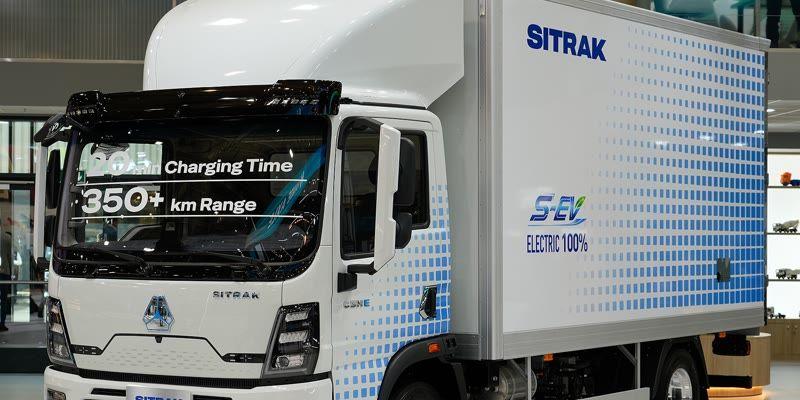
• Dangote Sinotruk West Africa, the truck-assembly joint venture between Dangote Group and China's Sinotruk, unveiled an electric 4x2 cargo truck at its plant in Ikeja, Lagos, on Sunday 15 November, describing it as Nigeria's first locally assembled electric heavy-duty truck.
• The figures released so far are a 100 kWh battery, a 95 kW motor, a 200 km driving range and a 400 kW fast charger shown alongside it, and the company says the electric model will be sold next to its existing range of heavy-duty trucks, tippers, light trucks, pickups and buses.
• No price, production volume or sales date has been announced, and the company's own case for lower running costs depends on electricity prices and charging infrastructure in a country reported to have had about 48 public charging stations at the end of 2025, so the unveiling is not evidence that haulage in Nigeria will become cheaper.
At a loading bay in Apapa, the cost of moving a container is worked out in litres before it is worked out in kilometres. When diesel moves, the price of everything on the back of the truck tends to follow it into the market.
That is the backdrop to Sunday's unveiling in Ikeja. According to Daily Trust's report on the rollout, Dangote Sinotruk presented a battery-electric cargo truck assembled at its Lagos plant, the first electric model in a line-up that until now has been heavy-duty trucks, tippers, light trucks, pickups and buses. Senior figures from both groups and the Lagos State Government attended, alongside customers and business partners.
What came off the line
The published specification is short: a 4x2 layout, a 100 kWh battery, a 95 kW high-efficiency motor, a 200 km driving range and a large cargo box. The truck was shown with a 400 kW ultra-high-power DC fast charger with dual-gun output.
A 200 km range suits deliveries within a city or between nearby towns rather than the long interstate runs that carry much of the country's freight. The company has not said what payload the truck is rated for, which is the figure fleet owners will ask about first, nor how long a full charge takes on the charger it displayed. The "heavy-duty" description is the company's own; on TheRadar's reading, a 4x2 truck with a 100 kWh pack sits closer to what is usually called a medium or urban cargo truck.
A plant built for diesel, now trying batteries
The venture is not new. Daily Trust reports that the partnership began in 2010, after Dangote evaluated several Chinese truck makers, and that the joint venture was set up in 2014. Its first heavy truck came off the line in 2017, a welding and e-coating paint line was added in 2024, and the plant says it has assembled more than 8,000 vehicles locally. In January 2017, a Dangote Group statement reported by Nairametrics put the plant's investment at $100 million and its capacity at 10,000 trucks a year, with 3,000 direct jobs expected once it was fully running.
Devakumar Edwin, Group Vice-President of Dangote Industries, told the audience: "This is more than a launch of new vehicles." He said the group had moved into compressed natural gas (CNG) first and was now moving into electric technology, while the Federal Government promotes CNG and other alternative-energy options. Dangote Refinery said in June 2025 that it had invested more than ₦720 billion in 4,000 CNG-powered trucks for fuel distribution and in nationwide CNG stations to run them. Liu Wei, president of Sinotruk Group, was reported as calling the Lagos truck the first new-energy truck assembled on the African continent, a claim the coverage does not test. It is not the first Sinotruk-brand electric truck launched in Nigeria: a separate firm, Nigerian Sinotrucks Limited, described in those reports as a government-recognised vehicle assembler, was reported on 28 October to have introduced Sitrak electric trucks aimed at consumer-goods distributors, though the reports do not say whether the trucks are assembled locally. Aliko Dangote is not quoted in the reports of the event.
The savings depend on the grid
Edwin was careful on costs. As Blueprint reported his remarks, electric trucks offer "the potential for lowering the operating cost and reducing the tailpipe emissions", depending on how they are used, what electricity costs and whether charging infrastructure exists. He added that adoption "will also require reliable charging facilities, technical expertise" and spare parts, and said the company was setting up an after-sales team, without giving locations or costs.
That condition is the whole story for Nigerian operators. A Reuters report in August cited a policy brief counting about 48 public charging stations in Nigeria as of late 2025, mostly in Lagos and Abuja, against more than 500 in South Africa, with the national Energy Transition Plan projecting about 60 by 2030. The same report noted that a grid of about 4,000 megawatts serves more than 200 million people, so many chargers fall back on diesel or petrol generators when the power goes. A charger fed by a generator still burns fuel, which is exactly the cost an electric truck is meant to cut.
Policy is moving in the trucks' favour on paper. Reuters reported that electric vehicles were exempted from VAT in 2024, that import duty on them was cut from 5% to zero this year, and that tax waivers were approved for nearly 4,000 EVs in the first half of 2026. Those incentives lower the cost of buying an electric vehicle; they do nothing on their own about the cost or reliability of the power needed to run one.
What buyers still cannot see
There is no price list, no order book and no delivery date. Olasunkanmi Ojowuro, managing director of Lagos Bus Services, spoke for the Lagos Commissioner for Transportation, Oluwaseun Osiyemi, and described the rollout as "a defining moment for Nigeria's industrial and transportation sectors", but no fleet or government purchase was announced.
For now the truck is a statement of intent: proof that an electric commercial vehicle can be put together in Ikeja, while the harder question of whether it can be run more cheaply on Nigerian roads waits for numbers.
Also read: Dangote Group's new facility set to boost Nigeria's industrial growth Also read: CNG witnesses dramatic growth in Nigeria after establishment of additional 149 conversion centres
If you run or rely on delivery trucks, what would an electric model need to cost, and where would it need to charge, before you switched? Tell us in the comments.
