
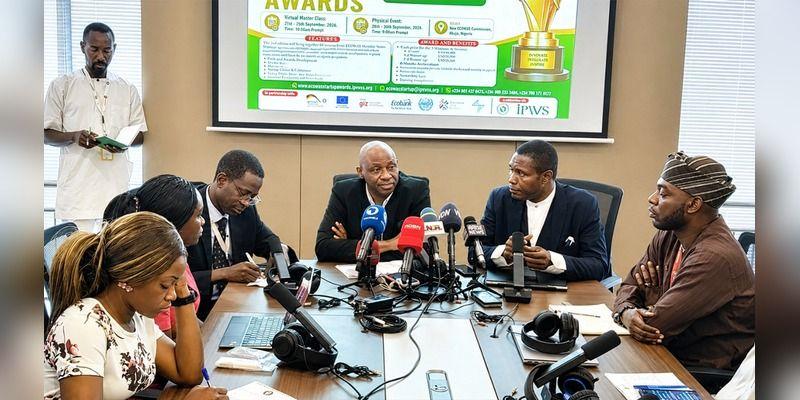
• The application deadline is August 31. The Awards are open to startups across ECOWAS, not only Nigerian companies, and the regional final is planned for Abuja on September 30.
• The US$65,000 is split between three winners. The overall winner gets US$30,000, followed by US$20,000 and US$15,000 for the two runners-up.
• A good idea is not enough. Applicants need at least two years of operations, a working product, proof of traction or scale potential, and a detailed application pack.
ECOWAS has put US$65,000 on the table for West African startups. The harder question is whether a founder has enough proof to get through the door before August 31.
At a press briefing in Abuja last week, ECOWAS Commission Acting Director for Private Sector and Industry Peter Oluonye said the programme was not meant to be a quick cheque handed to a winner and forgotten. The aim, he said, is to help promising companies grow into businesses that can create jobs, build markets and connect across borders. The Guardian Nigeria reported the briefing.
That is the context behind the second ECOWAS Startup Awards. The prize money will pull attention, as it should. But the official application portal makes the real filter clear: this is for startups that can show they already exist, already work and may be ready for a bigger regional conversation.
The money is real, but it is not for every applicant
The total prize pool is US$65,000. The overall winner receives US$30,000; the first runner-up gets US$20,000; the second runner-up takes US$15,000.
That is substantial money for a young company. It can pay for product work, customer testing, compliance, a small team or a longer runway than a founder can usually buy from personal savings. But it is an award for the top three companies, not a grant automatically shared among the startups that apply.
The official programme also promises a six-month acceleration and mentorship package, investor introductions through deal rooms, networking, regional visibility and digital tools. Those benefits matter because US$30,000 does not solve every hard part of scaling in West Africa. A strong product can still struggle to meet a customer in another country, find a reliable partner or understand a new market.
The value of the Awards, then, is not only the cheque. It is whether ECOWAS can turn a three-day Abuja event into useful links between companies, investors and markets that rarely sit in the same room.
The entry rules are asking for proof
The deadline is 31 August 2026, but the form is not built for a founder with a broad idea and no evidence behind it.
Applicants must be citizens of an ECOWAS member state and run a startup registered and based in an ECOWAS country. The company must have operated for at least two years, offer a working product or service and show market traction or the potential to scale.
That language narrows the field. A student with a fresh concept may have a promising future, but this particular programme is looking for a business that has survived the first difficult stretch: the point where an idea becomes a product, a product meets a customer and the team has something real to learn from.
The six sectors are also defined: EdTech and skills development, FinTech, HealthTech, AgriTech and food systems, CleanTech and green innovation, and tourism, hospitality and TravelTech. A startup operating outside those areas should read the scope carefully before spending a weekend on an application that is unlikely to fit.
The paperwork tells its own story
The portal asks applicants to complete ten sections and upload more than a short pitch deck. It requires founder identification, a recent passport photograph, business-registration material where applicable, two years of financial statements, management accounts or projections, a business plan of no more than ten pages, a deck of no more than ten slides and a one-minute pitch video.
That list can feel heavy. It is also a clue about the kind of company the judges expect to see.
ECOWAS is not only asking who has the brightest pitch. Its published scoring gives 20 per cent each to problem-and-solution fit and innovation, then weighs team execution, market potential, business viability, impact and alignment with regional priorities. The pitch itself, online voting and data integrity account for just five per cent.
In plain terms, the video will matter. But it will not carry a business that cannot explain its customers, numbers or next step.
Abuja comes after a regional filter
The programme expects 60 startups across the 12 ECOWAS member states. Half of each country’s allocated slots will come through national nominations, while the other half will be filled from public applications.
That matters for founders who may assume they need a government invitation to be considered. They do not. The public application route is real. It is also competitive.
The selected startups will take part in virtual masterclasses and startup clinics from September 21 to 25. The physical programme—pitch competitions, exhibitions and investor deal rooms—runs in Abuja from September 28 to 30, with the regional final set for September 30.
A founder who makes that stage will be joining more than a competition. It is an attempt at a regional marketplace, where a Nigerian health-tech company may need a Ghanaian distribution partner, a Senegalese agri-tech company may need a new customer, and an investor may need proof that a product travels.
The question is whether the company is ready now
The most useful way to read the Awards is not as another link to forward in a founders’ WhatsApp group. It is as a test of readiness.
Can the company explain its problem in one clear sentence? Does it have a product someone can use? Can it show what has happened in the two years since it started? Is there a believable path from its home market to another ECOWAS country?
Those questions are bigger than one competition. They sit at the centre of why many promising Nigerian startups remain stuck between a first product and a scalable business. TheRadar has already asked why Nigeria’s Startup Act has not yet made life easier for every founder. Programmes such as this cannot fix the policy gaps. They can show which companies are prepared to move when an opportunity appears.
A regional stage is only useful if it leads somewhere
There is a tendency to treat every conference badge, pitch stage and prize announcement as proof that a startup has arrived. It is not. The work starts again after the photograph, the panel and the applause.
Still, a programme that forces founders to put their financials, product, story and ambition in one place can have value before anyone wins. For the best applicants, the 31 August deadline is less about chasing US$30,000 than testing whether their company can make a case beyond its own city.
That is the regional opportunity ECOWAS is trying to buy: not simply three winners, but more West African businesses that are ready when the next market opens.
Also read: Nigeria’s Startup Act is supposed to help founders. Why are they still waiting?
Also read: What founders should do before GITEX Nigeria opens on August 31
Does your startup have the proof this application asks for—or does the deadline show what still needs work? Tell us in the comments.
