
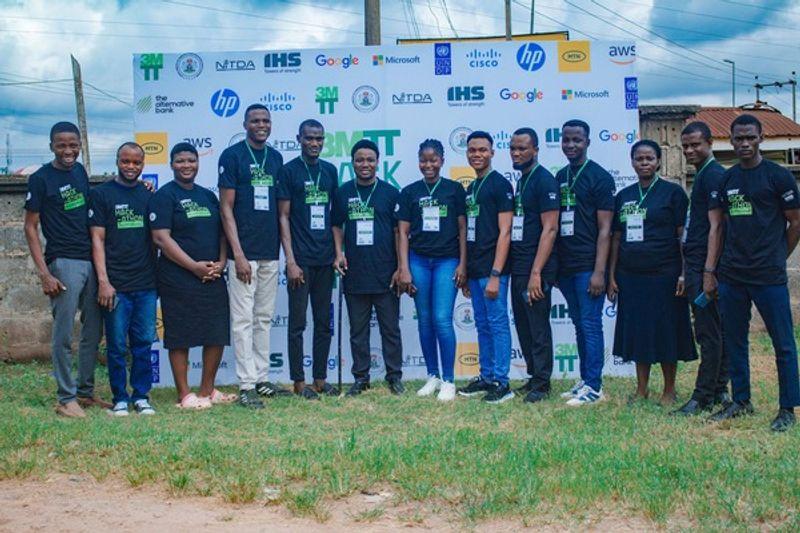
- 3MTT says it has trained more than 135,000 Nigerians, but its reported 15,000 figure is for job and opportunity pathways—not a published count of jobs accepted.
- Training can give someone a skill. It cannot, by itself, make an employer trust a first-time candidate with a salary, a deadline and a customer problem.
- The real test of Nigeria’s digital-skills push is whether fellows can turn course completion into proof of work, interviews and paid outcomes.
There is a painful moment many 3MTT fellows will recognise.
You finish the training. You pass the assessment. You add the certificate to LinkedIn. Your family asks when the tech money will start arriving. Then you open your email and meet the same silence that has been frustrating Nigerian job seekers since before anybody knew what a prompt engineer was.
That silence does not mean the training was useless.
It means a certificate and a job offer are not the same product.
Nigeria’s 3 Million Technical Talent programme has done something serious. In February, Communications, Innovation and Digital Economy Minister Bosun Tijani said the pilot had trained more than 135,000 Nigerians across three cohorts, with learning extended to more than 300,000 people through community resources. He also said the programme had contributed to 15,000 job and opportunity pathways. His update is here.
That is progress. But it is also the point where we need to read the sentence properly.
A pathway is not automatically a payroll.
A pathway can be a recruiter meeting, a career fair, a job lead, a certification voucher, a portfolio review, a paid trial, a mentor who introduces you to someone useful or a client who says, “Send me your work.” Those things matter. They are just not the same as waking up on the first day of the month to a credit alert.
The number is not the whole story
The most unserious way to discuss 3MTT is to look at 135,000 people and ask, “Where are 135,000 jobs?” as if a training programme is a job vending machine.
The other unserious way is to announce the training number and stop there.
Both sides dodge the real work.
The official 3MTT site describes the programme as a talent pipeline, built with fellows, training providers, partners and placement organisations. That language matters. Training is one system. Placement is another. Employer demand is another. A person can be technically ready and still lose a role because the company wants three years of experience, someone referred by an insider or proof that the person has already solved the exact problem before.
That is why a young Nigerian can complete data analysis training, know Excel and still hear, “Do you have a dashboard you built for a real business?” A UI/UX fellow can understand Figma and still be asked to show a case study with research, decisions, feedback and iteration. A software-development fellow can know the syntax and still be rejected because the hiring team cannot see a live project, a GitHub trail or evidence that the person can work inside a team.
The gap is not always intelligence. It is evidence.
That is the part people miss when they reduce the conversation to “learn tech and escape poverty.” Companies do not hire a course outline. They hire someone they believe can lower risk, finish work and make the team stronger.
The course ends before the hard work starts
3MTT’s first skills focus includes software development, data analytics, AI and machine learning, UI/UX design, cybersecurity, cloud computing, product management, DevOps and quality assurance. These are not fake skills. Nigerian businesses and global employers need people who can do this work. The official programme overview is here.
But the market does not pay people because the skill is fashionable. It pays for a result.
A data analyst needs to show that they can turn messy sales numbers into a decision somebody can use. A cybersecurity beginner needs to explain what problem they identified, what they would protect and what they would do after an incident. A product manager needs to prove that they can hear a user problem without writing “AI-powered ecosystem” in every sentence.
That is why TheRadar’s guide to tech skills that can pay more than an entry-level bank job should not be read like a menu of shortcuts. The skills can open doors. But the portfolio is what gives the person behind the door a reason to listen.
A certificate says, “I attended.”
A portfolio says, “Here is what I can do when the work gets confusing.”
The second one travels farther.
Training has to meet the employer in the middle
The government is not pretending that a classroom alone completes the job. In July 2025, the 3MTT programme and Microsoft held a Career & Employability Fair in Lagos, connecting trained talent with recruiters for interviews, networking and career workshops. The partnership has also included certification vouchers and LinkedIn Premium accounts. FMCIDE’s account of that effort is here.
That is the right direction because the difficult part is not only teaching somebody how to use a tool. It is building the bridge from “I learned this” to “an employer can see the value of hiring me.”
But career fairs cannot carry the whole burden either. A room full of recruiters is useful only when the candidates in it are prepared and the employers have real openings, not just branded backdrops and panel conversations.
The next version of the digital-talent story has to include more of the unglamorous work: supervised projects with real businesses, apprenticeships, entry-level contracts, job-shadowing, public case studies, mock interviews run by people who actually hire, and alumni communities that keep opening doors after the closing ceremony.
This is where placement organisations become more than a line on a website. They become the people who can translate talent into work.
The fellow also has a job after the programme
There is another truth that will annoy people because it is less dramatic than blaming government.
A 3MTT fellow cannot finish training and wait for opportunity to locate them by spiritual GPS.
The first job is often not the dream job. It may be a small freelance task, an unpaid but tightly scoped project for a legitimate organisation, a volunteer role with clear permission to use the work in a case study, an internship or a personal product that solves a boring local problem well.
The point is not to celebrate free labour. The point is to build proof quickly and be selective about what work is worth doing for that proof.
If you are a UI/UX fellow, redesign a painful local service and explain the research behind the decisions. If you are in data, take a public dataset and build a dashboard that answers a question a real business owner would ask. If you are in software, deploy something small, useful and functional. If you are in cybersecurity, document a safe lab project that shows how you think through risk.
Then stop hiding the work in a folder called “final final 2.” Put it where somebody can find it.
A polished LinkedIn profile, targeted applications and better interview practice will not replace experience, but they make the experience you do have easier to see. That is why TheRadar’s guide to using AI to land jobs faster is useful when treated as a tool, not a magic wand. AI can help tailor a CV, find openings and prepare for a question. It cannot attend the interview, show your judgement or manufacture a portfolio you never built.
The real scorecard is paid work, not graduation photos
Nigeria needs programmes like 3MTT. The country cannot build a digital economy with a tiny circle of people who had the money, location or connections to learn technical skills early.
Training 135,000 people is a meaningful start. Creating pathways into work is better than acting as if pathways do not matter.
But the programme’s next chapter has to be measured with more courage.
How many fellows got paid internships? How many got full-time roles? How many won remote contracts? How many earned their first client? How long did it take? Which skills converted fastest? Which states and groups are being left behind? What did the employers say they still could not find?
Those are not hostile questions. They are how a serious talent programme becomes more useful.
A Nigeria where young people can collect thousands of certificates but cannot show a recruiter one piece of credible work is not a talent pipeline. It is a waiting room.
3MTT has helped more Nigerians get to the door. The harder job now is making sure more of them get through it.
Also read: 6 tech skills that pay more than an entry-level bank job in Nigeria
Also read: How Nigerians are using AI to land jobs faster in 2026
Is Nigeria training young people for the future, or leaving them to figure out the work part alone? Drop your take in the comments below.
