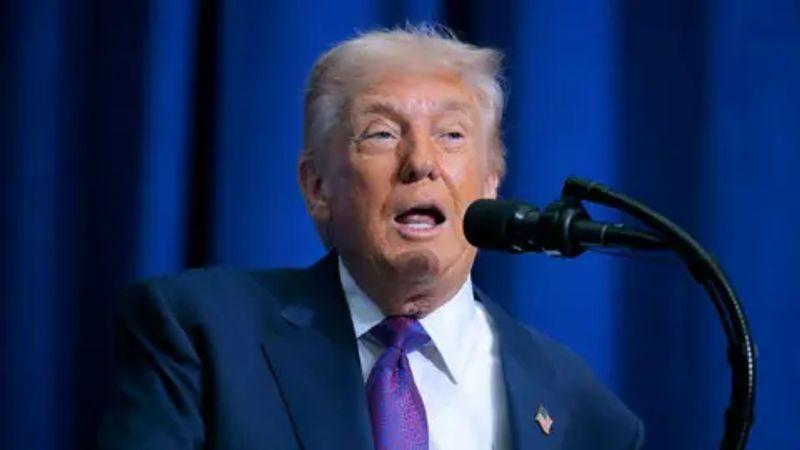
- President Donald Trump urged Latin American nations to deploy military force against drug cartels and offered U.S. missile support for precision strikes on narco kingpins
- He launched a 17-nation “counter cartel” coalition aimed at using “hard power” to combat security threats across the region
- Trump warned that Cuba was nearing collapse, stating, “Cuba’s in its last moments of life,” and pledged to “take care of Cuba”
The United States President, Donald Trump, has urged the Latin American nations to deploy military force against drug cartels and even offered support through U.S. missile strikes aimed at narcotics kingpins.
Trump, who is also pursuing a hardline stance toward Iran, presented a forceful vision of U.S. influence in the Western Hemisphere.
He described Cuba as being “in its last moments of life” and called for tough measures from regional allies to combat organized crime.
The president officially announced the formation of a 17-nation “counter cartel” alliance, which the The White House described as a commitment by participating governments to employ “hard power” against security challenges.
“We’re working with you to do whatever we have to do. We’ll use missiles. You want us to use a missile? They’re extremely accurate,” Trump told leaders from a dozen right-wing governments in Latin America and the Caribbean during a summit at his golf club in Miami.
“‘Piu,’ right into the living room,” he said, mimicking the imagined sound of a missile strike. “That’s the end of that cartel person. But we’ll do whatever you need.”
Trump has previously advanced assertive policies in the region, supporting the removal of Nicolas Maduro and collaborating with interim authorities, including Delcy Rodriguez, to pursue control over Venezuelan oil resources.
Among attendees at the “Shield of the Americas” summit were Javier Milei of Argentina, Daniel Noboa of Ecuador, and Nayib Bukele of El Salvador.
Bukele’s security crackdown has been cited by many regional governments as a potential model for combating organized crime.
According to analyst Irene Mia of the International Institute for Strategic Studies, right-wing leaders share growing concerns about the expansion of drug cartels into countries once considered relatively safe, such as Chile.
Mia noted that the rising security crisis has helped bolster conservative political movements in Latin America, reducing traditional opposition to U.S. involvement in regional security affairs.
Trump reiterated his belief that military action is necessary to defeat criminal organisations, comparing cartels to a cancer: “We don’t want it spreading.”
“The only way to defeat these enemies is by unleashing the power of our militaries. We have to use our military,” he declared.
He also issued renewed warnings about Cuba, suggesting that further action could be taken against the communist government.
“I’ll take care of Cuba,” Trump told the assembled leaders.
“They have no money, they have no oil. They have a bad philosophy, they have a bad regime that’s been bad for a long time,” he said, adding, “Cuba’s in its last moments of life.”
The comments followed recent U.S. and Israeli military operations against Iran, which triggered regional tensions and disrupted global energy markets.
Meanwhile, the United States and Ecuador announced joint efforts to combat drug trafficking. Both governments released footage of an airstrike targeting a house in a forested area, describing it as a successful operation against “narcoterrorists.”
In addition to leaders from Argentina, Ecuador, and El Salvador, Trump hosted representatives from Bolivia, Costa Rica, the Dominican Republic, Guyana, Honduras, Panama, Paraguay, and Trinidad and Tobago, as well as Chile’s president-elect.
Mia highlighted notable absences, including Mexico and Brazil, led by Claudia Sheinbaum and Luiz Inacio Lula da Silva respectively.
“Without Mexico and Brazil, it’s not going to be very successful in tackling those issues,” she observed, citing the importance of Mexican cartels in global trafficking networks and Brazil’s role as a key transit route for narcotics heading to Europe.