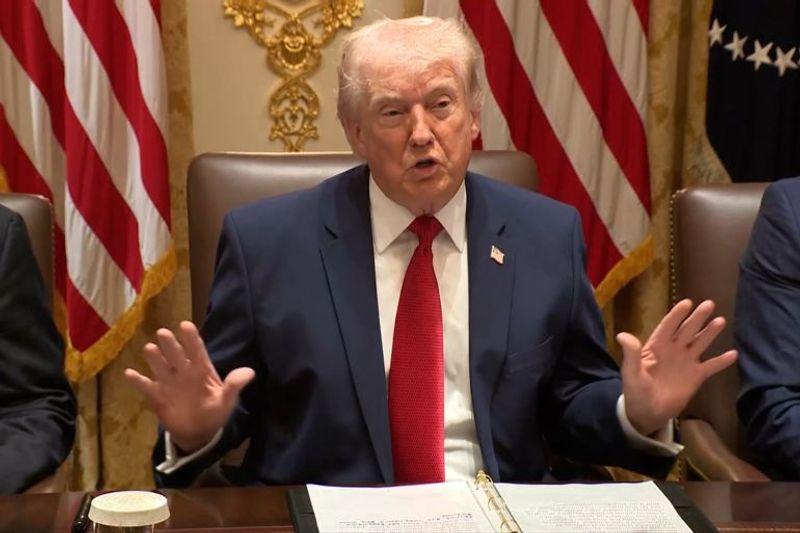
- US president Donald Trump has signed two major executive orders targeting foreign-made pharmaceuticals and imported metals
- The administration will impose a 100 percent tariff on patented medicines produced outside the United States
- The move is designed to pressure global pharmaceutical companies to shift production to US soil or negotiate favourable trade agreements
The United States President, Donald Trump, has announced sweeping new tariffs targeting foreign-made pharmaceuticals and imported metals, intensifying his trade agenda a year after launching wide-ranging global trade measures.
On Thursday, April 2, the US President signed two executive orders aimed at forcing pharmaceutical companies to relocate production to the United States while also tightening rules on metal imports.
The move is seen as part of a broader effort to revive domestic manufacturing, though critics warn it could raise consumer costs.
One of the orders imposes a 100 percent tariff on patented drugs manufactured outside the US. However, countries that negotiate trade deals or companies that commit to building manufacturing facilities in the US may receive reduced rates.
Large pharmaceutical firms have been given 120 days to submit “reshoring plans” before the tariffs take effect, while smaller companies have a 180-day window, according to a senior administration official.
“We expect the lion’s share of the world’s patented pharmaceuticals to be building in America,” the official said.
Companies that pledge to establish US-based production facilities, set to be completed before the end of Trump’s current term, will instead face a reduced tariff of 20 percent.
Meanwhile, allies including the European Union, Japan, South Korea, and Switzerland will face a lower 15 percent tariff due to pre-existing trade agreements with Washington.
Drug manufacturers that agree to “Most Favored Nation” pricing arrangements with the US government, while also investing in domestic production, may be fully exempt from the new pharmaceutical tariffs.
The policy comes on the anniversary of Trump’s so-called “Liberation Day,” when he introduced sweeping tariffs across multiple economies, triggering global market disruptions and supply chain challenges.
Although the Supreme Court of the United States invalidated those tariffs earlier this year, the administration has continued to pursue alternative legal avenues to reinstate them.
In a separate move, Trump also revised existing tariffs on metals, including steel, aluminum, and copper.
The updated rules require importers to pay duties based on the full value of goods rather than just the metal content.
Additionally, finished products containing more than 15 percent of these metals will now attract a 25 percent tariff on their entire value.
“It’s a simplification and a fairness issue,” the official said.
The administration also accused foreign countries of undercutting tariff payments by manipulating metal prices.
“Foreign countries were artificially manipulating” prices of imported metals in order to pay a lower tariff, the official stated.
Despite concerns about rising costs, particularly ahead of upcoming midterm elections, the White House dismissed fears that the new tariffs would impact consumers.
“I don’t think it’s going to have any impact in affordability,” the official said.
“These will not have an impact on the price of the good on the shelf,” the official insisted.