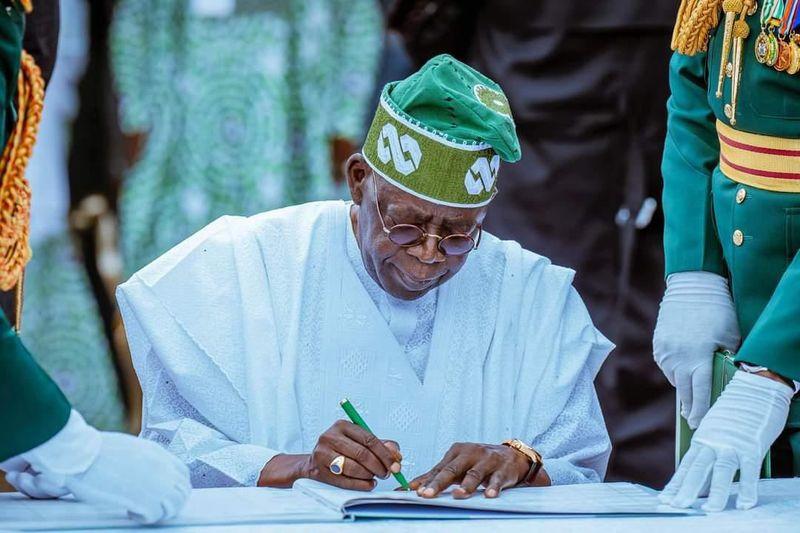
- The Federal Executive Council has approved $2.99 billion for three rail projects in Lagos, Kano and Kaduna
- Projects include Lagos Green Line Phase 1A, Kano Metro and Kaduna Light Rail
- President Tinubu will chair a new presidential taskforce on power sector reform as FEC appointed Rilwan Babalola as the Special Adviser to the President on Power
The Federal Executive Council has approved contracts worth $2.99bn for three major rail projects in Lagos, Kano and Kaduna, in what officials described as a major push to expand urban transport infrastructure and unlock economic productivity across key Nigerian cities.
The approvals, announced after Thursday’s FEC meeting at the State House in Abuja, cover the Lagos Green Line Rail Project Phase 1A, the Kano Metro City Rail Project and the Kaduna State Light Rail Project.
The Minister of Finance and Coordinating Minister of the Economy, Taiwo Oyedele, said the projects would be funded through the Ministry of Finance Incorporated, alongside counterpart financing arrangements, and aligned with the Federal Government’s capital expenditure plans for 2025 and 2026.
According to Oyedele, the government extended the 2025 capital expenditure cycle to June, while the remaining financing for the projects has already been captured in the 2026 fiscal framework.
He said Lagos, Kano and Kaduna were prioritised because of their economic significance and population density, noting that investments in the three cities would deliver high economic returns and improve capital budget efficiency.
“For economic development, you need infrastructure that works, infrastructure that improves productivity, drives growth and enhances quality of life,” Oyedele said while announcing the approvals.
At the centre of the rail package is the Lagos Green Line, one of the most anticipated routes in the Lagos metropolitan rail masterplan. The proposed 68-kilometre corridor will connect Marina to the Lekki Free Zone, passing through major commercial and residential districts such as Victoria Island, Lekki and Ajah.
Valued at about $3bn, the Green Line will feature 17 stations and modern commuter infrastructure, including pedestrian bridges, escalators, elevators and a depot near Sangotedo. The rail system is designed to run eight-car trains at speeds of up to 100 kilometres per hour, with a three-minute headway and passenger capacity of roughly 35,000 per hour in each direction.
Phase 1 is expected to run from Lekki First Tollgate to Epe, while a later phase will extend into Marina through a water-crossing segment.
The Federal Government had already earmarked N102.3bn as counterpart funding for the Green Line in the 2026 budget cycle, after allocating N146.14bn in the 2025 budget proposal through the Ministry of Transportation.
While the project has generated strong anticipation, transport experts have raised concerns over station spacing and commuter accessibility, warning that wider gaps between stations and limited coverage in Victoria Island could reduce ridership unless integrated more effectively with existing transport systems.
Beyond Lagos, the Kano Metro City Rail Project and Kaduna State Light Rail Project are expected to deepen urban mobility in two of northern Nigeria’s most commercially important cities.
The projects build on earlier plans announced in 2025 by the Federal Government to support light rail development in northern states through the Ministry of Finance Incorporated under public-private partnership arrangements.
In September 2025, the Federal Government disclosed that about N250bn had already been secured for rail development in the two states, with N150bn earmarked for Kano and N100bn for Kaduna.
In a parallel infrastructure push, FEC also approved more than N7tn in road and bridge contracts spanning 10 major projects across the six geopolitical zones, making it one of the largest single-day infrastructure approvals under the Tinubu administration.
Among the headline road approvals is a N1.86tn extension of the Lagos-Calabar Coastal Highway through Akwa Ibom, a technically demanding 165.6-kilometre dual carriageway designed for swamp terrain and scheduled for completion within 36 months.
FEC also approved N548.98bn for the complete demolition and reconstruction of the Carter Bridge in Lagos after structural assessments found severe deterioration in its underwater piles and pile caps.
Officials said repeated investigations conducted in 2013, 2019 and under the current administration confirmed the bridge could no longer be salvaged, making full reconstruction the only viable option.
The new Carter Bridge will be expanded from 1.525 kilometres to 1.93 kilometres and redesigned to eliminate long-standing traffic bottlenecks, with wider ramps and improved navigational clearance.
The Council also approved the fifth section of the Sokoto-Badagry Expressway, a 360-kilometre dual carriageway valued at N1.785tn, to be funded through a mix of federal allocation and external financing, with tolling built into its long-term cost recovery plan.
Other major road approvals include the reconstruction of the Mando-Birnin Gwari Road in Kaduna, the dualisation of the Ibadan-Ijebu-Ode Road linking Oyo and Ogun states, and new road projects across Osun, Yobe, Gombe, Rivers, Benue, Kogi and Nasarawa.
The Minister of Works, Dave Umahi, said the approvals reflect the administration’s commitment to accelerating national connectivity and modernising transport infrastructure across all regions.
In another major decision, FEC constituted a presidential taskforce on power sector reform to be chaired by President Bola Tinubu, signalling a fresh attempt to tackle one of the country’s most persistent economic bottlenecks.
The Minister of Information and National Orientation, Mohammed Idris, said the new committee emerged from a broader review of the commercial and institutional framework guiding the proposed Grid Asset Management Company.
As part of the shake-up, FEC also approved the appointment of Rilwan Babalola as Special Adviser to the President on Power.
The newly created Task Force on Power Sector Reform will include the Ministers of Finance, Industry, Trade and Investment, Information, the Attorney General of the Federation, the Chairman of the Nigerian Electricity Regulatory Commission, and representatives of power generation and distribution companies.
Idris said the taskforce was designed to drive a broad overhaul of the electricity sector and support industrial growth.
“The goal is to ensure a total overhaul of the power sector, without which meaningful industrialisation and economic prosperity cannot be achieved,” he said.
The approvals mark one of the most ambitious infrastructure and power reform packages endorsed by the Tinubu administration, combining rail expansion, road reconstruction and electricity reform in a sweeping attempt to tackle mobility, logistics and energy constraints across Nigeria.
FEC backs policy allowing medical fellowships to replace PhD for doctors in academia
Meanwhile, TheRadar earlier reported that the Nigerian government approved an amendment that will allow medical fellowships to be recognised as the equivalent of a PhD for academic promotion and career progression among medical professionals.
The Minister of Education, Tunji Alausa, said that the amendment had been endorsed by the FEC and will be forwarded to the National Assembly of Nigeria for legislative approval.
The agreement also clarified that clinical lecturers without a PhD should still be eligible for promotion up to the rank of professor within Nigerian universities.