
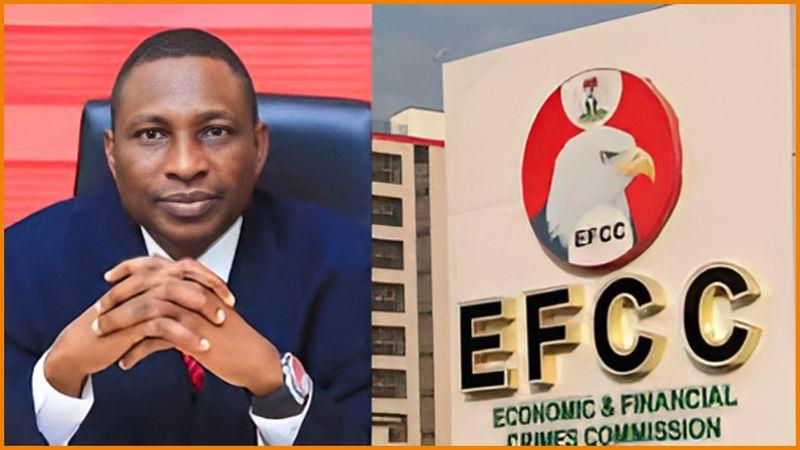
The Supreme Court has set date for the hearing of a suit filed by at least 16 state governments challenging the constitutionality of the laws establishing the Economic and Financial Crimes Commission (EFCC) and two others.
A seven-member panel of justices, led by Justice Uwani Abba-Aji, on Tuesday, October 8, fixed October 22 after the states were joined as co-plaintiffs and granted leave for consolidation of the case in the suit initially filed by the Kogi Government through its Attorney General (AG).
The states that joined in the suit marked: SC/CV/178/2023 include Ondo, Edo, Oyo, Ogun, Nassarawa, Kebbi, Katsina, Sokoto, Jigawa, Enugu, Benue, Anambra, Plateau, Cross-River and Niger.
The 16 states said they are relying on the fact that the constitution is the supreme law and any law inconsistent with it is a nullity.
The plaintiffs argued that the Supreme Court, in Dr Joseph Nwobike Vs Federal Republic of Nigeria, had held that it was a UN Convention against corruption that was reduced into the EFCC Establishment Act and that in enacting this law in 2004, the provision of Section 12 of the 1999 Constitution, as amended, was not followed.
They argued that, in bringing a convention into Nigerian law, the provision of Section 12 must be complied with.
According to them, the provision of the Constitution necessitated the majority of the states’ Houses of Assembly agreeing to bring the convention in before passing the EFCC Act and others, which was allegedly never done.
The argument of the states in their present suit, which they said had been corroborated by the Supreme Court in the previous case mentioned, is that the law, as enacted, could not be applied to states that never approved of it, following the provisions of the Nigerian constitution.
Hence, they argued that any institution so formed should be considered illegal.
When the case was called on October 8, lawyers who represented the states made their submissions.
Kogi AG’s counsel, Abdulwahab Mohammed, SAN, informed the court that states indicated interest in consolidating the case and those seeking to be joined as co-plaintiffs.
“It is for this honourable court to tell us how to proceed, my lord.
“Out of about 15 states, there are about 13 of them that have indicated interest to be co-plaintiffs and only two want consolidation.
“To make the task of the court easier, those who want to be joined as co-plaintiff should be joined and abide by the processes already filed and those who sought consolidation should be asked to file within seven days,” Mohammed said.
After the lawyers’ submissions, Justice Abba-Aji granted their prayers and adjourned the matter until Oct. 22 for a hearing.
The Kogi State AG had, in suit number SC/CV/178/2023, sued the Attorney-General of the Federation (AGF) as the sole defendant.
In the originating summons filed by a team of lawyers led by Prof . Musa Yakubu, SAN, the state raised six questions for determination and sought nine reliefs.
The Kogi government sought a declaration that the federal government, through the Nigerian Financial Intelligence Unit (NFIU), lacked the power to issue any directive, guideline, advisory, or any instrument; however, it called for the administration and management of funds belonging to the state.
The government also sought a declaration that the EFCC, the NFIU or any federal government agency cannot investigate, requisition documents, invite and or arrest anyone concerning offences arising from or touching on the administration and management of funds belonging to the state.
EFCC says it would not tolerate any protest against the commission
Meanwhile, TheRadar earlier reported that the Economic Financial Crimes Commission had raised the alarm about an impending protest by individuals under investigation, emphasising its zero-tolerance stance on any disruption of public order.
However, Nigerians took to social media to express their concern about some of the anti-graft agency’s mode of operations.
