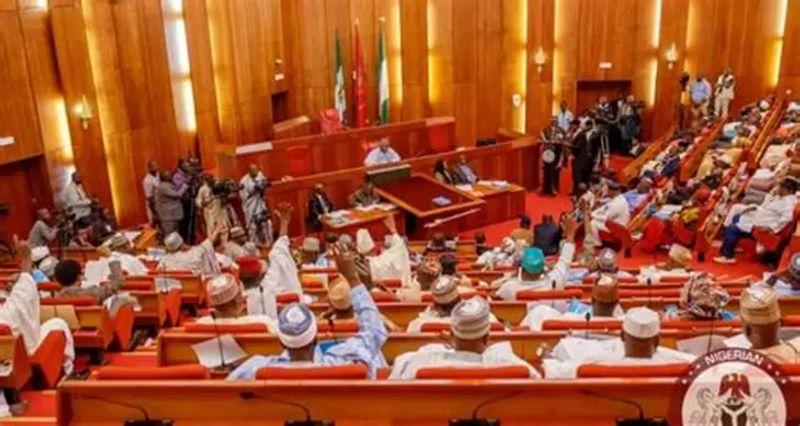
- Senate President Godswill Akpabio announced a 12-member committee to work with the House on the Electoral Amendment Act
- The committee was tasked with reconciling disputes over Clause 60(3) amid heated Senate debates
- Lawmakers aimed to complete the process quickly, enabling President Tinubu to sign the amended bill before February’s end
The Nigerian Senate has appointed a 12-member committee to work alongside the House of Representatives on the Electoral Amendment Act, a move aimed at fast-tracking the controversial bill through the legislative process.
Senate President Godswill Akpabio announced the committee during an emergency plenary session on Tuesday, describing the matter as one of urgency. The appointed members include Senator Simon Lalong as Chairman, along with Senators Orji Uzor Kalu, Tahir Monguno, Adamu Aliero, Abba Moro, Asuquo Ekpenyong, Aminu Iya Abbas, Tokunbo Abiru, Niyi Adegbonmire (SAN), Jibrin Isah, Ipalibo Banigo, and Onyekachi Nwebonyi.
“After consultation with the leadership, we have moved the number from nine to 12. I will now read out the names of the conference committee members from the Senate,” Akpabio said. He added that the committee is expected to conclude its work within days or a week, allowing President Bola Tinubu to sign the amended bill into law before the end of February.
The formation of the committee follows heightened tensions in the Senate over Clause 60(3) of the bill. The row erupted when Senate Chief Whip Senator Tahir Monguno (APC, Borno North) raised a point of order seeking the rescission of the chamber’s earlier approval of the clause. Monguno, supported by Senator Abdul Ningi (PDP, Bauchi Central), proposed replacing the word “transmission” with “transfer” and removing the phrase “real-time” from the clause.
The chamber erupted into heated debate, with several senators raising points of order in protest. Senator Enyinnaya Abaribe (APGA, Abia South) objected strongly and called for a division under Order 72 of the Senate Standing Orders, highlighting the intensity of disagreements over the bill.
Clause 60(3), as originally reported by the Senate Committee on Electoral Matters, mandates that “The Presiding Officer shall electronically transmit the results from each polling unit to IREV portal in real time and such transmission shall be done after the prescribed Form EC8A has been signed and stamped by the Presiding Officer and/or countersigned by the candidates or polling agents available at the polling unit.”
The 12-member committee is now tasked with reconciling differences between the Senate and House versions of the bill, with the aim of presenting a final version to President Tinubu for assent before the month’s end.
The development underscores the urgency lawmakers place on electoral reforms amid growing public scrutiny of Nigeria’s voting processes and the need for transparent, timely results reporting.