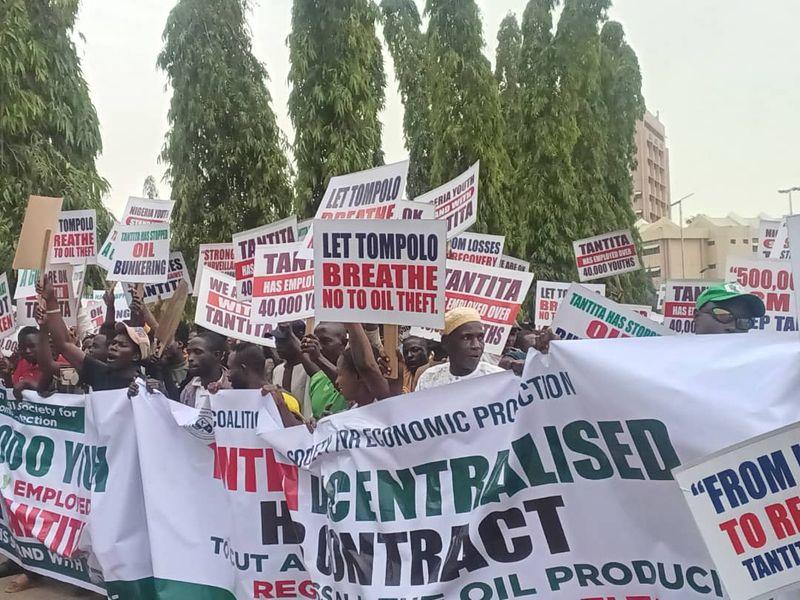
- Protesters gathered at the National Assembly demanding stronger action against crude oil theft and support for pipeline surveillance efforts
- Lawmakers are intensifying efforts through a joint parliamentary roundtable on oil theft and pipeline security
- The parliamentary session is expected to shape future strategies against oil theft and infrastructure sabotage
Protesters stormed the National Assembly on Wednesday, April 8, as lawmakers in both chambers ramped up discussions on crude oil theft and pipeline security in Nigeria’s oil-rich Niger Delta.
The demonstrators, operating under the Coalition of Civil Society for Economic Protection, marched to the complex chanting solidarity songs and displaying placards with messages such as “Oil thieves Are Conspiring Against Tantita” and “Say No to Oil Bunkering.”
Security operatives, including personnel of the Nigeria Police Force and other agencies, blocked their access to the premises.
The protest comes at a time when legislative attention on oil theft has intensified, given its long-standing impact on Nigeria’s crude oil output, government revenue, and security in host communities.
In response, the Joint Senate and House Committees on Petroleum Resources are set to convene a parliamentary roundtable focused on pipeline security and strategies to combat crude oil theft.
Top government officials and stakeholders expected at the session include Senate President, Godswill Akpabio; Speaker of the House of Representatives, Tajudeen Abbas; Chairman of the House Committee on Petroleum Resources (Downstream), Hon. Ikenga Ugochinyere; Inspector-General of Police, Olatunji Disu; and Chief of Defence Staff, Olufemi Oluyede.
Also expected are the Director-General of the Department of State Services, Tosin Ajayi; Chairman of the Senate Committee on Petroleum Resources (Upstream), Senator Eteng Williams; National Security Adviser, Nuhu Ribadu; Minister of Defence, Christopher Musa; Director-General of the National Intelligence Agency, Mohammed Mohammed; and Managing Director of Tantita Security Services Limited, Kestin Pondi.
Speaking during the protest, the convener of the group, Tesleem Kolawole, urged lawmakers to carefully evaluate the impact of pipeline surveillance contracts and avoid actions that could undermine progress.
He said, “We call on the lawmakers to sincerely and holistically look at the journey of Tantita from when they started securing the country to date, without fear or favour. They should examine the modus operandi of the contract and its primary aim to determine whether it has been successful or not.
“The conversation around pipeline surveillance must be guided by results, because when national assets are secured, the economy benefits, communities stabilise, and young people gain real opportunities.
“In that regard, Tantita Security Services Nigeria Limited has become a visible part of a broader national effort that has helped restore confidence in pipeline security and crude oil production.”
Kolawole further noted that Nigeria’s oil production has significantly improved, rising to about 1.8 million barrels per day in November 2024, compared to previous lows of roughly 500,000 barrels per day before Tantita’s engagement in 2022.
“So our message here today is simple. This is not the time to weaken a framework that has helped restore production, support youth enterprise, improve education, and create alternatives to criminality.
“This is the time to strengthen accountability, improve coordination, and protect what is working. When a programme produces measurable gains in oil security, education, skills, agriculture, and youth engagement, the responsible thing is not disruption; it is consolidation.
“Therefore, we call for continuity, transparency, and support for every initiative that secures national assets while also lifting people. Tantita’s record, as publicly reported, shows that security and development can work together. That is the standard we should protect for Nigeria’s future,” he added.
Crude oil theft continues to pose a major economic and security challenge in Nigeria, prompting successive governments to deploy both military operations and private surveillance contracts to tackle pipeline vandalism and illegal bunkering.
The outcome of the ongoing parliamentary engagement is expected to influence future policies on safeguarding Nigeria’s oil infrastructure.
NGF submits state police proposal to National Assembly for review amid national debate
Meanwhile, TheRadar earlier reported that the Nigeria Governors Forum had submitted its proposal on the establishment of state police to the National Assembly of Nigeria through the office of the National Security Adviser, Nuhu Ribadu.
The Chairman of the Forum and Governor of Kwara State, Abdulrahman AbdulRazaq, explained that consultations on the proposed state policing system were ongoing among various security agencies, under the coordination of the National Security Adviser.