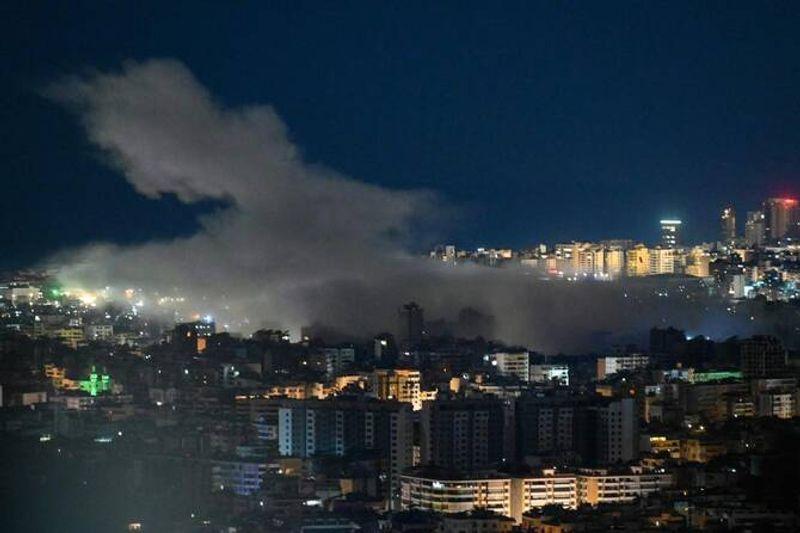
- Israeli airstrikes struck the southern suburbs of Beirut, damaging roads and buildings and forcing large numbers of civilians to flee as the conflict with Hezbollah intensifies
- Hezbollah claimed it was engaging Israeli forces in southern Lebanon and issued warnings to Israeli border communities to evacuate
- The escalation follows earlier strikes on Iran, which triggered renewed hostilities between Israel and Iran-backed groups
Israeli warplanes carried out heavy overnight airstrikes on the southern suburbs of Beirut and continued bombardments into Friday, March 6, intensifying the conflict with Iran-backed Hezbollah and forcing tens of thousands of Lebanese civilians to flee their homes.
The strikes targeted densely populated districts widely regarded as Hezbollah strongholds.
Ahead of the attacks, Israel issued evacuation orders urging residents in the affected suburbs to leave immediately.
Earlier warnings had also instructed civilians to evacuate parts of southern and eastern Lebanon.
Explosions illuminated the night sky as missiles struck multiple locations across the capital’s southern outskirts, leaving damaged roads and buildings in their wake.
On Friday morning, Hezbollah claimed it was confronting Israeli forces attempting a ground incursion in southern Lebanon.
The group said it had targeted Israeli military vehicles gathered near the border town of Khiyam. It also issued warnings to residents of Israeli communities close to the Lebanese border, urging them to evacuate the area.
Lebanon’s involvement in the escalating Middle East conflict began on Monday, March 2, after Hezbollah launched rockets into Israel.
The move prompted a new Israeli military offensive against the Shi’ite Muslim group, just 15 months after both sides reached a truce following the major 2024 war.
The renewed fighting has displaced large numbers of civilians. Many residents who fled the bombarded suburbs of Beirut spent the night in the city centre without shelter.
"We’re sleeping here in the streets - some in cars, some on the street, some on the beach," said Jamal Seifeddin, a 43-year-old who fled Beirut’s southern suburbs and spent the night outside in the capital's downtown district.
"I've never slept on the ground like this. I've been forced to. No one even brought a blanket," he said.
According to an Israeli military official, the overnight campaign involved several waves of strikes aimed at Hezbollah positions in Beirut’s southern suburbs.
About 115 targets were hit, including locations within residential buildings that Israel says were being used as operational headquarters by the militant group.
The Israeli military also reported conducting strikes in other parts of Lebanon, including Tripoli in the north, Tyre, Sidon, and Nabatieh in the south, as well as Baalbek in the east. Footage released by the Israeli army showed what it described as attacks on command centres and weapons storage facilities.
The latest escalation comes after Israeli and U.S. strikes on Iran a week earlier killed the country’s supreme leader, a symbolic figurehead for Hezbollah, dramatically intensifying tensions across the region.
Hezbollah, a Shi’ite militant group founded by Iran’s Revolutionary Guards in 1982, suffered heavy losses during its 2024 war with Israel and has since faced growing pressure to disarm and withdraw from military operations.
Lebanon’s health ministry said Israeli strikes this week have killed at least 123 people and injured 683 others, though the figures do not differentiate between civilians and combatants.
Israel’s sweeping evacuation orders covering large parts of southern Lebanon, several eastern towns, and the entire southern suburbs of Beirut have added to the humanitarian crisis. Hundreds of thousands of people had already been displaced during earlier clashes in 2023 and 2024.
The United Nations has raised concerns about the scale of the evacuation warnings.
U.N. human rights chief Volker Turk criticised the move, saying the orders were broader than previous ones and could raise serious issues under international humanitarian law.
Meanwhile, Israeli troops have pushed deeper into southern Lebanon. Tanks and ground forces were seen operating in a heavily damaged village near the border on Thursday, March 5, with smoke rising from nearby areas.
On the Israeli side of the frontier, hundreds of soldiers were also observed building defensive fortifications.
Before launching the overnight strikes, Israeli military spokesperson Avichay Adraee posted a message on X directing residents of Beirut’s southern suburbs to move north or east.
The warning included a map marking four large districts near the capital, including areas close to Beirut’s airport.
"Save your lives, evacuate your homes immediately," the military spokesperson, Avichay Adraee, posted on X, saying that any movement southwards may endanger their lives.
While Israel has previously issued evacuation warnings for buildings in the southern suburbs, this marked the first time the military ordered residents to leave the entire area.
In response, Hezbollah issued its own warning directed at Israelis. In a statement posted in Hebrew on its Telegram channel early Friday, March 6, the group urged residents in towns within five kilometres of the Lebanese border to leave their homes.
"Your military's aggression against Lebanese sovereignty and safe citizens, the destruction of civilian infrastructure and the expulsion campaign it is carrying out will not go unchallenged," Hezbollah said.
During the 2024 conflict between Israel and Hezbollah, tens of thousands of Israelis were evacuated from border communities, although many have since returned. Israeli authorities say there are currently no plans to evacuate those towns again.
Despite Hezbollah’s warnings and cross-border attacks, there have so far been no reported fatalities in Israel resulting from the group’s latest strikes.