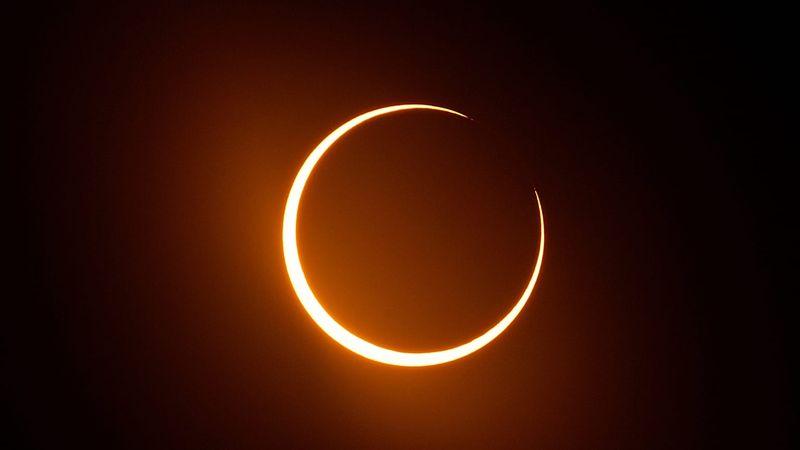
- A rare total solar eclipse will take place on August 12, the first visible from mainland Europe since 2006
- The path of totality will cross Russia, Greenland, Iceland, Spain, and northeastern Portugal
- People across much of Europe, Canada, the northern United States, and northwest Africa will see a partial eclipse
Imagine the middle of the day suddenly looking like evening. That's exactly what will happen across parts of northern Spain on August 12, when the Moon completely blocks the Sun during a rare total solar eclipse.
It's the first total solar eclipse visible from mainland Europe since 2006, and skywatchers are already counting down.
What is a solar eclipse?
A solar eclipse happens when the Moon moves directly between the Earth and the Sun, casting a narrow shadow across the planet.
For people standing in the right location, daylight briefly fades into an eerie twilight. Temperatures can drop, shadows look unusual, and some animals even start acting like it's bedtime.
It's easy to see why ancient civilisations believed eclipses were signs of the apocalypse or messages from the gods.
But there's a much simpler explanation.
According to NASA, it's all thanks to a "cosmic coincidence."
Even though the Sun is about 400 times larger than the Moon, it's also roughly 400 times farther away. From Earth, both appear almost the same size, allowing the Moon to completely cover the Sun and reveal its outer atmosphere, known as the corona.
Where will people be able to see it?
The first total eclipse on August 12 will be visible from a remote part of northern Russia.
From there, the path of totality will stretch across Greenland, Iceland, Spain, and the northeastern tip of Portugal.
In Spain, the eclipse will travel roughly from the northern city of Oviedo to the island of Mallorca.
How long will the darkness last?
Don't blink. For people watching from Spain, totality will last less than two minutes, just before sunset.
In the northern city of Burgos, for example, darkness will last exactly one minute and 48 seconds.
Parts of Russia and Greenland will experience slightly longer totality, although it will still remain under two and a half minutes.
The partial eclipse, which happens before and after totality as the Moon moves across the Sun, will last around one hour and 45 minutes.
People across most of Europe, Canada, the northern United States, and northwest Africa will also be able to see the partial eclipse.
How rare is this?
Solar eclipses aren't as uncommon as many people think. One or two happen somewhere on Earth almost every year.
The catch is that the path where a total eclipse can be seen is extremely narrow. Because of that, the same location might wait around 400 years before another total eclipse passes overhead.
Another major event is already on the calendar.
On August 2, 2027, a total solar eclipse will cross southern Spain, northern Africa, and the Arabian Peninsula.
Some media outlets have nicknamed it the "eclipse of the century" because totality will last six minutes and 23 seconds, the longest of the 21st century.
Spain will also experience an annular, or "ring of fire," eclipse on January 26, 2028, when the Moon leaves a bright ring of sunlight visible around its edges.
Can you watch it without protection?
No. Looking directly at the Sun during any stage of the eclipse can seriously damage your eyes.
Experts recommend using specially designed eclipse glasses that meet the ISO 12312-2:2015 safety standard and filter harmful UV rays.
One reason eye injuries happen is that your eyes don't have pain receptors to warn you something is wrong. By the time symptoms appear, the damage may already have been done.
Researchers also found that after the total solar eclipse in the United States in 2024, online searches for "my eyes hurt" increased sharply.