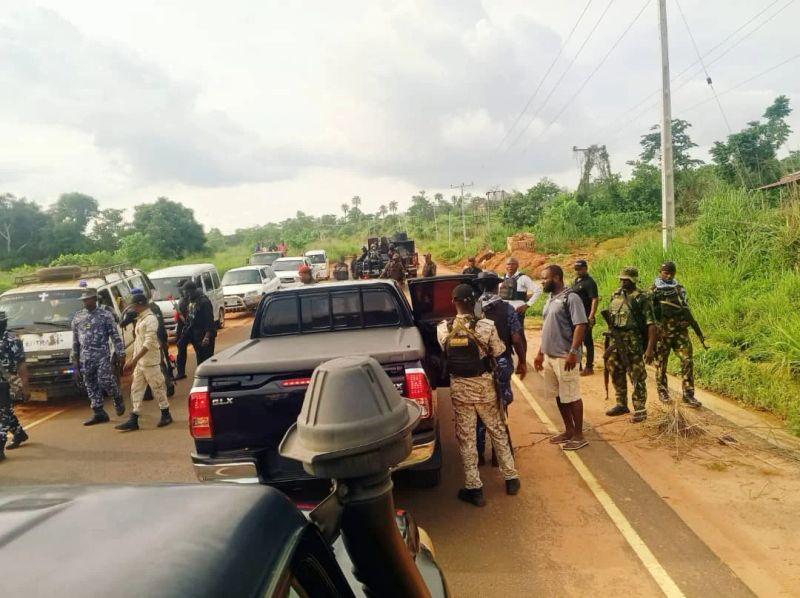
- Security operatives cordoned off access routes to the Presidential Villa Abuja ahead of a planned protest led by Omoyele Sowore
- The protest, tagged #OccupyAsoRock, was organised to demand the release of abducted schoolchildren and other victims of insecurity
- Authorities deployed anti-riot police across strategic locations in Abuja to restrict movement around the State House
Security has been tightened around the access routes to the Presidential Villa in Abuja, with anti-riot police officers cordoning off the main entrances of the State House on Thursday amid a planned protest led by human rights activist Omoyele Sowore.
TheRadar observed a heavy presence of security operatives in full riot gear stationed at strategic points around the Villa, restricting movement and allowing entry only to individuals with valid State House identification tags. Others attempting to approach the premises were reportedly turned back.
The heightened security follows Sowore’s announcement that he would lead members of the African Action Congress and the Take It Back Movement on a march to the Presidential Villa under the hashtag #OccupyAsoRock.
The protest, scheduled to commence from Eagle Square in Abuja, was aimed at demanding the immediate release of schoolchildren and other victims abducted in recent attacks across Nigeria. Sowore also called for President Bola Ahmed Tinubu to ensure their safe return or resign if unable to fulfil the constitutional duty of protecting lives and property.
Speaking earlier, Sowore criticised the deployment of security personnel to prevent protests, arguing that such resources should instead be directed toward protecting schools and vulnerable communities.
“You cannot claim to be president of Nigeria and then refuse to do the job of the Commander-in-Chief of the Armed Forces,” he said, adding that authorities must prioritise citizen safety over political protection.
The planned demonstration comes in response to recent mass abductions, including the May 15 attacks on three schools in Oyo State and another incident in Borno State, where dozens of pupils and teachers were kidnapped.
In response to the security situation, the Federal Government had earlier dispatched a high-level delegation led by Chief of Staff Femi Gbajabiamila, alongside top security chiefs including the National Security Adviser, Inspector-General of Police, and Chief of Defence Staff, to affected communities.
Authorities also announced measures including the approval of the recruitment of 1,000 forest guards and the deployment of a specialised rescue team, alongside a combination of kinetic and non-kinetic security strategies.
Meanwhile, the Nigeria Union of Teachers has continued its industrial action in Oyo State, shutting down schools and joining nationwide solidarity protests over the rising insecurity affecting education workers and students.
The situation has intensified public debate over national security, with civil society groups, labour unions, and political actors calling for stronger measures to address the recurring wave of kidnappings across the country.