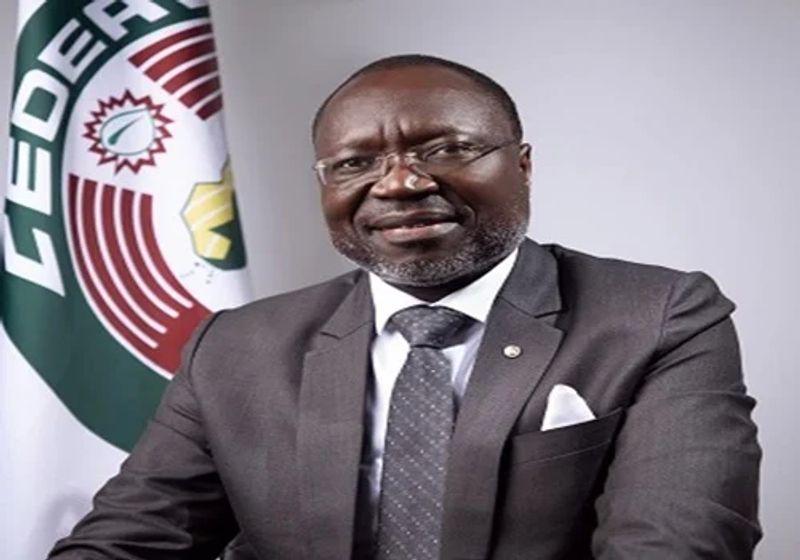
- ECOWAS highlighted peace and security as central to its 2025 agenda, strengthening forces and counter-terrorism capabilities across the region
- Dr Omar Touray reported West Africa achieved 4.6% growth in 2025, projecting five per cent in 2026, driven by reforms, investment, and regional trade
- The bloc condemned unconstitutional changes of government, intervened in political crises, and promoted regional integration, infrastructure and humanitarian efforts
The Economic Community of West African States (ECOWAS) has placed regional peace and security at the centre of its agenda as it works towards achieving five per cent economic growth across West Africa, the President of the ECOWAS Commission, Dr Omar Touray, has said.
Touray made this known on Thursday in Abuja while presenting highlights of the ECOWAS 2025 Annual Report at a meeting with development partners. He noted that persistent insecurity in parts of the region continues to pose a major challenge, necessitating intensified regional cooperation and intervention.
“If we look at the various sectors and areas of our activities, we will see that in the area of peace and security, our preoccupation remains with growing insecurity that some areas of the region continue to suffer from,” Touray said. He stressed that peace and security remain at the core of ECOWAS’ mandate.
According to him, the regional bloc has strengthened its security architecture, including the ECOWAS Standby Force and a 1,650-member Counter-Terrorism Brigade. He added that assessment missions to The Gambia and Guinea-Bissau had revealed gaps in training and exit strategies, which ECOWAS is working to address.
Touray also spoke about the ongoing implications of the withdrawal of Burkina Faso, Mali, and Niger from the bloc, noting that ECOWAS remains open to constructive dialogue despite the setback. On counter-terrorism efforts, he disclosed that ECOWAS had taken over the West Africa Police Information System from Interpol. Still, he acknowledged that reduced cooperation with the Alliance of Sahel States had complicated regional security operations. While terrorist attacks declined slightly, he said fatalities increased due to the rising use of improvised explosive devices.
The ECOWAS Commission president reiterated the bloc’s zero-tolerance stance on unconstitutional changes of government, condemning in strong terms a recent attempted coup in the Republic of Benin. He said swift intervention was necessary to send a clear message that coups would not be tolerated in the region.
On political developments, Touray said ECOWAS had called for a short and inclusive transition in Guinea-Bissau following the aborted elections, while confirming that Guinea had been readmitted to the bloc after holding elections.
Beyond security, Touray highlighted the region’s economic resilience despite global economic headwinds. He said West Africa recorded 4.6 per cent growth in 2025 and is projected to reach five per cent in 2026, outperforming the continental average. He attributed the performance to structural reforms, increased investment in mining and energy, improved regional trade facilitation, and a rebound in services, transport and tourism.
Touray added that inflation, fiscal deficits and debt ratios had improved in several member states, while progress had also been made in regional integration, infrastructure development and humanitarian interventions.
In conclusion, he said that despite ongoing challenges, ECOWAS remains committed to its vision of a peaceful, stable, and economically integrated West Africa, noting that the goal “remains within reach.”
FG, Morocco, ECOWAS drive $26bn African gas pipeline initiative.
Meanwhile, TheRadar earlier reported that the Federal Government of Nigeria, in collaboration with the Economic Community of West African States (ECOWAS), Morocco, and Mauritania, reaffirmed its commitment to advancing the African Atlantic Gas Pipeline (AAGP) project, a transformative initiative estimated to cost $26 billion.
The project aims to connect at least 13 countries and enhance regional economic growth.