
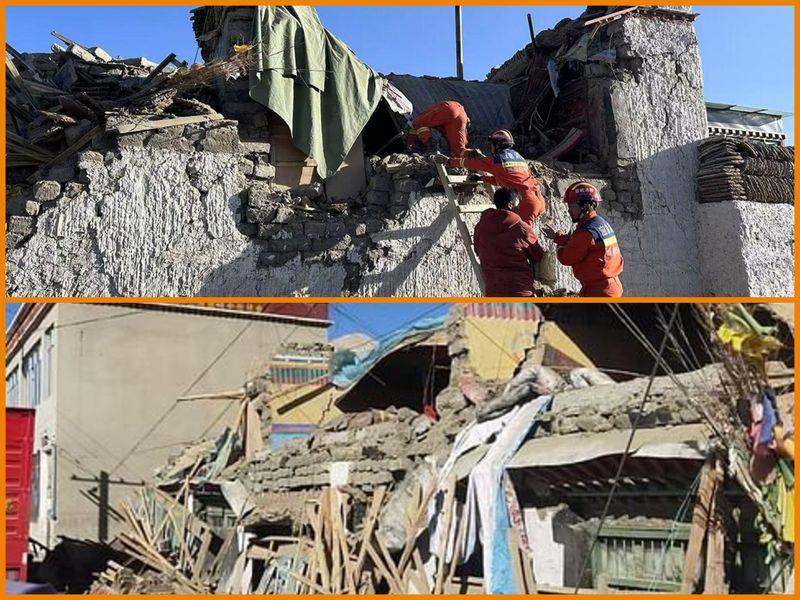
- A magnitude 7.1 earthquake struck Tingri County near Mount Everest
- Over 126 people were confirmed dead, 188 injured, and more than 3,600 homes damaged
- Chinese President Xi Jinping has urged an "all-out effort" to rescue survivors and provide shelter
A powerful earthquake struck the Himalayan foothills near one of Tibet's holiest cities on Tuesday, January 7, leaving at least 126 people dead and 188 injured, Chinese authorities confirmed.
The quake, which registered a magnitude of 7.1 according to the U.S. Geological Survey (USGS), caused widespread destruction, toppling homes and disrupting lives across the region.
The earthquake's epicentre was in Tingri County, approximately 80 kilometres (50 miles) north of Mount Everest. Tingri, the northern gateway to the Everest region, lies high on the Tibetan plateau.
The quake struck at a shallow depth of 10 kilometres (6.2 miles), magnifying its impact. Over 3,600 houses were damaged, and villages in the surrounding area reported significant destruction.
The Shigatse region, home to 800,000 people and the traditional seat of the Panchen Lama, experienced the most severe damage.
In Shigatse City, rescue footage showed firefighters pulling injured survivors from the rubble as buildings collapsed. Temperatures dropped as low as minus 16°C (3°F) overnight, exacerbating the plight of those left homeless.
Surveillance footage from a supermarket in Shigatse captured the moment of the quake, with shelves shaking violently and customers fleeing. Over 22,000 relief items, including tents, coats, and quilts, were dispatched to the area.
The quake's tremors extended across Nepal, Bhutan, and northern India, shaking buildings and sending residents running for safety.
In Nepal’s capital, Kathmandu, 400 kilometres (250 miles) from the epicentre, panic ensued as people fled their homes. Authorities reported 13 injuries and structural damage to several buildings in Nepal but no fatalities.
In Bhutan’s capital, Thimphu, and India’s northern Bihar state, tremors caused alarm, but no significant damage or casualties were reported.
Chinese authorities mobilised over 1,500 rescue workers, including military personnel, to assist in relief operations.
Helicopters and planes carried emergency supplies to remote areas. Rescuers, including immigration officers, searched the rubble with bare hands in a race to find survivors.
Temperatures are expected to remain below freezing in the affected areas, with local governments providing shelters and essentials to the displaced population.
Shigatse is one of Tibet's most important spiritual centres, hosting the Panchen Lama, the second-highest figure in Tibetan Buddhism.
Tibet’s spiritual leader, the Dalai Lama, who lives in exile in India, expressed his sorrow, offering prayers for the victims and wishing a swift recovery to the injured.
Chinese President Xi Jinping called for “all-out efforts” in rescue and recovery operations, emphasising the need to minimise casualties and provide adequate shelter for those affected by the disaster.
The Tibetan plateau is prone to earthquakes due to the collision of the Indian and Eurasian tectonic plates.
The quake is one of the strongest in the region since 2017 when a 6.9-magnitude earthquake struck Mainling, located in the lower reaches of the Yarlung Zangbo River.
The region is also scarred by memories of the 2015 Nepal earthquake, which killed 9,000 people and triggered an avalanche at Mount Everest’s base camp.
The quake has temporarily closed the Mount Everest climbing base camp on the Tibetan side.
Though winter is not a peak season for climbers, the area remains a popular destination for tourists seeking views of the Himalayas.
As aftershocks continue to rattle the region, rescue efforts remain underway.
Officials are focusing on sheltering survivors, providing medical aid, and restoring communication lines in the isolated villages.
The tragedy serves as a stark reminder of the seismic risks facing the Himalayan region and the resilience of its people.
China grapples with spike in respiratory illnesses amid fears of new outbreak
Meanwhile, TheRadar earlier reported that China grappled with a surge in respiratory illnesses that has led to overcrowded hospitals and renewed fears of a potential outbreak.
Videos circulating on social media depict packed hospital units, long queues of parents with sick children, and patients wearing face masks, reminiscent of the early days of the COVID-19 pandemic.
