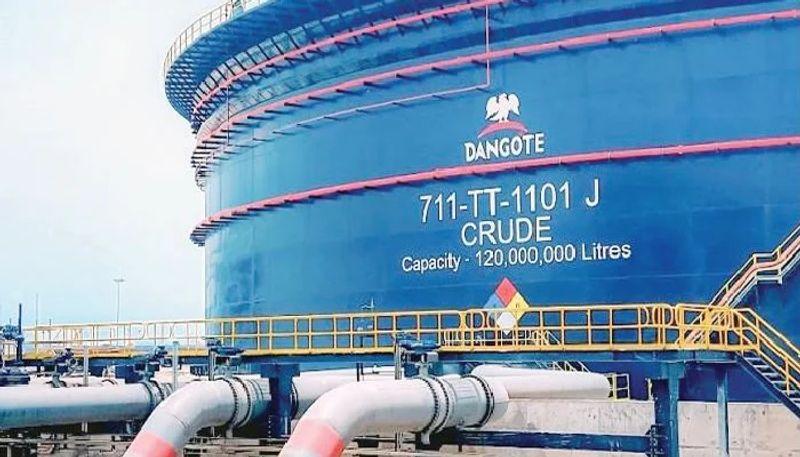
- Dangote Refinery supplied about 92% of Nigeria’s daily petrol demand in February after the government paused issuing import licences
- Petrol imports plunged by nearly 88%, dropping from 24.8 million litres daily in January to three million litres per day in February
- Industry operators raised concerns that reliance on a single refinery could create monopolistic risks in Nigeria’s downstream sector
The Dangote Petroleum Refinery supplied about 92 per cent of Nigeria’s daily petrol consumption in February, marking a major shift in the country’s fuel supply chain as the government paused the importation of Premium Motor Spirit (PMS).
Despite a recent N100 reduction in the refinery’s gantry price, filling stations across the country on Tuesday continued to sell petrol at above ₦1,200 per litre.
Multiple sources within the Nigerian Midstream and Downstream Petroleum Regulatory Authority (NMDPRA) and among fuel-importing companies confirmed that no import licences had been issued so far in 2026.
According to officials at the regulatory agency, the decision reflects the growing capacity of domestic refining to meet national fuel demand.
“It’s correct that we’ve not issued import licences this year. It is obvious that the local production has met national requirements, so there’s no need for importation,” a source at the NMDPRA said.
Data contained in the regulator’s February 2026 fact sheet shows that local refineries supplied an average of 36.5 million litres of petrol per day in February, while imports accounted for only three million litres daily.
The figures indicate that Nigeria’s total daily petrol supply for the month stood at about 39.5 million litres, with domestic refining contributing roughly 92 per cent of the total volume.
Currently, the Dangote facility remains the only refinery producing petrol in significant quantities, as most other modular refineries primarily process crude oil for Automotive Gas Oil (diesel).
The February data marks a sharp contrast to earlier trends. In January 2026, petrol imports averaged 24.8 million litres per day, while domestic refineries produced 40.1 million litres daily, bringing the total supply to 64.9 million litres per day.
According to the NMDPRA, the decline in imports significantly reduced the overall fuel supply in February.
“PMS supply in February 2026 reduced by 25.4 million litres per day due to a significant drop in imports,” the regulator said.
Historically, Nigeria has relied heavily on imported petrol. For example, in December 2025, imports averaged 42.2 million litres per day compared with 32 million litres from local refineries.
However, the increasing output from the Dangote refinery has gradually reversed that pattern. By late 2025 and early 2026, domestic refining had begun to dominate the market.
The refinery, owned by Aliko Dangote, recently announced that it had reached its full capacity of 650,000 barrels per day and was supplying more than 50 million litres of petrol to the local market daily.
While many industry stakeholders say the shift towards local refining could reduce Nigeria’s dependence on foreign exchange for fuel imports, some operators have expressed concerns about possible monopolistic tendencies in the downstream sector.
One industry operator warned that relying on a single refinery for most of the country’s fuel supply could create market imbalances.
“Dangote is gradually enjoying a monopoly in the downstream, and this is not healthy for any sector,” the operator said, noting that previous reports suggested imported petrol had at times been cheaper than locally refined products.
Amid ongoing geopolitical tensions in the Middle East that could influence global fuel prices, the Dangote refinery has assured Nigerians that sufficient petrol supply will be maintained.
According to the NMDPRA’s figures, Nigeria imported just 84 million litres of petrol in February—an average of three million litres per day—while domestic refineries supplied more than one billion litres during the same period.
Overall, petrol imports dropped sharply from 24.8 million litres per day in January to three million litres daily in February, representing a decline of about 87.9 per cent.