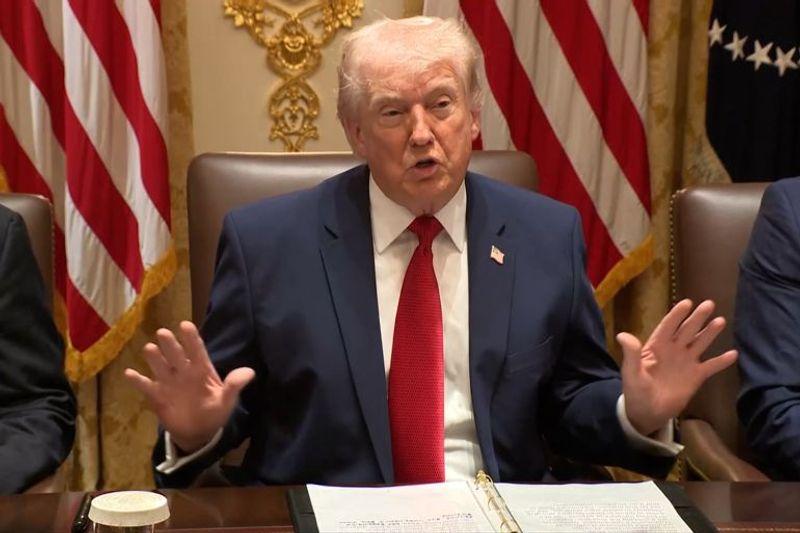
- U.S. President Donald Trump stirred controversy after declaring that “Cuba is next” during a speech in Miami
- Cuban President Miguel Díaz-Canel reacted firmly, stating that any external aggression would be met with “unbreakable resistance”
- The U.S. president brushed off concerns that his aggressive rhetoric and military actions could alienate supporters of his Make America Great Again (MAGA) movement
The United States President, Donald Trump, has sparked fresh geopolitical tension after declaring that “Cuba is next,” while insisting that his aggressive foreign policy will not erode support among his political base.
Speaking at the Saudi-backed FII Priority investment forum in Miami on Friday, March 27, Trump made the remark in what appeared to be a mix of seriousness and sarcasm, leaving analysts uncertain about his exact intentions toward the Caribbean nation.
“I built this great military. I said, ‘You’ll never have to use it,’ but sometimes you have to use it,” Trump said.
“And Cuba is next, by the way. But pretend I didn’t say that.”
Despite telling reporters to disregard the statement, the president repeated the comment moments later, drawing laughter from the audience but raising concerns internationally.
Rising pressure on Cuba
Trump’s remarks come amid escalating pressure on Cuba, whose communist government has faced renewed hostility from Washington since the start of his second term.
In January, the administration imposed what observers describe as a de facto oil blockade on the island, significantly tightening economic restrictions.
Trump has also previously hinted at the possibility of “taking” Cuba, further straining already fragile diplomatic relations.
Cuba has long been under a U.S. trade embargo dating back to the aftermath of Cuban Revolution, and while relations briefly improved in past years, tensions have once again intensified.
Cuba responds with defiance
Cuban President Miguel Díaz-Canel responded firmly to the growing rhetoric, warning that any external aggression would be met with “unbreakable resistance.”
His comments come at a difficult time for the island nation, which has recently experienced two nationwide blackouts within a week, compounding existing economic challenges.
A senior Cuban diplomat also reiterated that Havana remains open to dialogue with Washington but made it clear that discussions involving changes to Cuba’s political system are off the table.
Regional and global implications
Trump linked his hardline stance to recent U.S. military actions, including a January operation targeting Nicolás Maduro, which he cited as an example of the “strength” his Make America Great Again (MAGA) movement supports.
Dismissing concerns about political fallout, Trump argued that his supporters favour decisive leadership and military readiness over restraint.
In a lighter yet controversial moment during the speech, Trump joked about renaming the Strait of Hormuz as the “Strait of Trump,” further underscoring his unconventional communication style.
Meanwhile, concerns are growing over two sailboats that were part of an international humanitarian convoy heading to Cuba with medical supplies, food, and solar equipment.
The vessels have been reported missing and remain unaccounted for.
The situation adds another layer of uncertainty to an already tense geopolitical climate, as observers watch closely for any concrete policy moves following Trump’s remarks.