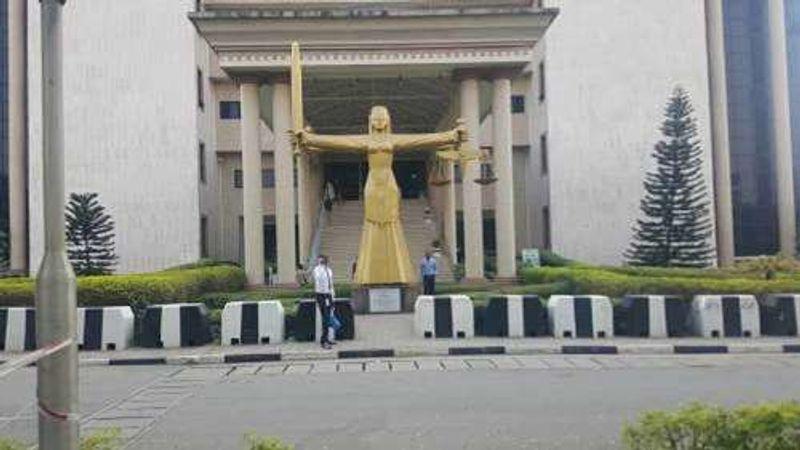
- The Federal High Court in Abuja adjourned the trial of Yahaya Bello, setting May 8, 2025, for a ruling on the admissibility of a key FCT High Court judgment
- Prosecution and defence clashed over the admissibility of documents related to school fees payments in the investigation of an alleged N80.2 billion fraud
- The case continued to unfold, with financial transactions and payments linked to Bello’s children at the American International School central to the investigation
The Federal High Court in Abuja has adjourned the ongoing trial of former Kogi State Governor, Yahaya Bello, to May 8, 2025, for a ruling on the admissibility of a judgment delivered by the Federal Capital Territory (FCT) High Court in the case involving Ali Bello and the Incorporated Trustees of the American International School, Abuja (AISA).
The case, which is central to an investigation into an alleged N80.2 billion fraud involving Yahaya Bello, continues to unfold in a high-profile legal battle.
On Thursday, March 6, following the conclusion of the examination of the third prosecution witness, Nicholas Ojehomon—an auditor with the American International School, Abuja—the defence counsel, Joseph Daudu (SAN), sought to introduce a key document before proceeding with cross-examination.
The document in question allegedly pertains to the payment or refund of school fees and has been tied to the broader investigation into financial transactions linked to Yahaya Bello.
According to earlier testimonies, Ali Bello, the son of the former governor, contacted the American International School with an offer to cover the school fees of Bello’s children until their graduation. This offer was accepted by the school, and payments were made on behalf of four of Bello’s children, enrolled in grades 8, 6, 4, and 2.
In his testimony, Ojehomon revealed that Bello also made preemptive payments for the school fees of children who had not yet been enrolled at the institution, further complicating the financial landscape of the case.
During the continuation of the trial on Friday, Daudu sought to tender receipts linked to the recertification of documents involved in the payment of fees.
The prosecution, represented by Kemi Pinheiro (SAN) from the Economic and Financial Crimes Commission (EFCC), objected to the admission of these documents on the grounds that the prosecution had not yet concluded its case, citing Section 232 of the Evidence Act.
In response, Daudu contended that the admissibility of evidence in both criminal and civil cases should be determined by its relevance to the ongoing proceedings. Citing Sections 4, 5, and 6 of the Evidence Act, he argued that once a document is deemed relevant, it becomes automatically admissible.
He also stressed that the document in question, a public record involving AISA, was essential due to the witness being the sole representative of the school in the matter.
Despite Daudu’s arguments, Pinheiro maintained his objection, urging the court to reject the document based on its non-compliance with procedural requirements set out in the Evidence Act.
Ojehomon’s testimony also centred on a series of financial transactions made to AISA on behalf of Yahaya Bello’s children.
He confirmed multiple payments, including a bank telex sent by Ali Bello via Forza Oil and Gas, as well as telexes from Whales Oil and Gas, Aleshua Solution Services, Uliati General Training LLC, and Dada Rand Merchant Limited in Uganda. Among the sums confirmed was a significant $90,000 payment, along with others totalling several hundred thousand dollars.
During cross-examination, Pinheiro asked Ojehomon to specify the names under which the payment receipts had been issued. The witness responded that the receipts were issued in the names of four of the former governor’s children.
However, the defence counsel interjected, questioning the accuracy of this identification and requesting that Ojehomon read the names directly from the receipts.
The cross-examination was abruptly halted as the judge, Justice Emeka Nwite, decided to adjourn the hearing for a ruling on the admissibility of the FCT High Court judgment.
The case, which is being closely watched for its high-stakes implications on the integrity of government officials and financial institutions, will continue in May when Justice Nwite is expected to deliver his ruling on whether the FCT High Court judgment will be accepted as evidence in the ongoing trial.
The Federal High Court has scheduled May 8 and 9, 2025, for this crucial ruling.
Court orders public notice of summons for Yahaya Bello at widely circulated newspaper, others
Meanwhile, TheRadar earlier reported that court summoned Yahaya Bello over new fraud charges worth N110.4bn.
Public summons authorised by Justice Maryanne Anenih to be published in widely-read newspapers, and others.