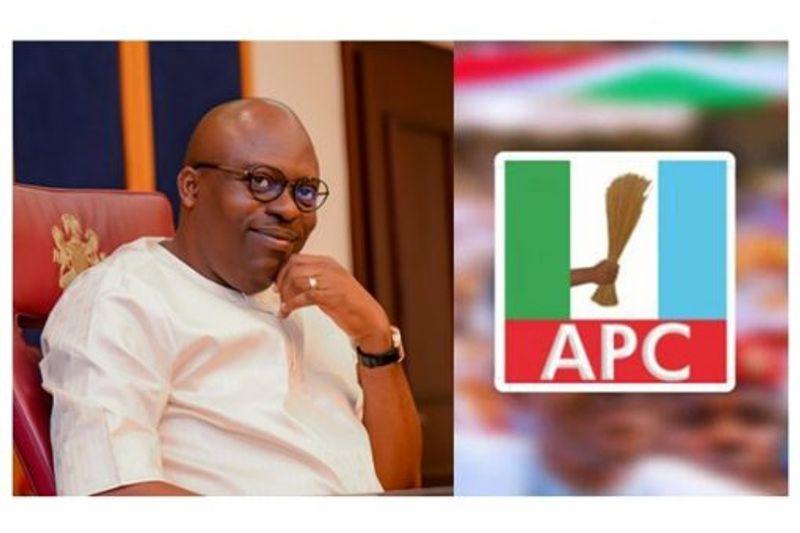
- The All Progressives Congress conducted governorship primaries across Nigeria amid rising tensions over consensus arrangements ahead of the 2027 elections
- In Rivers State, Governor Siminalayi Fubara withdrew from the APC governorship race after consultations, citing peace and unity
- Political rivalries linked to figures including Nyesom Wike continued to shape party dynamics, while aspirants in states like Kwara State and Lagos State intensified campaigns
The All Progressives Congress is set for a decisive round of governorship primaries across the country today, with mounting political tension in several states over attempts to impose consensus candidates ahead of the 2027 general elections.
Across the 36 states, party leaders and influential stakeholders have intensified efforts to adopt consensus arrangements in a bid to avoid divisive contests and maintain party unity. However, the move has sparked resistance from a number of aspirants determined to test their popularity through direct primaries.
Among the most closely watched contests is the Rivers State governorship primary, where dramatic political developments unfolded on Wednesday night following the withdrawal of Governor Siminalayi Fubara from the race.
Fubara, who had earlier been cleared to contest the APC governorship primary, announced his decision to step aside in a statement titled “My Decision to Withdraw from the Rivers State Gubernatorial Primaries.”
The governor said the decision followed extensive consultations and deep reflection, stressing that preserving peace and stability in Rivers State was more important than personal ambition.
“After deep reflection and extensive consultations with my family, friends, and associates, I have taken the difficult but necessary decision to withdraw from the APC gubernatorial primaries,” Fubara stated.
“I do so with a full heart and with a firm commitment to support whoever emerges as the candidate of our great party.”
The governor described leadership as a call to sacrifice, insisting that the unity and stability of Rivers State must take precedence over individual political interests.
“Leadership is ultimately about sacrifice. There comes a time when personal ambition must yield to the greater good of the people,” he added.
Fubara also thanked his supporters for standing by him throughout the political process and maintained that his withdrawal should not be seen as weakness or surrender.
“Let it be clearly understood that I stepped aside not out of weakness, fear, or surrender, but out of conviction and sacrifice so that Rivers State may move forward in peace and unity,” he said.
His withdrawal came amid months of political tension within the Rivers APC and a prolonged power struggle involving loyalists of the governor and allies of the Minister of the Federal Capital Territory, Nyesom Wike.
Political observers had earlier suggested that Fubara faced an uphill battle after several aspirants believed to be loyal to him were reportedly disqualified from the Rivers State House of Assembly primaries. Among those affected were lawmakers and political figures aligned with the governor during the state’s prolonged political crisis.
The political rivalry between Fubara and Wike has dominated Rivers politics since 2023, shortly after Fubara assumed office as governor with the backing of the former governor. Their relationship later deteriorated over disagreements concerning control of political structures in the oil-rich state.
President Bola Tinubu had previously brokered peace agreements between both camps, but the arrangements eventually collapsed, leading to heightened political instability and the declaration of emergency rule in the state in 2025.
Although Fubara later returned to office after the emergency rule was lifted, tensions within the state’s political landscape have remained unresolved.
Before Fubara’s withdrawal, two other governorship aspirants, Tonye Cole and former Commissioner for Works, Dakorinama George-Kelly, had also stepped down from the race, leaving House of Representatives Minority Leader Kingsley Chinda as the sole remaining contender.
Cole, who contested the 2023 governorship election, explained that his withdrawal followed consultations with the APC national leadership and was aimed at preserving party unity ahead of the 2027 elections.
“This decision was not made lightly. It is the product of deep reflection, patriotism, and an unwavering commitment to the stability, growth, and success of our great party and our beloved state,” Cole said in a statement.
Meanwhile, political tensions are also rising in Kwara State, where more than a dozen aspirants are reportedly preparing to challenge Governor AbdulRahman AbdulRazaq’s preferred successor, Ambassador Yahaya Seriki, despite endorsements from party stakeholders.
In Lagos, negotiations among party leaders intensified as some aspirants rallied behind Deputy Governor Kadri Hamzat, while others insisted on contesting the governorship ticket.
The APC is expected to conduct direct primaries in states where consensus arrangements fail, amid concerns from party officials that unresolved disputes could trigger deeper internal divisions ahead of the 2027 governorship elections.