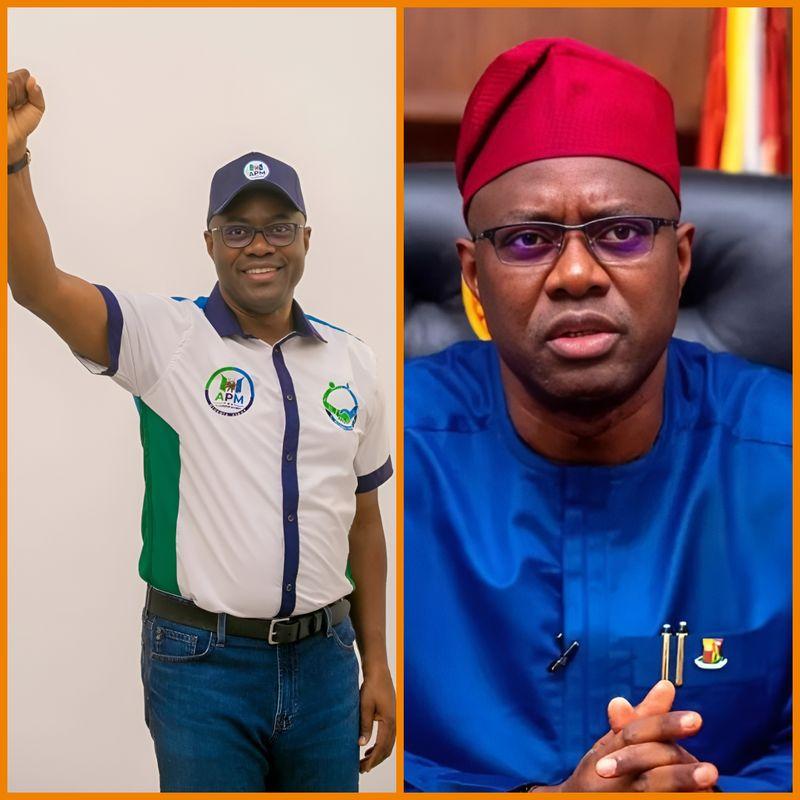
- Seyi Makinde’s announcement of his presidential ambition caused ripples across the Nigerian political space
- Analysts opine that Makinde’s entry could further divide southern opposition votes, potentially benefiting incumbent President Bola Ahmed Tinubu
- There is also a long-term strategy behind Makinde’s ambition ahead of the 2031 elections and beyond
Despite the lot happening in Nigeria, from insecurity to economic dawdling, 2027 has become quite the song on everybody’s lips as political entities begin to align and disalign ahead of the general elections next year.
For the presidential race, the front-runners of 2023 remain very much active, with Bola Tinubu enjoying the power of incumbency having emerged victorious at the last polls, perennial contender Atiku Abubakar refusing to give up, and Peter Obi defying odds and scheming to remain in contention.
Other names such as Bala Mohammed, Rotimi Amaechi and Rabiu Kwankwaso have been thrown up as possible candidates, but the recent announcement by Seyi Makinde, the governor of Oyo State, is one that caught many by surprise.
The governor made his ambition known on Thursday, May 14, at the joint mega-rally of the Peoples Democratic Party and the Allied Peoples Movement held at Mapo Hall in Ibadan, Oyo State.
He declared, “The time to reset Nigeria is now. Therefore, today, I, Oluseyi Abiodun Makinde, announce my candidacy for the position of the president of the Federal Republic of Nigeria.”
In the wake of this, some have opined that a presidential declaration is never simply an announcement of intention, but a strategic, well-timed entry into long-running negotiations among elite blocs, regional interests, and party structures.
What makes Makinde’s declaration more interesting is his decision to run on the platform of the Allied Peoples Movement (APM).
In order to understand the political statement made by Governor Seyi Makinde, one needs to understand the dynamics of Nigerian presidential politics. It has never been about popularity. Since 1999, outcomes have always been determined by coalition politics, regional balancing, and elite consensus. In 2015, for example, Muhammadu Buhari won the presidency not just because of his popularity but also because of a historic union of opposition blocs like CPC and ACN.
In the same manner, the emergence of Peter Obi showed the strength of frustration-induced emotionality and youth-driven politics while highlighting the weakness of movements without a strong institutional presence. Despite overwhelming digital and urban mobilisation, structure and elites still make a difference. Atiku ticks the boxes in this regard but has often swum against the tide, either in terms of zoning arrangement as seen in 2023 or competing with a Northern heavyweight and incumbent as seen in 2019.
The declaration of Makinde is then examined against the grand scheme of things as the jostle for the biggest job in the land heats up.
Why now for Makinde?
Makinde embodies a high-performing governor with credible administrative and political stability in Oyo State who is aiming to take his ‘performance’ national.
His declaration, especially on the platform of APM, lends further credence to the crisis that has befallen the PDP, and it remains to be seen how low the once-grand party will fall before it is revived.
The G5 rebellion involving Nyesom Wike and Seyi Makinde himself, among others, and the emergence of Atiku as the 2023 presidential candidate marked the beginning of the end for the party that produced Nigeria’s presidents from 1999 to 2015.
Political analysts have pointed to a long game being played by Seyi Makinde, and it is difficult to disagree with that.
By beginning his presidential ‘failure’ now, by the time 2039 rolls in, when it will be the turn of the South for the presidency, he will have become popular across the nation while also using the opportunity to build bridges and coalitions across the country, especially in the core North.
It is interesting to point out that Tinubu became president at 71 and, in 2039, Makinde will also clock 71. Not bad for a coincidence.
Recall that Seyi Makinde lost the governorship election in Oyo State several times before he emerged victorious in 2019. At the national level, the late Buhari had a similar run before eventually clinching it.
In the short term, a vice-presidential slot is a possibility in 2031. By being ‘out there’ from now, he positions himself to be a contender for the position of vice president when presidential zoning returns to the North.
In addition, in the context of Nigerian politics, ambitions for the presidency have little to do with actual victories; they have everything to do with strategic positioning. By entering the race early, Makinde enhances his position as a player in opposition discussions and negotiations. Even without winning the nomination, he is a key actor at the negotiating table, whether now or later.
This is not new in Nigerian politics. Politicians like Bukola Saraki and Aminu Tambuwal remained relevant in the country's politics well after abandoning the presidential race because, in Nigeria, visibility sometimes equates to influence.
How is Tinubu affected?
A tweep, @olamathew777, believes that Makinde’s presidential declaration is a game plan by President Tinubu.
“I'm �� percent sure that BAT is behind this. A game plan.”
While the game plan is one that is difficult to see, others on the X platform think it is a ploy by the opposition to eat into Tinubu’s prospective votes in the South-West. Tinubu is firmly entrenched in incumbency and South-West political domination. Therefore, Makinde’s candidacy introduces another pole of the South-West elite operating outside APC control.
This could be significant because regional dominance loses steam when an internal elite alternative emerges. Makinde does not have to defeat Tinubu; he just has to upset the regional uniformity.
A political analyst, Kunle Okunade, added his voice:
“It is obvious that the Southern votes will be divided among Tinubu, Adebayo, Makinde and Obi, considering the fact that the election will be predominantly influenced by ethnicity/tribalism and other factors.
“Having four presidential candidates in the South alone gives any northern candidate an edge. Although the North votes will not be bulky and one-sided as they usually used to be, more damage will be done to the southern votes and candidates,” Okunade told BusinessDay.
Another expert, Kunle Adebisi, opined, “The moment multiple candidates from the same region begin competing aggressively against one another, the advantage naturally shifts to the region that negotiates better politically.”
Political commentator Dipo Oguntusi, however, sees Makinde as part of the opposition that would only ensure the smooth return of Tinubu to Aso Villa.
“Whether they are southerners or northerners, the opposition ought to be united if they want to defeat the incumbent or else we will have a repeat of 2023 and it would be congratulations to President Bola Ahmed Tinubu in advance,” he submitted.
Nonetheless, despite the submissions of experts and analysts, incumbency still counts in Nigeria. Since the beginning of the Fourth Republic in 1999, all incumbent Nigerian presidents have won their respective re-election bids with the exception of Goodluck Jonathan, who spent six years as president, as opposed to four, following the death of his principal, Umaru Yar’Adua, in 2010.
If we count Yar’Adua/Goodluck as incumbents in 2011, then the ratio is 3:1 — a 75 per cent probability of success for an incumbent. Tinubu undoubtedly has an edge, despite the likely complexity in the dynamics of the opposition.
What Makinde’s ambition means for Peter Obi
Peter Obi is also not left out of the possible impact of Makinde’s ambitions.
Unlike Atiku Abubakar, who still commands traditional northern political networks, or Tinubu, who enjoys incumbency and an entrenched party structure, Obi’s strength lies heavily in emotional mobilisation, youth enthusiasm, urban voters, and the perception that he represents a break from the old political establishment.
Makinde’s entrance into the race threatens to chip away at some of these advantages, especially in the South. The emergence of another relatively younger southern governor with an administrative performance record introduces a fresh variable into that coalition.
However, some observers have expressed hope that if opposition forces — Obi, Atiku, Makinde, Kwankwaso and other aspirants — can somehow manage to unite, then Tinubu can be given a run for his money. Else, he may benefit from a divided field just as he did in 2023.
Makinde raises alarm over threat to Nigeria’s democracy
Meanwhile, in a previous report by TheRadar, Oyo State governor, Seyi Makinde, expressed renewed concern over the state of democracy in Nigeria, warning that the country may be gradually drifting towards a one-party system.
Makinde noted that individuals who oppose the idea of a one-party state are increasingly facing intimidation, while opposition parties are being marginalised.
He cautioned that Nigeria could be entering a phase characterised by silence, apathy, and disengagement among citizens, a trend he warned might prove difficult to reverse if left unchecked.