
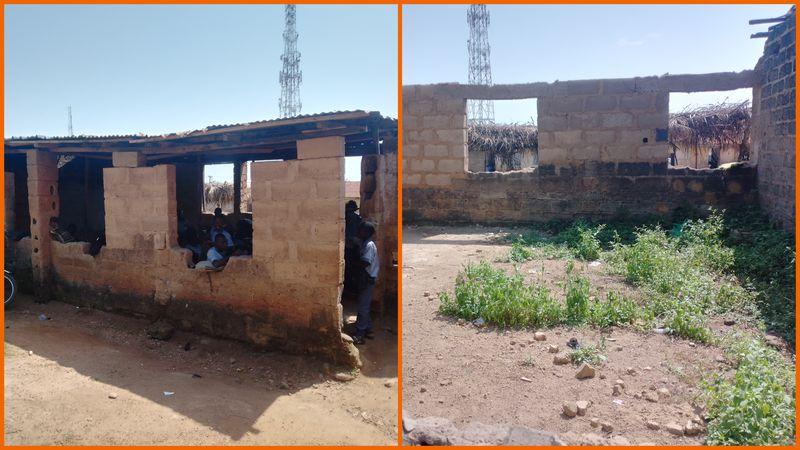
- Oyo State Governor, Seyi Makinde, approved ₦9.97 billion for the renovation of schools in Oyo State in April 2025
- Checks by TheRadar revealed that students continue to learn in dilapidated classrooms across various schools in the state, amid cases of vandalism and theft
- The government said the renovations are in phases and constrained by a ₦10 billion budget, schools are selected based on the level of disrepair, while assuring that it is committed to providing a conducive learning environment for students
Despite a ₦9.97 billion contract awarded for the renovation of schools in Oyo State, students continue to learn in dilapidated classrooms, raising concerns about the government’s commitment to improving education infrastructure.
The contract, approved by Governor Seyi Makinde in April 2025, was for the renovation of public schools across the state. The government added that the schools were selected based on their urgent need for infrastructural intervention, as many are currently in varying stages of disrepair.
According to the Commissioner for Information and Orientation, Dotun Oyelade, the contract would cover perimeter fencing, construction of toilet facilities, drilling of solar boreholes, installation of solar lights, and procurement of furniture.
Many months after the announcement, findings, however, reveal that many schools in the state are still in a deplorable state, with blown-off roofs, crumbling walls, and inadequate furniture.
At Aponmade Moniya High School in Moniya, Akinyele Local Government Area of Oyo State, Victoria Olawuyi, a senior secondary 3 (SS3) student, goes home whenever she needs to urinate or defecate because there’s no functional toilet in her school. Each time she needs to change her sanitary pad during menstruation, she rushes to her house, which is a stone’s throw from her school.
“I personally don’t ease myself in school; my house is not far from the school, so I go home to ease myself or change my pad,” she said.
For other students and teachers whose houses are not close to the school, they make use of a bush beside a heap of dirt and a dilapidated structure that was once the school’s toilet. When done, they wash their hands from a 1,000-litre tank donated for the purpose and other needs by the Muslim Students’ Society of Nigeria (MSSN).
Aside from the non-availability of a toilet facility, the school’s infrastructure is at various stages of disrepair: leaking roofs, uncemented classroom floors, inadequate desks, and classroom windows covered with planks. With a dwarf fence and no gates, the school is open to intruders, who sometimes cart away its property.
“We need social amenities, number one being a toilet. The toilet is not good enough for students because there are many infectious diseases that one can contract from it. Secondly, the road leading to the school is poor and should be fixed,” Victoria said. “The roof is equally bad. Even in the lab, it’s only God who is protecting us. If it is raining, the whole place will be flooded from the leaking roofs. If it rains, we have to clean the floor before continuing with classes.”
A former student of the school, who identified himself simply as Khaleed, corroborated Victoria’s statement. He said, “When I was here, the SS3 classroom and the lab were very bad. I wish the lab were equipped.”
Situation not peculiar
At Community High School in Apapa Moniya, TheRadar observed that the school faces inadequate classrooms with only two blocks of classrooms serving the entire school. Students were seen learning in a decrepit classroom with parts of its roof blown off. This reporter learnt that students make their desks themselves, while those who cannot afford to, share with others.
“You can imagine three or two students on a bench. You will see two students sharing a single chair. I will ask them how convenient it is for them to sit on a chair? How do you want to write when you are given a note? It’s really affecting them negatively,” an official of the school who does not want to be named said. “When it rains, you will think there is erosion here,” the school official added.

A classroom at Community Grammar School, Apapa Moniya
Beside it is another classroom without a roof, windows, or doors, and taken over by weeds. Due to inadequate classrooms, the SS3 students were transferred to a rented space a few metres away from the school. According to a teacher, the school is being threatened with eviction from the space.
“They are indirectly driving us out of a rented apartment we are managing to use for SS3 students. We were desiring and hoping that if that place (the classroom without a roof) can be completed, we will move the SS3 students to the place so our eyes can be on them. Though some teachers do sit there to monitor the students, we know how smart students can be because whenever they want to sneak out, teachers may not know.”
The source also disclosed that during a recent Parents-Teachers Association (PTA) meeting, parents agreed to contribute N2,000 for each child towards the renovation of the school’s structures.
There is also no staffroom; teachers either sit in classrooms or under a shade in front of the school made from palm fronds.
The only standard building in the school is a block of three classrooms and the principal’s office, built by the Apapa-Ojemo Community Project Management Committee (CPMC), Akinyele LGA (OYOCARES Project). It was funded by the Oyo State Community and Social Development Agency (OYCSDA). The OYOCARES project also facilitated the building of toilets and water facilities in the school.
It was also observed that there are no laboratories or a library in the school. Some of the books meant to be in the library were seen stacked against a wall in the not-fully-furnished principal’s office.
Some SS2 students of the school told TheRadar that they hold their practical classes in their classrooms and read up on whatever they don’t understand.
“We do it (practical) in our class; they bring the equipment to our class and explain. We are managing,” one of the students said.
Our official source and staff of the school sadly noted that the poor state of infrastructure does not affect enrolment into the school, as parents do not understand the essence of infrastructure in learning.
“It doesn’t affect enrolment. Even till next term, some will still be coming. The parents don’t understand. You can’t give what you don’t have. When parents don’t even know the value of education, do you want them to give their children a valuable education? Some parents are unaware that they give their children assignments. Who will be at home to even put the child through?” the official said.
For Army Barracks Grammar School, proximity to the government doesn’t guarantee attention
The situation was not different at Army Barracks Grammar School, Iwo Road, Ibadan. The school, situated a few metres behind the Ibadan North-East Local Government secretariat, lacks basic infrastructure, including classrooms, furniture, laboratories, a library, and administrative offices.
TheRadar observed that the school has only three functional blocks of classrooms, and some of the old classrooms are dilapidated and overgrown with grass. The floors of some of the classrooms are not cemented, with broken ceilings and a damaged roof. Some of the ceilings in the principal’s office are also broken.
The laboratory, which has become dusty from not being in use, lacks equipment, with broken ceilings, a damaged roof, and its windows missing some louvres. The Home Economics laboratory has been converted to a staffroom, and some of the equipment in it, including an oven and baking pans, has been kept in a corner of the room. The books in the library are old.

A classroom in Army Barracks Grammar School, Iwo Road, Ibadan
When TheRadar visited the school on a Thursday afternoon in mid-November 2025, two of the newly elected officials of the school’s national alumni association, Mr Ajibola Osuntoogun, the National General Secretary and President of the 1999 set, and Mr Kolapo Onigbinde, the National Assistant General Secretary and President of the 2006 set, were on ground to take inventory of what the school had and what was lacking for the association’s intervention.
They told TheRadar that the school is practically being supported by the alumni associations of various sets, as each set regularly adopts one project as a way of giving back. Various sets of the school’s alumni donated white marker boards, generating sets, a public address system, drums, renovation of some classrooms, and building of a toilet for the school.
Dr Sanmi Bamidele, the National President-elect of Army Barracks Grammar School, Ibadan, Alumni Association, appealed for urgent government intervention to support the efforts of the association.
“The school is not in very good shape. In fact, what we left when we left school some decades ago is no longer there, and that is why we are appealing to the government to be magnanimous to us and come to our aid.
“The old students are equally not relenting in our efforts to make sure that we salvage some situations, but if the school can be included in the government’s database of schools in need of intervention, it is going to really help us,” he said.
One of the old students, Mr Ajibola Osuntoogun, who is also the president of the school’s 1997 alumni set, lamented that the poor state of the 40-year-old school has led to a decline in enrolment of students. He said, unlike in his days when the school had thousands of students, it can only boast of between 400 and 500 students now.
When TheRadar visited Olubadan High School, Aperin, Ibadan South-East LGA, it was noticed that the roof of one of the buildings was blown off, its windows were missing, and it was no longer occupied by students.
When asked if there were any plans to renovate the building or other structures in the school, the principal of the school retorted, “No renovation is going on here.” One of the school’s vice-principals, however, told TheRadar that government officials had inspected the structure and others in the school last term and promised they would be renovated.
At IMG Grammar School (Mixed), located on the ever-busy Orita Aperin road, one is met with dilapidated classrooms and students sitting on the window frames due to inadequate desks.
It was observed that two blocks of classrooms serving the junior secondary section were built under the 2021 FGN-UBEC/Oyo SUBEB Project Intervention Programme in the JSS Education Sub-sector.
The school principal, Mr R.O. Fehintola, said the absence of a fence or other security measures exposes the school to thieves who regularly steal valuables like desks, laboratory equipment, and books.
He said the school resorted to keeping most of its valuables in the principal’s office or in teachers’ houses for safekeeping, adding that the situation was not only peculiar to the school, as all the schools around the area had similar tales of burglary.
The principal noted that since the school is relatively young, the old students are still finding their feet and not yet able to contribute to the development of the school. He said apart from government interventions, the school receives support from the PTA and has agreed to contribute towards the repair of chairs and rebuilding some of the damaged structures.
“The PTA agreed to pay N500 for the repair of chairs. They’ve carted all the chairs in this school. So, we decided to replace some, but we are not going to build the iron type again since they (thieves) have an interest in the iron. During the long vacation, in the first two weeks, I was told that they had burgled the classrooms and stolen the chairs.
“They can’t pay for the building now because it will be too much for them. We will do it one after the other. The government built some classrooms and provided seats, but thieves stole them. The government is trying, but the state is wide, so it can’t be the same.”
Mr Fehintola also said the school has two toilets, one for staff and another for students, at each end of the school, equipped with running water, which were built by the government.

Back view of a classroom at IMG Grammar School (Mixed), Aperin, Ibadan
The story of vandalism and property theft was the same at Community High School, Fiditi in Afijio LGA. The school is not fenced or gated, which makes it vulnerable to thieves.
A teacher in the school, Mr Ayo Olafuyan, told TheRadar that the school, which was formerly a modern school, previously boasted of electricity, a dining area, a technical workshop, a student hostel, among others, but has suffered vandalism and dilapidated structures.
He said, “We barely have infrastructure just because of the environment. We are closer to the border than to the town, so vandalisation and theft are rife. From what I heard, we used to have electricity here before, and even the lab we have now is nothing to write home about. The physics and chemistry labs have been vandalised by community members. The school is not fenced, so it’s open to anybody.”
TheRadar found that students are expected to pay N600 and N200 every term as security dues and for pumping of water, respectively. Mr Olafuyan said the amount is barely enough to cater for the security and other needs of the school and called for government intervention in fencing the school.
He also said the old students’ association supports the school by providing chairs for students and renovating some of the classroom buildings.
Mr Olafuyan also disclosed that some of the renovated classrooms and a block of two toilets were done by the Ajimobi government. TheRadar, however, observed that students ease themselves in a nearby bush within the school, while teachers make use of a zinc-enclosed area within the school, as the toilets were marked for principal and official use only.

Some students of Community High School, Fiditi, returning from relieving themselves at a nearby bush in the school
Schools at various stages of renovation
In April, the Oyo State Government announced the commencement of the renovation of 36 public schools across the state. A statement by the government noted that the schools were selected based on their urgent need for infrastructural intervention, as many are currently in varying stages of disrepair, adding that more schools from all the zones in the state have been slated for renovation in subsequent phases.
Before the list of schools that would benefit in the first phase of the renovation was released, the state government announced the approval of N9.97 billion for the immediate construction and rehabilitation of schools across the state, involving 50 contractors at a cost of N9,974,332.00 in February 2025.
The government also collaborated with the Global Partnership for Education (GPE), a World Bank-assisted programme, to disburse grants for the renovation of 58 public schools in the state. Under the approved project plan, some schools were selected for infrastructural development, including the renovation of classrooms, the provision of potable water, furniture, toilet facilities, and solar systems.
When TheRadar visited some of the schools in the first batch of 36 schools being renovated in the state in mid-to-late November 2025, they were at various stages of renovation. At Oba Akinyele Memorial Secondary School, Basorun in Ibadan North LGA, two visible blocks of classrooms were observed to have been completed and painted in the state’s signature cream and burgundy colours, with minor finishing touches, but not yet open for students’ use.
The renovation of a block of 12 classrooms at Community High School, Otun-Agbaakin, Moniya, in Akinyele LGA was observed to have been completed, fitted with metal doors and windows, and already in use. The building is yet to be painted.
A community member, who identified himself simply as Lekan, noted that the renovation and fencing of the school, which began last term, have helped in curbing absenteeism and other vices among the students, as they are confined within the school compound and study in a more conducive environment than previously obtained.
He said, “During the rainy season or when the sun was high, by 11 a.m. or 12 noon, the students would start going home because it was not conducive. But now that they’ve done this, it is preventing them from going home; they stay till closing time.”

A block of renovated classrooms at Community High School, Otun-Agbaakin, Moniya
A visit to Community Grammar School, Mokola, one of the schools selected in the first batch of renovation in Ibadan North LGA, showed that three blocks of classrooms have been fully renovated, painted, equipped with desks, and already in use, in addition to the provision of toilet and water facilities. It was also observed that it is fully fenced, gated, and painted.
However, two other blocks of classrooms were still being renovated and were at the roofing stage.
A teacher in the school, who pleaded anonymity, commended the efforts of the government in renovating the school and appealed that adequate security should be provided to avoid vandalisation of the school’s properties.
The teacher said, “In this place, we have only one security guard and the compound is large; only one security guard at night and in the afternoon. What if they attack the security man or lock him inside one place and unleash havoc here? If the government can add enough security both in the primary and secondary sections, it will preserve what they are spending now.”
The teacher also disclosed that due to the security lapses, the school’s laboratory, built by an old student, was burgled by thieves who carted away laboratory instruments, leaving the students to borrow from other schools for their practicals, especially during senior school examinations.
“The lab is already dilapidated; nobody can learn anything here. It’s as good as the school doesn’t have a lab. If they renovate this place, this is a superb lab. We have chemistry, biology, and physics. But due to the security lapses, you will see that they’ve broken all the windows. When the security was down there, they started committing the atrocity here.
“Practical? When they don’t have instruments? They will teach them off-hand; no practical. It’s only when they want to sit either NECO or WAEC that they go and borrow from those schools that have the instruments because all the instruments here have been carted away,” the teacher said.
At HLA Primary School, Agodi Gate in Ibadan North, TheRadar observed that only one classroom building has been roofed, with visible signs of newly constructed pillars, lintel, and brickwork, but without windows and doors, and not yet in use. Another building within the school had a new lintel and brickwork above it, but not yet roofed.
According to Ayomide, a member of the community, the renovation began about two months ago, and the pupils were relocated to another building with visible signs of disrepair. The classrooms are without windows, doors, or desks, and their roofs or ceilings are damaged. It was observed that people from the community often took naps in the classrooms and defecated in a nearby bush.

A block of classrooms under renovation at HLA Primary School, Agodi Gate, Ibadan
TheRadar observed that the large expanse of unfenced land, housing IMG Grammar School, HLA primary and secondary schools, was strewn with school buildings in various decrepit stages, some of which have been abandoned, overgrown with grasses, and have become an abode for miscreants.
Educationist speaks
Folorunsho Moshood, Programme Director, Educare Trust Nigeria, told TheRadar that the poor state of infrastructure in most public schools in Oyo State poses a challenge to the quality of education students receive.
Mr Moshood said the situation contributes to the reduction in school enrolment levels and leads to a higher number of out-of-school children, 60,000 of whom the state government claims to have returned to the classroom. He added that it was the responsibility of all stakeholders, including parents, Civil Society Organisations, PTA, and old students, to ensure the provision of adequate infrastructure, but noted that the government bears a greater responsibility.
“You hardly get a public secondary school in Oyo State that has most of these facilities that constitute quality of education. Quality of education is not the responsibility of the government alone, but the government has more roles to play than any other stakeholder in ensuring quality education,” he told our reporter.
Oyo State budgetary allocation to education since 2020
The Oyo State Government, under Seyi Makinde, has always stated its commitment to the improvement of the education sector by prioritising it in budgetary allocations.
A look at the state’s budgets since 2020 shows that the allocation to the Ministry of Education has increased over the years and consistently met UNESCO’s recommendation of governments to allocate between 15 to 20 percent of their annual budgets to the education sector.
Out of the state’s 2020 budget of ₦213 billion, education was allocated ₦47 billion, which is 22 percent of the entire budget. In 2021, ₦56.3 billion was allocated to education out of the ₦266.6 billion budget. Though the amount is ₦9.3 billion higher than what was allocated to the ministry in 2020, it is 21 percent of the year’s budget.
In 2022, however, the sector’s allocation decreased to ₦54.1 billion, representing 18.37 percent of the state’s ₦294.5 billion budget for the year. The education sector’s allocation in the 2023 budget increased by ₦4 billion to ₦58.2 billion, representing 18.78 percent of the ₦310.4 billion budget for the year.
In the 2024 budget, the education sector was allocated ₦90.6 billion. Though the amount is ₦32.4 billion higher than what the sector received in the 2023 allocation, it represents 20.8 percent of the state’s ₦434.2 billion budget.
Out of the ₦678 billion 2025 budget estimate, the state government allocated the second-highest amount of N145.26 billion to education, representing 21.44 percent of the entire budget.
Moshood, however, noted that beyond budgetary allocation, it is imperative to ensure the judicious use of allocation to avoid scepticism from citizens.
“Whatever the budgetary allocation to the education sector is, it should be judiciously used to solve the problems of education in Oyo State. One thing is to increase the budgetary allocation to education in Oyo State; another thing is the actual implementation of that budgetary allocation. I think over the years, members of the public are always sceptical about the judicious utilisation of budgetary allocation to the education sector.”
Government responds
In an interview with The Radar, the Special Adviser to Governor Seyi Makinde on Education Intervention, Olooye Suraj Abiodun Tiamy, acknowledged that the state of dilapidation of schools in the state contributes to the decline in public school enrolment and attendance by students and hampers effective teaching and learning.
He explained that since an earlier World Bank-assisted Better Education Service Delivery for All (BESDA AF-TESS) project focused on renovating 105 schools in rural areas, the new state project, targeting about 100 schools, concentrated more on the urban areas to ensure a balance.
Mr Abiodun noted that the ongoing renovation of schools across the state is limited because of the amount earmarked for the project. He added that the government assessed the level of dilapidation in schools across the state and selected as much as the ₦10 billion budget could accommodate, assuring that more schools across the zones in the state would be included in the second and third phases of the project.
He said, “His Excellency made available ₦10 billion for the renovation of our schools, and by the time we started visiting all the schools to evaluate the cost of renovation, we realised that some of our schools will cost about ₦200 million because this has piled up from one administration to another.
“During Omituntun 1.0, we renovated a number of schools, but because of the accumulation of dilapidated schools, and things are more expensive now, to renovate Oba Akinyele is about ₦200 million, another school ₦250 million, some ₦300 million, some ₦400 million. So, we are limited with numbers of schools that can be selected as part of phase one. That’s the only reason because we have to work with the budget that we have. The cost of all the schools, when you add it up, you will be looking at about ₦20 billion, ₦30 billion, and we have a budget of ₦10 billion. So that limited the selections in terms of the number of schools.”
On the timeline for the completion of ongoing renovations, the governor’s aide said the government initially targeted 12 weeks and wanted the projects to be done during the holidays, but due to some challenges, the project implementation did not commence as scheduled. This, he said, affected the completion timeline of the project, especially as students have to be relocated from one classroom to another while work is ongoing, in addition to being mindful of the safety of students. He added that ongoing renovation works would be completed during the Christmas and New Year holiday.
The challenge of millions of children in Oyo state reported to be out of school is another that plagues the state’s education sector. Mr Abiodun reiterated that the government is committed to ensuring no child of school-going age is left behind, as proposed by its free and compulsory education policy.
He disclosed that in addition to efforts, the government plans a project that would commence in 2026, where children in identified locations, who attend non-teaching schools like Islamic schools (Ile-kewu), would be taught English and Maths for a period of time and subsequently assessed and placed in regular schools based on their performance.
“This project is going to start next year. So, we will be visiting all the areas to identify the number of non-learning schools, whereby we can encourage them from Ile-kewu to start going to the formal schools,” he said.

Olooye Suraj Abiodun Tiamy, Special Adviser to Governor Seyi Makinde on Education Intervention, explains the prototypes and progress of renovations of the selected schools
To curb the incessant cases of vandalism and theft of schools’ properties, Mr Abiodun said the government included the erection of perimeter fences and gates in the schools being renovated and plans to deploy security operatives to each of the schools by next year.
He said, “In the selected schools, we are erecting fences with gates. And from next year, we will have a security personnel in each of our schools, they will be there day and night looking after all our investments. There will be a stand-alone light in order to help the security to walk around at midnight or during the day.”
The government official also added that the equipping of schools’ laboratories and libraries with necessary instruments and books would be implemented in the subsequent phases of the project.
Reporting note
After repeated attempts to obtain responses through official channels were declined by some school officials, who cited fear of retribution, this reporter adopted alternative reporting methods in the public interest. She visited some schools while posing as a prospective guardian seeking enrolment for a ward and conducted additional interviews as an academic researcher. This enabled her access to experiences that could not be documented through conventional reporting.
This report was facilitated by DevReporting in partnership with Education As a Vaccine (EVA) and supported by the Malala Fund.
Ministry of Education clarifies proposal on 12-year education system, hints at implementation date
Meanwhile, TheRadar earlier reported that the Federal Ministry of Education had clarified that the Minister of Education, Tunji Alausa, only proposed the introduction of a 12-year basic education system, and there has been no immediate policy change.
In response to widespread media reports suggesting that the Junior and Senior Secondary School (JSS and SSS) system would be scrapped, the ministry issued a statement emphasising that the proposal was still under review.
