Nigeria currently has one of the highest neonatal and maternal mortality rates in Africa, yet efforts by the government to curb the crisis continue to be undermined by failures within its own control.
The Patient
It’s past midnight on a Friday in September 2025. Esther Nicholas's water has broken, and there is an urgent need to move her to the hospital for delivery. With no means of transport apart from their legs, her husband walks with her for about fifteen minutes under the light of the moon.
Esther, in her late twenties, lives in a two-bedroom apartment in a grey-painted block in Ogbere Resettlement, a rural community in the Ona-Ara Local Government Area of Ibadan, Oyo State. Near the main junction in her neighbourhood, a church member of theirs, who had a car, came to their aid and drove the young couple to the hospital, about 20 minutes away. Hours later, the cry of a baby echoed from the labour room.
“I wept,” she recalled, “until there were no tears left in me.”
Esther had been expecting twins. Only one was delivered alive; the other died from complications. While people came to congratulate them, she carried both joy and pain. One day, she would have to explain to her surviving child how he lost his sibling.
Esther married immediately after her National Youth Service Corps (NYSC) in 2022. She and her husband started building their lives, and during one of her antenatal sessions, she was confirmed to be pregnant with twins.
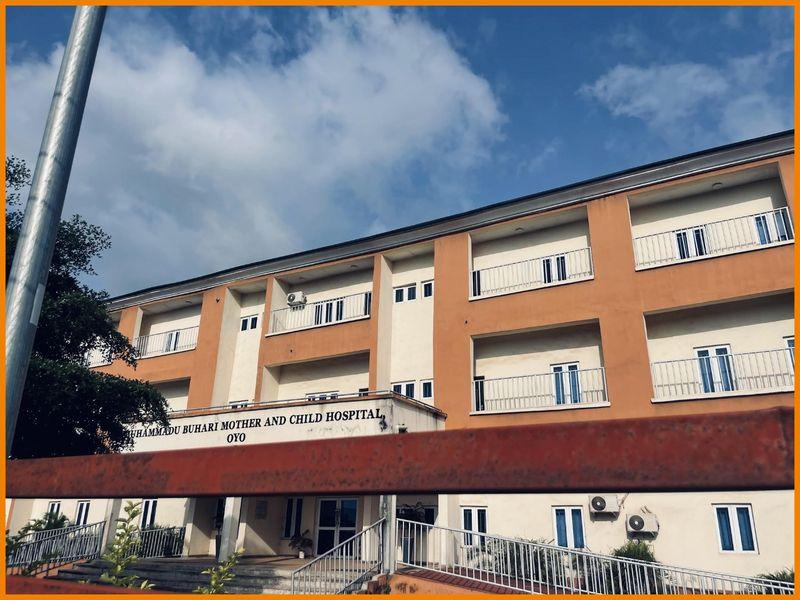
On the night she went into labour, Esther walked by a certain “ultra-modern hospital” that was close to her house. She described it as a gigantic medical landmark, beautified with a plethora of flowers and lighting. The hospital was built as part of a Federal Government-funded project four years ago and was named after Muhammadu Buhari, who was president at the time. The hospital’s name, Muhammadu Buhari Mother and Child Hospital, Ibadan, is written in bold letters at the top of the building’s front.

“If only it were working; maybe David (her son’s name) would have his twin,” Esther said in a faint voice, close to tears. The distance to the hospital where she was registered for care was one of the factors she believes contributed to the loss of her child. Still, she remains grateful that she survived.
Over 15 months, this investigation examined the non-functionality of the facility. On repeated visits, we found it idle. Residents initially thought it would address maternal and infant mortality in the area, but that expectation remains far-fetched.
Nigeria has one of the world’s highest maternal mortality burdens and the highest number of maternal and neonatal deaths in Africa. About 20,811 maternal, neonatal, and under-five deaths were recorded between January and September 2025 alone, according to the Nigeria Health Statistics Report. The infant mortality rate for the country in 2026 is 51.54, a slight improvement from 2025 but less than the United Nations’ standard, which is to be met before 2030.
This investigation traces what happens when government intervention stops at the construction of a building and does not extend to the people, personnel, equipment, and systems required to make that building a functioning hospital.
Community members are confused
In May 2025, when we first visited the Muhammadu Buhari Mother and Child Hospital in Ibadan, many residents were unaware of the facility’s origin, while a few believed its continued closure was connected to the state’s political leadership.
Kunle Daisi, a resident, said, “The facilitator is an APC (All Progressives Congress) member, and the state government is PDP (People’s Democratic Party); what do you expect?” he said, offering his own political interpretation of the situation.
But the uncertainty among residents goes beyond politics; many simply do not understand why a fully constructed hospital has remained closed for years. When it was commissioned, Shola Ajayi, a resident, was early in her pregnancy and eager to be among the first set of women to register for antenatal care there. However, that did not happen.
“To the glory of God, as you can see,” she said, turning towards her baby, who was eating from a little green bowl, “my baby is two years and a few months old now… while the hospital is still there and useless.”
The hospital’s inactivity has also affected businesses that sprang up around it. Facing the hospital is an array of shops built by private individuals simultaneously with the hospital project. The landlord and tenants had thought the opening would bring economic activities which would help their pockets. Little do they know that the hospital facilitators were not party to their beautiful plans, as in the case of Muslimat Durojaiye.
“Out of excitement, I started a baby-items store to be best aligned with the purpose and operations of the hospital here. However, since the hospital is locked, business is a struggle,” Muslimat lamented in May last year. During a visit in June 2026, we found her shop locked.