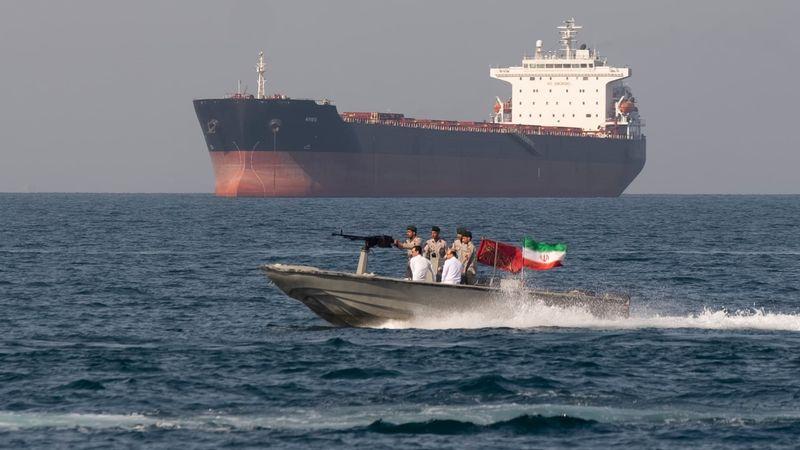
- Iran has attacked two commercial ships in the Gulf, including the Liberian-flagged Express Rome and Thai bulk carrier Mayuree Naree
- G7 and IEA disclosed plans to release strategic oil reserves to stabilise markets as Germany and Japan pledge contributions
- The Strait of Hormuz shutdown threatens 20% of global crude and LNG, plus one-third of global fertilizer supply
Iran fired on two commercial vessels in the Gulf on Wednesday, March 11, setting at least one ship ablaze, as tensions in the Middle East escalated and global powers released oil reserves to stabilize markets.
Oil prices jumped more than 5% in early trading, with markets remaining volatile following the US and Israeli strikes on Iran that killed its supreme leader, plunging the region into conflict.
Now entering its 12th day, Iran has vowed to target “economic centres and banks” linked to US and Israeli interests.
Attention has focused on the Strait of Hormuz, the key shipping lane connecting Gulf oil and gas export terminals to the global economy.
Iran’s Revolutionary Guard said it had attacked the Liberian-flagged container ship Express Rome and the Thai bulk carrier Mayuree Naree for entering the strait “after ignoring the warnings of the IRGC naval forces.”
Thailand’s navy confirmed the Mayuree Naree was struck while transiting the strait. Oman’s navy rescued 20 crew members, while efforts continue to locate three others.
IRGC naval commander Alireza Tangsiri posted on social media: “Any vessel intending to pass must get permission from Iran.”
Separately, Iran’s military operational command declared on state television that any vessel from the United States, Israel, or their allies would be considered a legitimate target, reiterating that it would “not allow a single litre of oil to transit” the strait.
In response to rising oil prices, G7 leaders held a video conference to discuss releasing strategic petroleum reserves.
Germany’s Energy Minister Katherina Reiche said the International Energy Agency (IEA) had requested member states release 400 million barrels, and Germany would comply.
Japan’s Prime Minister Sanae Takaichi announced that her country is ready to release reserves by Monday without waiting for an IEA directive.
Iran’s missile and drone attacks have effectively shut down the Strait of Hormuz, through which 20% of global crude oil and liquefied natural gas passes.
Analysts warn that a prolonged closure, which also carries one-third of the world’s fertilizer supply, could severely impact the global economy, especially in Asia and Europe.
On Tuesday, March 10, the Pentagon said US forces destroyed 16 mine-laying vessels capable of blocking the strait. Despite this, Iranian attacks continued on Wednesday, March 11, hitting at least three ships.
US President Donald Trump warned on social media: “If for any reason mines were placed, and they are not removed forthwith, the military consequences to Iran will be at a level never seen before.”
Israel announced a “wide-scale wave of strikes” across Iran and Hezbollah targets in Beirut. Defence Minister Israel Katz stated: “This operation will continue without any time limit, as long as necessary.”
Meanwhile, drones fell near Dubai airport, injuring four people, the city government said.
Trump has suggested the US Navy could escort tankers through the strait, though experts remain skeptical.
“The security risks alone could make a single transit through the strait more costly than the profit margin on the oil shipment itself,” the Soufan Center said.
Analysts estimate Iran’s naval mine stockpile ranges between 2,000 and 6,000, complicating any escort operation.
The conflict comes weeks after Iran suppressed mass protests, though the US and Israel say their actions are not intended to topple the Islamic Republic.
Iranian authorities warned against domestic dissent, with police chief Ahmad-Reza Radan stating that protesters would be treated as “enemies” and that “all our forces are also ready, with their hands on the trigger, prepared to defend their revolution.”
Despite the attacks, ordinary Iranians are adapting to daily life under constant strikes.
“We’ve put our faith in God. For now, there’s food in the shops. Every day I go to buy greens and bread, that’s all,” said 70-year-old Tehran resident Mahvash.
Another resident added, “People are calm. They are getting used to living despite everything and adapting, as best they can, to this situation.”
The conflict began on February 28, when US and Israeli forces killed Iran’s supreme leader, Ayatollah Ali Khamenei.
His son Mojtaba Khamenei has been named his successor, though reports of injuries and lack of public appearances have fueled uncertainty.
“I heard news that Mr. Mojtaba Khamenei had been injured. I have asked some friends who had connections. They told me that, thank God, he is safe and sound,” said Yousef Pezeshkian, son of Iran’s president.
According to Iran’s health ministry, over 1,200 people have been killed in US and Israeli strikes, with more than 10,000 civilians injured.