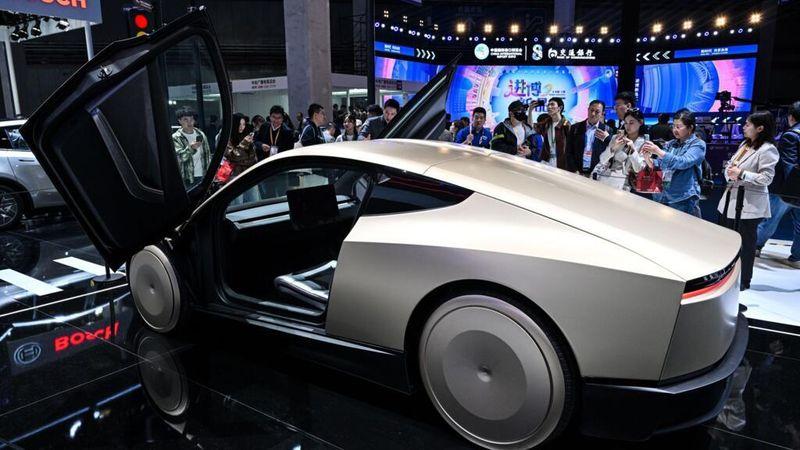
- Elon Musk confirms that Cybercab production has officially started
- Musk shared promotional videos showing driverless Cybercab in motion and multiple units in formation
- Cybercab is designed with no steering wheel or pedals for full autonomy as wider Cybercab availability is projected for 2027
Elon Musk has announced that Tesla has officially begun production of its highly anticipated autonomous robotaxi, the Cybercab, marking a significant milestone in the company’s push toward a driverless future.
Musk revealed the development on Friday, April 24, via his social platform, X, posting a promotional video with the caption, “Cybercab has started production.”
The 38-second clip, filmed largely from inside the vehicle, showed the driverless car moving off the factory floor and onto public roads, offering a glimpse into Tesla’s vision of autonomous mobility.
In a separate post, Musk shared another short video showing multiple gold-colored Cybercabs driving in formation, hinting at the scale and coordination the company aims to achieve with its robotaxi fleet.
The production update comes just days after Tesla reported stronger-than-expected first-quarter earnings, posting profits of $477 million.
The company also reaffirmed plans to begin “volume production” of both the Cybercab and its Tesla Semi truck within the year.
First unveiled in late 2024, the Cybercab is designed as a fully autonomous vehicle with no steering wheel or pedals. Musk had earlier projected that the robotaxi would become widely available by 2027.
Tesla has already taken early steps toward deploying the service, having launched a limited robotaxi programme for invitation-only users in Austin, Texas, last June.
Earlier this year, the automaker shared a factory-floor image captioned, “First Cybercab off the production line at Giga Texas,” signaling that development had reached an advanced stage.
With production now underway, Tesla appears to be accelerating its ambitions to redefine urban transportation through self-driving technology.
Elon Musk’s SpaceX launches Starship test flight, catches booster
Meanwhile, TheRadar earlier reported that SpaceX had launched its fifth Starship test flight from Texas and returned the rocket’s towering first-stage booster to land for the first time, achieving a novel recovery method involving large metal arms.
After separating from the Starship booster some 74km (46 miles) in altitude, the Super Heavy booster returned to the same area from which it was launched to make its landing attempt, aided by two robotic arms attached to the launch tower.
This marks the first successful recovery of the Super Heavy booster at the launch site using robotic arms.