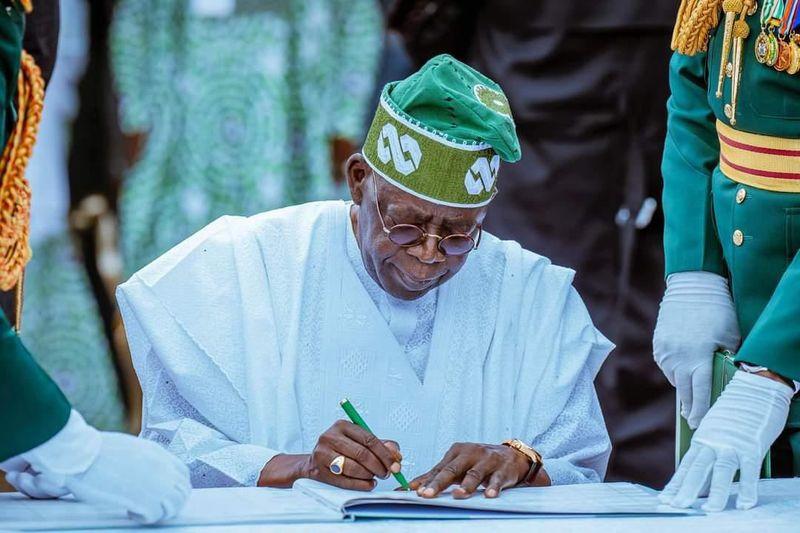
- President Bola Tinubu revealed that high borrowing costs are crippling Africa’s manufacturing sector
- He blamed illicit financial flows and restrictive global financial systems for Africa’s weak industrial growth
- Tinubu warned that the current global financial system could become irrelevant if inequalities remain unresolved
- He urged African nations to stop exporting raw materials without local processing
President Bola Tinubu has attributed Africa’s struggling manufacturing sector to high borrowing costs, illicit financial flows, and restrictive global financial policies that continue to hinder industrial growth across the continent.
According to a statement released by presidential spokesperson Bayo Onanuga, Tinubu made the remarks during the Africa Forward Summit held in Nairobi, Kenya, on Tuesday, May 12.
The summit, co-hosted by Emmanuel Macron and William Ruto, brought together leaders from more than 30 countries to discuss financing industrial development in Africa.
Speaking during one of the sessions, Bola Ahmed Tinubu said Africa contributes less than two per cent to global manufacturing because many countries on the continent still depend heavily on exporting raw materials while importing finished goods.
“How can an African manufacturer compete with competitors in Europe, Asia, or North America when borrowing costs in Africa are five to ten times higher?” Tinubu asked.
The Nigerian leader warned that the current global financial structure risks losing relevance if it continues to ignore the economic inequalities affecting developing nations.
Tinubu said Nigeria’s ongoing economic reforms, including the removal of fuel subsidy, exchange rate unification, and a banking recapitalisation programme worth more than $45.5 billion, were designed to improve investor confidence and stabilise the economy.
However, he admitted that rising debt servicing obligations remain a major challenge to industrialisation and infrastructure development.
According to him, Nigeria is projected to spend about $11.6 billion on debt servicing in 2026, limiting funds available for critical sectors.
The President also condemned illicit financial flows and restrictive financial policies, saying they continue to weaken Africa’s competitiveness and industrial capacity.
He urged African nations to focus on value addition by refining crude oil locally, processing minerals within the continent, and producing goods such as pharmaceuticals instead of relying on raw material exports.
Tinubu also highlighted Nigeria’s blue economy strategy as an important tool for regional growth and integration, stressing the need for stronger maritime cooperation across Africa.
“Interoperable systems, harmonised laws, and seamless joint enforcement must become operational realities,” he said.
“Secure sea lanes, predictable regulations, and functional courts remain essential to unlocking private sector investments in Africa’s maritime economy.”
As part of regional security efforts, Tinubu pledged to make Nigeria’s Deep Blue Project maritime intelligence infrastructure available as a data hub for countries within the Gulf of Guinea.
He added that Nigeria would continue pursuing climate-friendly port modernisation and digital transformation within the maritime sector.
The President further called on African nations to move “from sea blindness to ocean sovereignty” through stronger security coordination and maritime partnerships.
On migration, Tinubu argued that improving economic opportunities across Africa would reduce irregular migration.
“People with jobs, security, and hope rarely risk dangerous migration journeys across borders,” he stated.
He called for greater investment in infrastructure, agriculture, energy access, digital skills, and employment creation, while urging international development partners to support programmes that address migration pressures.
Meanwhile, the United Nations Economic Commission for Africa had earlier revealed that Africa loses an estimated $40 billion annually to illicit financial flows from the extractive sector.
Deputy Executive Secretary of the commission, Antonio Pedro, said the financial losses reflect Africa’s long-standing dependence on raw material exports, a system he described as a major obstacle to industrial growth and economic equality.
Senate clears Tinubu’s $6bn loan plan to fund budget gap, ports upgrade
Meanwhile, TheRadar earlier reported that the Nigerian Senate had approved President Bola Tinubu’s request to secure external loans totaling $6 billion, a move aimed at addressing fiscal shortfalls and funding key infrastructure projects.
The approved loan is divided into a $5 billion loan from Abu Dhabi Bank targeted at financing the budget deficit and a $1 billion facility from UK Export Finance earmarked specifically for infrastructure upgrades.
The approval was set against the backdrop of a widening fiscal gap in Nigeria’s 2025 budget.