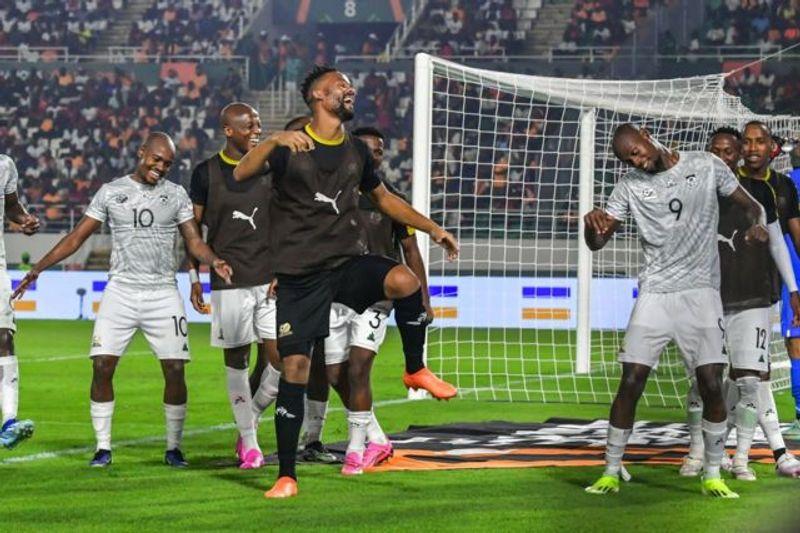
- South Africa claimed a crucial 2-0 victory over Benin, with goals from Lyle Foster and Jayden Adams, maintaining their top position in Group C
- Despite the win, South Africa faced eligibility concerns after midfielder Teboho Mokoena played against Lesotho while suspended, raising the threat of losing points
- The victory left South Africa five points clear at the top of the group, as they aim to secure automatic World Cup qualification amid ongoing controversy
South Africa maintained their position at the top of Group C in the 2026 FIFA World Cup Africa qualifiers with a solid 2-0 victory over Benin Republic in Abidjan on Tuesday, March 25.
The win saw Hugo Broos’ side extend their lead in the race for an automatic World Cup ticket, though it came on the back of significant uncertainty regarding the eligibility of one of their players.
Before kick-off, the South African team had been under the cloud of potential disciplinary action, with the threat of losing three points hanging over them after fielding an ineligible player in their previous match against Lesotho.
The player at the centre of the controversy was midfielder Teboho Mokoena, who had accumulated two yellow cards in previous matches, thus making him ineligible to feature in the 2-0 win over Lesotho last Friday.
According to FIFA’s World Cup qualifying rules, a player is automatically suspended from the team’s next match after receiving two yellow cards in separate games.
Mokoena, who plays for Mamelodi Sundowns, was first cautioned during South Africa's 2-1 victory over Benin Republic in November 2023, in the 54th minute.
He was again booked in the 52nd minute of the 3-1 win over Zimbabwe in June 2024. Despite this, he was named in the starting lineup against Lesotho, where he played 82 minutes before being replaced by Thalente Mbatha.
Had FIFA ruled the South Africans' fielding of Mokoena to be in violation of eligibility rules, it could have meant the team would lose the points from their victory over Lesotho, giving Lesotho—or Nigeria—an opportunity to close the gap.
However, South Africa’s win against Benin on Tuesday has allowed them to keep their momentum going.
Despite the concerns, South Africa showed little sign of pressure on the field, with second-half goals from Burley forward Lyle Foster and Jayden Adams sealing the win.
The victory now leaves Broos’ team with 13 points from six matches, five points clear of second-placed Rwanda and third-placed Benin Republic, who are both on 8 points.
The potential protests from Nigeria or Lesotho regarding the fielding of Mokoena could have complicated the situation.
Under FIFA’s guidelines, any protest over player eligibility must be submitted in writing to the FIFA Match Commissioner within two hours of the match in question, with a detailed report following within 24 hours.
Failure to adhere to these procedures could result in the protest being dismissed.
If a protest had been successful, Lesotho, currently in fifth place with five points, could have been awarded three points, propelling them to 8 points and tightening the race for World Cup qualification.
Nigeria, sitting just four points behind South Africa, could also have benefitted from such a ruling, depending on the outcomes of other matches.
With South Africa now holding a comfortable lead in the group, the focus shifts to their remaining qualifiers.
The result also leaves the South Africans in a strong position to secure automatic qualification, while Benin and Rwanda will be scrambling to keep pace in the coming weeks.
Nigeria, Germany, 10 other countries to have been banned by FIFA and why
Previously, TheRadar reported that FIFA, the global body governing football, has sanctioned a number of countries for breaching its rules over the years.
The most prominent case today is Russia, whose exclusion stems from its invasion of Ukraine in 2022. This sanction serves as a reminder that football isn’t immune to political realities. But there are several other countries with similar bans in FIFA's history.