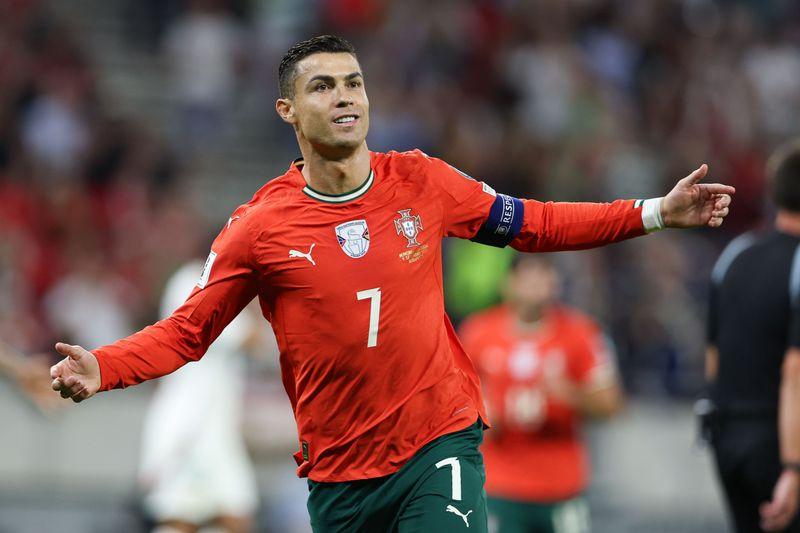
- Cristiano Ronaldo had confirmed the 2026 tournament as his sixth and final FIFA World Cup appearance
- Veteran players such as Essam El Hadary and Roger Milla had previously set records for competing at advanced ages
- His participation had underscored a remarkable career defined by longevity, discipline, and sustained excellence at the highest level
As anticipation builds for the 2026 FIFA World Cup in North America, global attention is once again fixed on one of football’s most enduring figures, Cristiano Ronaldo, who is poised to make history as one of the oldest players ever to feature at the tournament.
Ronaldo, who celebrated his 41st birthday on 5 February 2026, has confirmed that the upcoming competition will mark his sixth and final appearance on football’s grandest stage. The Portugal captain, currently playing club football with Al-Nassr, remains determined to lead his country one last time in pursuit of international glory.
His inclusion in the squad for the 2026 tournament not only highlights his remarkable longevity but also cements his place among a select group of players who have defied age to compete at the highest level of the game.
Historically, the FIFA World Cup has witnessed several veteran players whose careers extended well beyond the norm. Among them is Essam El Hadary, who became the oldest player in World Cup history when he featured for Egypt at the age of 45 during the 2018 tournament against Saudi Arabia.
Colombia’s Faryd Mondragón also etched his name into the record books when he appeared at 43 in the 2014 edition against Japan. Similarly, Cameroon legend Roger Milla captured global admiration by playing at 42 during the 1994 World Cup, famously scoring against Russia.
Goalkeepers, in particular, have often dominated the list of older participants. Northern Ireland’s Pat Jennings played at 41 in 1986, while England’s Peter Shilton featured at 40 during the 1990 tournament. Italy’s iconic Dino Zoff not only played at 40 but captained his side to victory in the 1982 final against West Germany.
Other notable names include Tunisia’s Ali Boumnijel, who appeared at 40 in 2006, and Scotland’s Jim Leighton, who took part at 39 during the 1998 edition.
Ronaldo’s expected participation in 2026 will therefore place him firmly within this elite company. More significantly, it underscores a career that has spanned more than two decades at the pinnacle of world football.
As fans prepare for what promises to be a memorable tournament, Ronaldo’s farewell appearance is likely to be one of its defining narratives—an enduring symbol of excellence, discipline and an unrelenting drive to compete against the odds.