
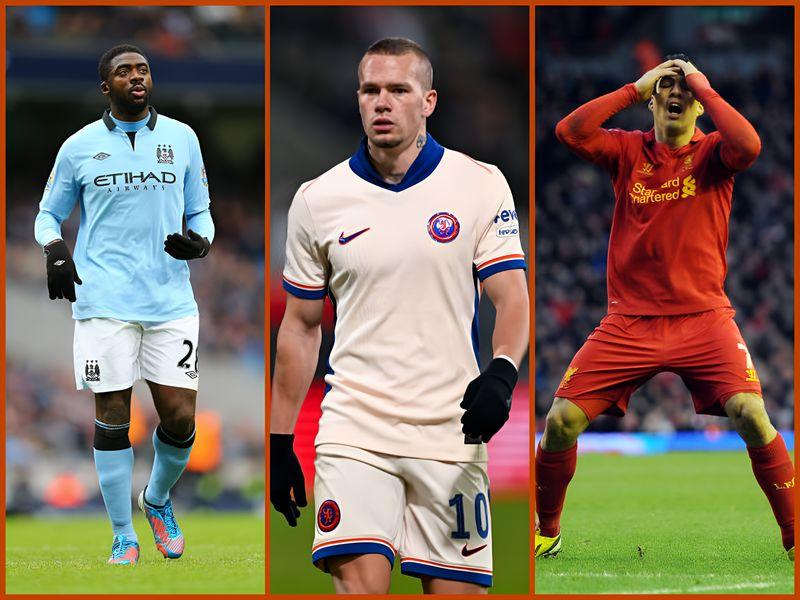
- Chelsea winger Mykhailo Mudryk is facing a possible four-year ban after testing positive for a banned substance during a routine drug test in November
- Mudryk denies knowingly using any banned substances and is working with his team to investigate the source, with meldonium being the suspected substance
- TheRadar has compiled in this article a list of some of the longest player football bans in history
Chelsea winger Mykhailo Mudryk is facing a potential four-year ban after a routine drug test revealed the presence of a banned substance.
The 23-year-old Ukraine international was notified by the Football Association (FA) about the adverse finding in a urine sample he provided following international duty in November.
Mudryk, who last played for Chelsea in the Europa Conference League on November 28, took to Instagram to express his shock at the development.
He vehemently denied knowingly using any banned substances, stating that he has always adhered to the rules.
Mudryk clarified that a routine doping test in August had returned negative results, adding to the bewilderment surrounding the latest test.
“I can confirm that I have been notified that a sample I provided to The FA contained a banned substance, this has come as a complete shock as I have never knowingly used any banned substances or broken any rules,” he said.
The forward expressed his commitment to investigating how the banned substance found its way into his system, insisting he remains hopeful for a swift return to the pitch.
Reports suggest that the substance in question could be meldonium, a drug typically used for heart conditions but banned by the World Anti-Doping Agency.
Mudryk has been provisionally suspended while the English FA completes its investigation, with a potential four-year ban looming as the next step.
Over the years, English football has witnessed its fair share of controversies, but some incidents have left an indelible mark due to the severe punishments handed out.
From violent outbursts to doping scandals and rule violations, below is a comprehensive list of the longest bans in English football history.
Longest bans in English football history
Here is a look at some of the longest bans in English football history compiled by TheRadar:
1. Paolo Di Canio - 11 Games (1998)
In a heated clash between Sheffield Wednesday and Arsenal in 1998, Paolo Di Canio lost his temper, shoving referee Paul Alcock to the ground. The shocking act earned Di Canio an initial red card, but the incident didn’t end there.
After apologising at a disciplinary hearing, the fiery Italian forward was handed an additional eight-game suspension, bringing his total ban to 11 matches. Di Canio’s push remains one of the most talked-about disciplinary moments in Premier League history.
2. Luis Suárez - 4 Months (2014)
The infamous biting incident during the 2014 World Cup between Uruguay and Italy saw Luis Suárez sink his teeth into Giorgio Chiellini. The act led to a ban from “all football-related activities” for four months, preventing Suárez from starting his debut La Liga season with Barcelona.
This incident added to Suárez’s controversial career, making headlines worldwide and leaving fans divided over his actions.
3. Vinnie Jones - 6 Months (1992)
Vinnie Jones was no stranger to controversy, but his six-month ban in 1992 had nothing to do with on-field antics. The tough-tackling midfielder released a video titled Soccer’s Hardest Men, which the FA deemed as glorifying football violence.
The ban served as a stern reminder of the FA’s zero tolerance toward promoting unsportsmanlike behaviour.
4. Kolo Touré - 6 Months (2011)
In 2011, Manchester City’s Kolo Touré faced a six-month suspension after testing positive for a banned substance. Touré claimed the substance was contained in water tablets provided by his wife and had no intention to enhance his performance.
The ban pointed out the importance of athletes verifying their supplements, even when taken innocently.
5. Adrian Mutu - 7 Months (2004)
Chelsea striker Adrian Mutu’s career took a drastic turn in 2004 after testing positive for cocaine. The Romanian forward publicly admitted to the offence and received a seven-month ban, marking the end of his Chelsea tenure.
Mutu eventually signed for Juventus during his suspension, but the incident left a blemish on his career.
6. Rio Ferdinand - 8 Months (2003)
Manchester United’s Rio Ferdinand faced an eight-month ban in 2003 for missing a routine drugs test. Although there was no evidence of doping, Ferdinand’s failure to comply with FA regulations resulted in a misconduct charge.
The ban forced the defender to miss England’s Euro 2004 campaign, a major blow to both club and country.
7. Eric Cantona - 9 Months (1995)
Eric Cantona’s infamous kung-fu kick on a Crystal Palace fan in 1995 remains one of the most controversial incidents in football history. The Manchester United forward was banned for nine months, restricted to friendly matches, and nearly left the club.
However, Sir Alex Ferguson convinced Cantona to stay, and the Frenchman went on to make his own legacy at Old Trafford.
8. Mark Bosnich - 9 Months (2002)
Chelsea goalkeeper Mark Bosnich was banned for nine months in 2002 after testing positive for cocaine.
The Australian shot-stopper claimed the drug was unknowingly ingested, but the FA found him guilty of improper conduct. The incident ended his stint at Chelsea and cast a shadow over his career.
9. Joey Barton - 13 Months (2017)
Joey Barton received a 13-month ban in 2017 for breaches of betting regulations. Although initially set at 18 months, the ban was reduced upon appeal. The length of the suspension effectively ended Barton’s playing career.
10. Enoch West - 30 Years (1915)
The longest ban in English football history belongs to Manchester United forward Enoch West, who was embroiled in a match-fixing scandal in 1915. West, along with other players, received a lifetime ban but refused an offer to fight in World War I in exchange for leniency.
His ban was eventually lifted in 1945, but by then, West had spent 30 years away from the game.
Nigeria, Germany, 10 other countries to have been banned by FIFA and why
Previously, TheRadar reported that FIFA, the global body governing football, has sanctioned a range of countries for breaching its rules over the years.
The most prominent case today is Russia, whose exclusion stems from its invasion of Ukraine in 2022. This sanction serves as a reminder that football isn’t immune to political realities. But there are several other countries with similar bans in FIFA's history.
